
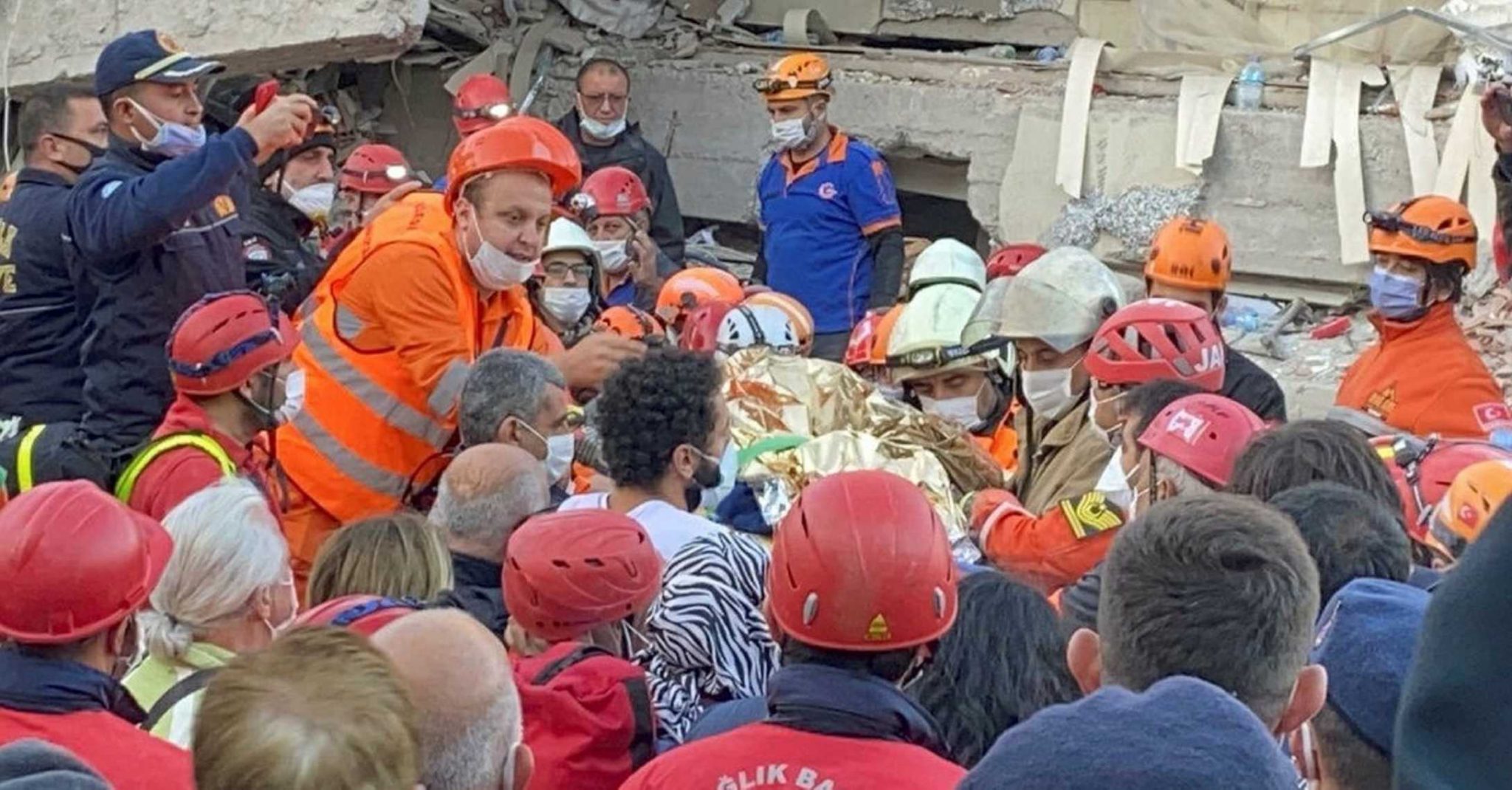

Frantic activity with thousands of search and rescue personnel amongst the debris of collapsed building, looking for survivors…
The noise stops after a firefighter shouts. Silence surrounds the entire area around the Rıza Bey Apartment, in the Bayrakli district, Izmir. The firefighter is heard again shouting, ‘Is there anyone there?’
Search and rescue teams lift 16-year-old Inci Okan from under the rubble of the eight-storey Riza Bey building, 17 hours after the strong earthquake.
Inci is one of the lucky ones. The earthquake in Izmir killed at least 51 people and injured more than 900 people.
While walking on the beach in Kusadasi where I spend my summer holidays, I sometimes look at the sea and ask myself ‘Is there anyone there?’
Kuşadası is just across from Samos island. The distance between the two lands is only 27km.
I often pass an olive tree during my walks. This olive tree was planted by former Turkish and Greek Foreign Ministers Ismail Cem and George Papandreou on June 29, 2001.
I find myself contemplating the twin of this tree, planted on the island of Samos. “Is there still an olive tree there?”
Following of the 1999 earthquakes in Izmit and Athens, Cem and Papandreou dared to go against the tide, opening an era of new relations between Turkey and Greece. Against the odds, the two political leaders managed to bring the two sides of the Aegean closer.
Nowadays the Greek island across from the Aegean Sea from Kuşadası feels of great distance. I only happen to be standing on this side of the Aegean because of a particular moment in time. On the other side of the Aegean, my grandfather fought alongside the Greek army against the German occupation during World War II. Which side was he on then? From what side was he looking at the Aegean Sea?
My family was excluded from the 1924 population exchange because they were Western Thrace Turks, eventually found themselves on the Turkish side of the Aegean after the Second World War. My grandfather spent 50 years of his life on the other side of the Aegean and 25 years on this side of the Aegean.
On the new land we migrated to, we were given the nickname ‘muhajir’. Despite the nickname, my grandfather’s tombstone reads the name of the Turkish village he migrated to – “Mehmet from Ömerköy lays here.”
I still do not know which side my grandfather belonged to the most. He belonged to the Aegean.
Before the earthquake in Izmir and Samos, Turkey and Greece once again were on the brink of war, sparked by a dispute over the natural resources of the region.
Turks and Greeks started to hear once again about 6 miles or 12 miles, concepts that we’ve been familiar with since our childhood.
When I look from this side of the Aegean standing next to the olive tree in Kuşadası, I see an endless sea, not the borders separating each other. I am searching for politicians from both sides of the Aegean to bring the two sides closer, like Cem and Papandreou once did.
Is there anyone there?
Emre Caliskan

