

Greek Cypriot Representative at the CMP, Leonidas Pantelides, told CNΑ on Wednesday that the team, which also came last year, is conducting specific tests with two GPR devices. The device, he said, looks beneath the surface not for bones but for disturbances to determine human intervention. “If there is an indication of human intervention, a disturbance of the soil, beneath the surface, it may be an indication that there is a grave,” Pantelides said.
He noted that if the CMP finds that such machines can help, the Committee will procure them and will train personnel in collaboration with the University of Wisconsin for data interpretation.
“We are very interested in technology and we are following its development to see if there is something that can help us cover the gap left by the human factor, where witnesses forget, die, the environment changes, and they cannot pinpoint an exact location,” he told CNA.
“If we can incorporate the technology, where it can help us, we will secure the machines”, he added. However, tests are being conducted beforehand to see the effectiveness of the machines.
This year, the team brought two machines to conduct the tests.
“We have given the teams locations both in the occupied and free areas,” Pantelides said. Last year the team indicated a location with a disturbance and the CMP excavated, found the disturbance, but it was not a grave, said Pantelides.
One machine conducts tests at a shallower depth but with much greater detail, and the other looks deeper. Research was conducted this week in Turkish-occupied Panagra, Strovolos, and other locations.
Cyprus has been divided since 1974, when Turkish troops invaded and occupied 37% of its territory. Since then, the fate of hundreds of people remains unknown.
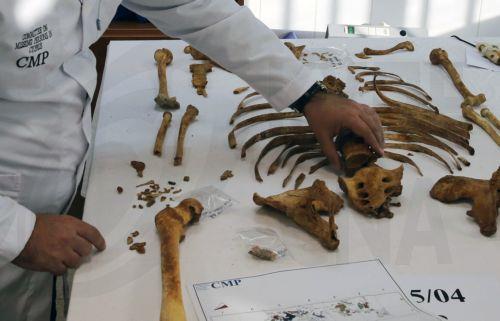
A Committee on Missing Persons has been established, upon agreement between the leaders of the two communities, with the scope of exhuming, identifying and returning to their relatives the remains of 492 Turkish Cypriots and 1,510 Greek Cypriots, who went missing during the inter-communal fighting of 1963-1964 and in 1974.

