
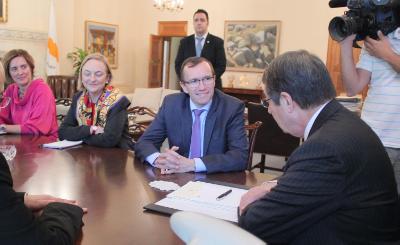

The main issue is to have a solution that in itself is economically viable, that creates growth and wealth, and there is more money there that the one of investment in making the solution happen, UN Secretary General`s Special Adviser on Cyprus Espen Barth Eide said on Thursday, after a meeting he had with Cyprus President Nicos Anastasiades.
“So while we are working on the economic support, when we talk about the economic aspects of a settlement, the main issue is to have a credible, functional federal state that can unlock the potential that Cyprus has for more growth than what happens on either the Republic of Cyprus side or the northern part today,” Eide said, in statements to the media after the meeting.
Asked about the involvement of the World Bank in the whole process, Eide said he was extremely happy “about the level and the quality of the support that the leaders are getting through us from the World Bank, the International Monetary Fund and also the European Commission. They are working hard, they are working in a dedicated way, and it has given all of us, I mean the leaders and myself, a strong base for bringing the economic aspect of the settlement into the talks,” he added.
Asked if these organisations are ready to pay for the solution, Eide said: “I would strongly suggest that we start thinking about something else than the so called cost of the settlement. Because we are working on economic support, and I have only over the last five days been speaking to the US Assistant Secretary Nuland, to the Foreign Minister of France, the UK Foreign Secretary. We are working constantly on this issue. But the main issue is to have solution that in itself is economically viable, that creates growth and wealth and there is more money there that then one of investment in making the solution happen.”
“So while we are working on the economic support, when we talk about the economic aspects of a settlement the main issue is to have a credible, functional federal state that can unlock the potential that Cyprus has for more growth than what happens on either the Republic of Cyprus side or the northern part today,”he noted.
“And that`s what the World Bank and the IMF are principally doing. And on top of that of course they are looking into issues of property settlement and so on, which we all know that it is a broader issue than just that. And on that front I think the potential is quite good,” he said.
Eide said he had a very good and constructive meeting with Anastasiades. “As you will have heard from the two leaders when they came out of Tuesday`s meeting, they both described that meeting as very constructive,” and “that`s absolutely my sense as well,” he noted.
He stressed that “the process is in a good shape and hard work is being done in order to take these many understandings that have developed over the last months into black (the colour in which convergeces are written down). It is moving in the right direction,” he added
He went on to say that “the leaders are showing a strong personal dedication to this and what I am discussing now between Tuesday`s meeting and Monday`s meeting is how do we best continue this good momentum that we had on Tuesday.”
Furtermore he underlined that “contrary to what some people seem to have thought, there is no letup in the process,” adding that there is no change in the determination of either leader “and they are working hard to achieve more convergences, so that we prepare for a later phase,where the final issues can be tackled. And we are still basically working inside the four known chapters,” he noted
Invited to say to which persons he was referring to when he said that some people seem to have though that there is a letup in the process, Eide said that he was referring to a sense that he picked up in media commentaries overs the last weeks, that the process was stalled.
I think we would all like to say more about what we did, on which day, and what was achieved, he added, noting, however, that this cannot happen.
As he said, the leaders are the ones who will explain the whole package if and when it`s there. “My role is not say more than the leaders want to say, but I also want again to underline that when things are inter-dependent it is difficult to take out one piece and explain it independently of the other issues,” he noted.
President Anastasiades and Turkish Cypriot leader Mustafa Akinci have been engaged in UN-led talks since May last year, with a view to reunite the island, divided since the Turkish invasion of 1974, under a federal roof.

