
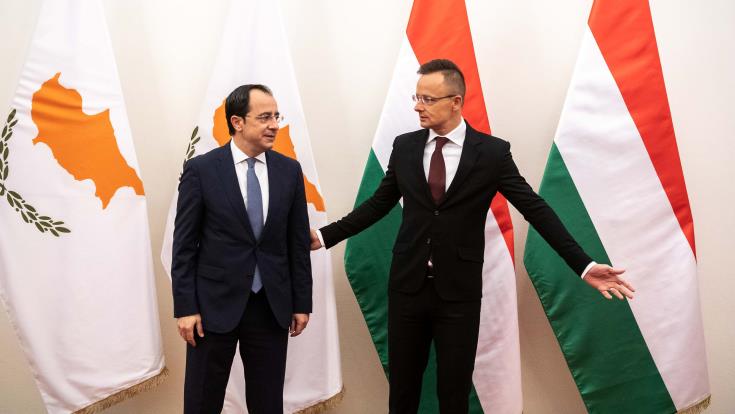

Turkey’s violations of the Republic of Cyprus’ Exclusive Economic Zone (EEZ), among other things, vitally affect vital EU and its member states interests and goals, since the aim is to invalidate any prospects the Eastern Mediterranean has of becoming an alternative energy option for the EU, Foreign Minister Nikos Christodoulides has said.
Christodoulides who was speaking following a meeting he had with Hungarian FM Péter Szijjártó, expressed the conviction that his visit to Budapest and the signing of the Memorandum for Political Consultations between the Ministries of Foreign Affairs of Cyprus and Hungary, will become the foundation to strengthen bilateral relations and to deepen cooperation in the fields of economy, commerce and tourism, bringing closer the two countries and their people.
As expected, he noted, discussions also covered developments in the Eastern Mediterranean, in light of the new illegal behaviour of Turkey, both on land and at sea, as well as the recent, EU common decisions and conclusions following the Foreign Affairs Council yesterday, which unanimously agreed in drafting a text of alternative choices to be decided upon as a reaction on Turkey’s revisionist behaviour.”
Unfortunately, Christodoulides, said, “Turkey escalates the illegal, aggressive and provocative violations of the Republic of Cyprus’ sovereign rights, aiming to create new faits accomplis in full contradiction to relevant UN and EU decisions.”
“Turkey’s violations of the Republic of Cyprus’ EEZ, among other things, vitally affect EU and its member states interests and goals, since the aim to invalidate any prospects, the Eastern Mediterranean has of becoming an alternative energy option for the EU,” he added.
“The Foreign Affairs Council made it clear that any decision to adopt a positive agenda on EU – Turkey relations depends exclusively on Ankara who should, among other things, put an end on any illegal actions both on land and at sea, but also to substantially contribute in the settlement of a quintessential European problem such as the Cyprus problem is, on the basis of relevant UN resolutions and EU principles and values,” Christodoulides noted.
Referring to the visit, he said it coincides with the 60th anniversary since the establishment of diplomatic relations between the two countries. It is not only a good coincidence as we can celebrate the event and also determine the next steps in our bilateral relations, he added.
Christodoulides said that in the framework of today’s expanded negotiations, they reviewed the course of cooperation and ascertained the powerful willingness for new initiatives that will contribute in further developing bilateral relations and cooperation in the EU spectrum.
He noted that the proof of this common desire is the signing of the memorandum which lays strong foundations to deepen cooperation and understanding on a number of issues, sanctioning at the same time on an annual basis, negotiations and the exchange of visits on a political and staff level.
Historical relations between the two countries and the longstanding ties between the two peoples are significantly strengthened either through frequent and direct flights something that strengthens prospects to increase tourism and also business opportunities between the two countries. He said that Cyprus acknowledged early on Hungary’s vaccination certificate, facilitating travel between the two countries.
He also said they exchanged views on issues that are at the forefront of the European agenda such as handling the pandemic, Climate Change, the Future of Europe and immigration, adding that the EU is at a critical crossroads fundamental actions are necessary for Europe to successfully overcome today’s challenges.
Christodoulides said that as EU partners, the two countries share common concerns and challenges. Regarding immigration, he said that despite some different approaches due to different situations in both countries, we agree that exploitation of immigration should be condemned and measures should be taken against third countries that resort to these methods.
Regarding the conference for the future of Europe, Christodoulides said that the two have a common approach on its significance.
On climate change, he said that it is imperative that the peculiarities and limitations of each state are taken into consideration. In the case of Cyprus, he said, being an island state with an isolated energy system, purchasing power and size scale, with sectors such as shipping and air transport of vital significance for the economy and these should be taken into consideration.
He noted that they also discussed regional matters, such as developments in the Western Balkans “where we have a common approach on the fact that a visible prospect of W. Balkans accession to the EU constitutes the only way to safeguard peace, stability and prosperity in a region which is a direct neighbour of the EU.”
The Cypriot FM said that he also briefed his counterpart about his recent visit to Beirut.
Cyprus has been divided since 1974 when Turkish troops invaded and occupied the island`s northern third. Numerous rounds of talks under the UN aegis to reunite the island under a federal roof failed to yield results.

