
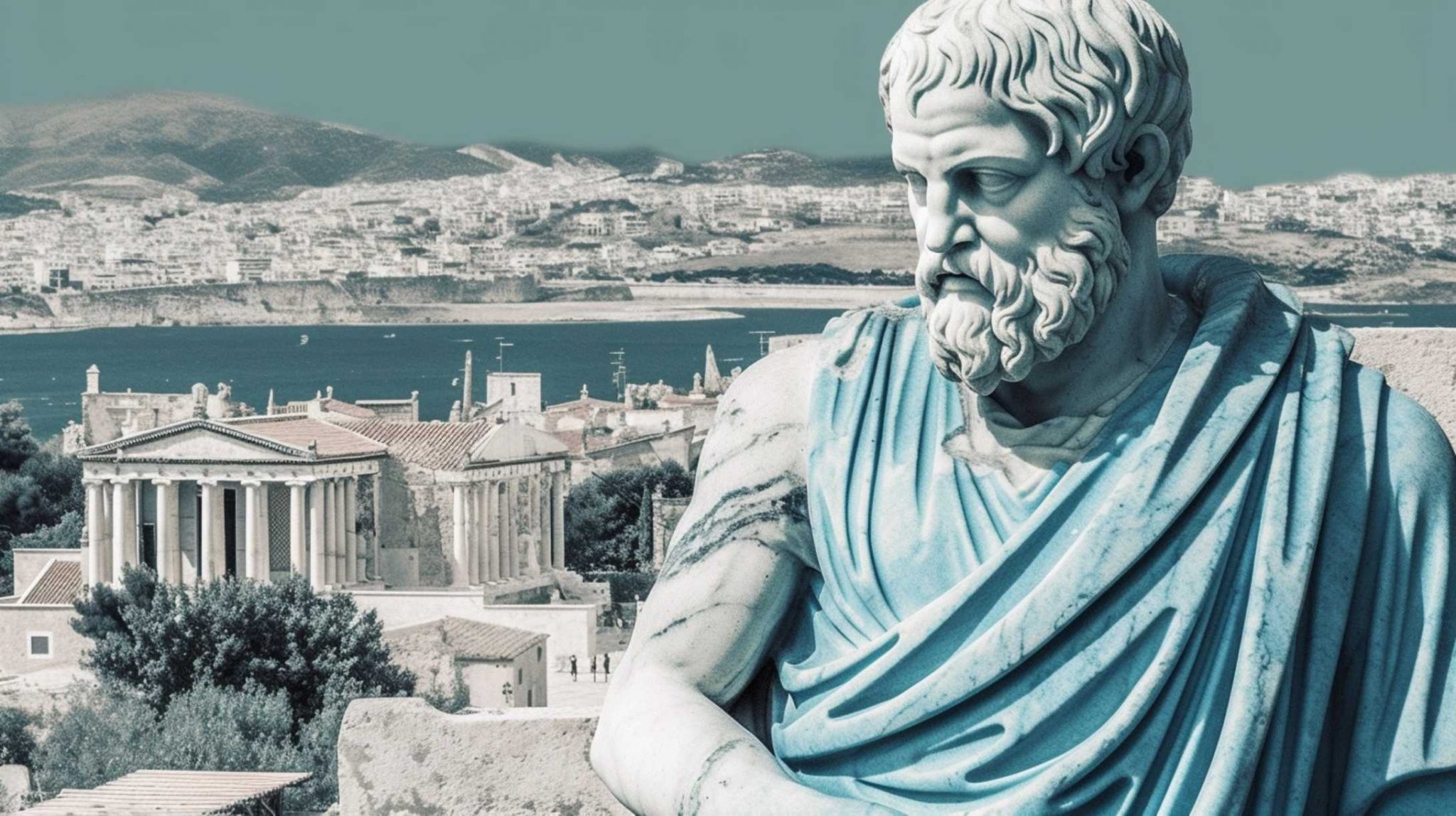

Aristotle
Aristotle (384–322 BC) was an Ancient Greek philosopher and polymath. He was hired by Philip II, King of Macedon (r. 359-336 BC) as tutor for his 13-year-old son Alexander and made such an impression on the youth that Alexander carried Aristotle’s works with him on campaign and introduced Aristotelian philosophy to the East when he conquered the Persian Empire.
In general, the details of Aristotle’s life are not well-established. The biographies written in ancient times are often speculative and historians only agree on a few salient points.
He was born in Stagira, Chalcidice, about 55 km east of modern-day Thessaloniki. His father, Nicomachus, was the personal physician to King Amyntas of Macedon. While he was young, Aristotle learned about biology and medical information, which was taught by his father. Both of Aristotle’s parents died when he was about thirteen, and Proxenus of Atarneus became his guardian. Although little information about Aristotle’s childhood has survived, he probably spent some time within the Macedonian palace, making his first connections with the Macedonian monarchy.
At the age of seventeen or eighteen, Aristotle moved to Athens to continue his education at Plato’s Academy. He probably experienced the Eleusinian Mysteries as he wrote when describing the sights one viewed at the Eleusinian Mysteries, “to experience is to learn.” Aristotle remained in Athens for nearly twenty years before leaving in 348/47 BC. The traditional story about his departure records that he was disappointed with the Academy’s direction after control passed to Plato’s nephew Speusippus, although it is possible that he feared the anti-Macedonian sentiments in Athens at that time and left before Plato died. Aristotle then accompanied Xenocrates to the court of his friend Hermias of Atarneus in Asia Minor. After the death of Hermias, Aristotle travelled with his pupil Theophrastus to the island of Lesbos, where together they researched the botany and zoology of the island and its sheltered lagoon.
In 343 BC, Aristotle was invited by Phillip to become the tutor to his son Alexander and was appointed as the head of the royal academy of Macedon. During Aristotle’s time in the Macedonian court, he gave lessons not only to Alexander but also to two other future kings: Ptolemy and Cassander.
Aristotle encouraged Alexander toward eastern conquest and Aristotle’s own attitude towards Persia was unabashedly ethnocentric. In one famous example, he counsels Alexander to be “a leader to the Greeks and a despot to the barbarians, to look after the former as after friends and relatives, and to deal with the latter as with beasts or plants.”
In 336 BC, however, Alexander had Aristotle’s nephew, Callisthenes of Olynthus, executed, whom he accused of being a traitor. Since the Macedonian executions used to be extended to relatives, Aristotle took refuge for a year in his estates in Stagira, moving in 334 to Athens, always in company of his faithful Theophrastus, to found the Lyceum, a pedagogical institution that for years competed with the Academy of Plato.
After the death of Alexander in 323, an outbreak of hatred against the Macedonians spread in Athens, instigated by the orator Demosthenes. Despite his reputation as a philosopher, the Macedonian was brought before the Athenian courts accused of impiety against the gods. Fearing to end up like Socrates, Aristotle fled to the neighbouring island of Euboea and died a natural death there a year later.
As a gesture for saving the city, his compatriots buried Aristotle in his homeland and honoured him as hero, saviour, legislator, and refounder of their city.
Mieza
Mieza (shrine of the Nymphs) was a town in Ancient Macedonia, where Aristotle taught the young Alexander between 343 and 340 BC.
The site where Mieza once stood is the modern Lefkadia, near the modern town Náousa, Imathia, Central Macedonia, Greece, and has been the subject of archeological excavations since 1954.
Mieza was named for Mieza, in ancient Macedonian mythology, the daughter of Beres and sister of Olganos and Beroia. It was the home of Alexander’s companion Peucestas. Aristotle was given the Temple of the Nymphs as a classroom. In return, Philip re-built and freed the citizens of Stagira, Aristotle’s hometown, which he had razed in a previous conquest across Greece and Macedon.
Fellow students educated at Mieza include Hephaestion, Ptolemy I Soter, Cassander and Cleitus the Black – all would be lifelong friends of Alexander.
Hephaestion (c. 356 BC – 324 BC)
Son of Amyntor, was an Ancient Macedonian nobleman and a general in the army of Alexander the Great. He was “by far the dearest of all the king’s friends; he had been brought up with Alexander and shared all his secrets.” This relationship lasted throughout their lives, and was compared, by others as well as themselves, to that of Achilles and Patroclus.
His military career was distinguished. A member of Alexanders personal bodyguard. He went on to command the Companion cavalry and was entrusted with many other tasks throughout Alexander’s ten-year campaign in Asia, including diplomatic missions, the bridging of major rivers, sieges and the foundation of new settlements. Besides being a soldier, engineer and diplomat, he corresponded with the philosophers Aristotle and Xenocrates and actively supported Alexander in his attempts to integrate the Greeks and Persians. Alexander formally made him his second-in-command when he appointed him Chiliarch of the empire. Alexander also made him part of the royal family when he gave him as his bride Drypetis, sister to his own second wife Stateira, both daughters of Darius III of Persia.
When he died suddenly at Ecbatana, Persia around age thirty-two, Alexander was overwhelmed with grief. He petitioned the oracle at Siwa to grant Hephaestion divine status and thus Hephaestion was honoured as a Divine Hero. Hephaestion was cremated and his ashes taken to Babylon. At the time of his own death a mere eight months later, Alexander was still planning lasting monuments to Hephaestion’s memory.
Ptolemy I Soter (c. 367 BC – 282 BC)
A Macedonian Greek general, historian and bodyguard of Alexander. Originally from the Kingdom of Macedon in northern Greece, he went on to become ruler of Egypt, then part of Alexander’s former empire. Ptolemy was pharaoh of Ptolemaic Egypt from 305/304 BC to his death. He was the founder of the Ptolemaic dynasty, which ruled Egypt until the death of Cleopatra in 30 BC, turning the country into a Hellenistic kingdom and Alexandria into a centre of Greek culture.
Ptolemy was one of Alexander’s most trusted companions and military officers. After the death of Alexander in 323 BC, Ptolemy retrieved his body as it was en route to be buried in Macedon, placing it in Memphis instead, where it was later moved to Alexandria in a new tomb. Afterwards he joined a coalition against Perdiccas, the royal regent over Philip III of Macedon. The latter invaded Egypt but was assassinated by his own officers in 320 BC, allowing Ptolemy I to consolidate his control over the country. After a series of wars between Alexander’s successors, Ptolemy gained a claim to Judea in southern Syria, which was disputed with the Syrian king Seleucus I. He also took control of Cyprus and Cyrenaica, the latter of which was placed under the control of Ptolemy’s stepson Magas. Ptolemy also had the Library of Alexandria built.
Ptolemy I may have married Thaïs, his mistress during the life of Alexander; he is known to have married the Persian noblewoman Artakama on Alexander’s orders. He later married Eurydice, daughter of the Macedonian regent Antipater; their sons Ptolemy Keraunos and Meleager ruled in turn as kings of Macedon. Ptolemy’s final marriage was to Eurydice’s cousin and lady-in-waiting, Berenice I. Ptolemy I died in 282 BC and was succeeded by his son with Berenice, Ptolemy II.
Cassander (c. 355 BC – 297 BC)
King of the Ancient Greek kingdom of Macedonia from 305 BC until 297 BC, and de facto ruler of southern Greece from 317 BC until his death.
A son of Antipater and a contemporary of Alexander, Cassander was one of the Diadochi who warred over Alexander’s empire following the latter’s death in 323 BC. Cassander later seized the crown by having Alexander’s son and heir Alexander IV murdered. In governing Macedonia from 317 BC until 297 BC, Cassander restored peace and prosperity to the kingdom, while founding or restoring numerous cities (including Thessalonica, Cassandreia, and Thebes); however, his ruthlessness in dealing with political enemies complicates assessments of his rule.
Cassander stood out amongst the Diadochi in his hostility to Alexander’s memory. As Cassander and the other diadochi struggled for power, Alexander IV, Roxana, and Alexander’s supposed illegitimate son Heracles were all executed on Cassander’s orders, and a guarantee to Olympias (Alexanders mother) to spare her life was not respected.
Cassander’s decision to restore Thebes, which had been destroyed under Alexander, was perceived at the time to be a snub to the deceased King. It was later even said that he could not pass a statue of Alexander without feeling faint. Cassander has been perceived to be ambitious and unscrupulous, and even members of his own family were estranged from him.
Of more lasting significance was Cassander’s refoundation of Therma into Thessalonica, naming the city after his wife.
Cleitus the Black (c. 375 BC – 328 BC)
An officer of the Macedonian army led by Alexander. He saved Alexander’s life at the Battle of the Granicus in 334 BC and was killed by him in a drunken quarrel six years later. Cleitus was the son of Dropidas (who was the son of Critias) and brother of Alexander’s nurse, Lanike. He would be given the epithet ‘the Black’ to distinguish him from Cleitus the White.
In 328 BC, Artabazos resigned his satrapy of Bactria, and Alexander gave it to Cleitus. On the eve of the day on which he was to set out to take possessions of his government, Alexander organised a banquet during a feast day for Dionysus in the satrapial palace at Maracanda. At this banquet an angry dispute arose, the particulars of which are disputed by various authors.
Most of the members were rather drunk, and Alexander announced a reorganisation of commands. Specifically, Cleitus was given orders to take 16,000 of the defeated Greek mercenaries who formerly fought for the Persian King north to fight the steppe nomads in Central Asia.
Cleitus knew that he would no longer be near the king and would be a forgotten man. Furious at the thought of commanding what he saw as second-rate soldiers and fighting nomads in the middle of nowhere, he spoke his mind. To make matters worse, when Alexander arrogantly boasted that his accomplishments were far greater than that of his father, Phillip II, Cleitus responded by saying that Alexander was not the legitimate king of the Macedonians, and that all of his achievements were due to his father. Alexander called for his guards, but they did not want to intervene in a quarrel between friends. Alexander threw an apple at Cleitus’ head and called for a dagger or spear, but the party near the two men removed the dagger, restrained Alexander, and hustled Cleitus out of the room. Cleitus managed to return to the room to utter more grievances against Alexander (it is possible that Cleitus had not even left the room). But sources agree that at this point Alexander got hold of a javelin and threw it through Cleitus’s heart.
In all of the four major known texts, it is shown that Alexander grieved for the death of Cleitus. Alexander may have genuinely not wanted to kill Cleitus. However, Cleitus was a member of Philip II’s generation and Alexander had been removing that generation from power to keep his own peers in power.
The motives of Cleitus in this quarrel have been interpreted in various ways. Cleitus may have been angered at Alexander’s increasing adoption of Persian customs. After the death of King Darius III, Alexander was King of the Persian Empire and adopted the Persian customs of proskynesis, which was considered degrading by many in the Macedonian army.
Alexander and the Iliad
Under Aristotle’s tutelage he had studied Homer’s epic poem The Iliad, with its great warrior-hero Achilles. Alexander carried a copy of The Iliad with him for the rest of his life, and the poem seems to have inspired him to become a great warrior-hero in his own right.
Phillip had succeeded in conquering the Greeks. Now his son Alexander packed his copy of The Iliad and led his joint Macedonian and Greek army into Asia Minor. Alexander soon proved himself a brilliant warrior and stunning tactician. Leading from the front lines of any battle, he took the greatest risks himself and galvanised his troops. His forces defeated the Persians in Asia Minor, and then moved farther into Persian territory. At Issus, they defeated Darius, the Persian emperor. Alexander then turned his attention west to Phoenicia and Egypt, seizing power by force. Once these areas were subdued, Alexander moved back through the former Persian Empire fighting more battles and seizing more territory, including Mesopotamia, until his forces reached the Indus River in India.
As Alexander won battles, his ego grew and grew. He named many cities after himself. (Alexandria in Egypt would become the most important.) He also began to adopt the Persian customs of kingship. Forcing his men to treat him as Persian subjects treated their kings, Alexander made supplicants lie prostrate on the ground before him. Greeks did not believe in these sorts of customs for men, believing that it was too subservient. Alexander’s troops were not pleased, and he was obliged to discontinue the practice.
Alexander continued his wars in the east until, during the monsoon season, with his troops poorly supplied, he and his men encountered the horror of war elephants expertly trained in India. The Greeks did not lose, but Alexander’s men did lose heart. They would fight no more. It was said that when Alexander realised he must turn back, he broke down in tears, sobbing that for him there were no more worlds to conquer. Nevertheless, Alexander turned westward. On his return through Babylon in 323 BC, the great conqueror became ill after an extended period of particularly heavy drinking. Alexander died at age 33, having gone well beyond his father’s dream, conquering much of the known world.
Aristotle’s influence was apparent in Alexander’s attitude toward the people he conquered. He did more than fight wars and seize territory. Alexander was also very interested in spreading Greek culture among the peoples he ruled, and blending Greek, Persian, Indian, and Egyptian customs and institutions. Greek scholars, artists, government officials, and merchants followed Alexander’s army. In Egypt, he founded the city of Alexandria, which became a centre of Hellenistic learning.
Source: en.wikipedia.org coreknowledge.org world history.com

