
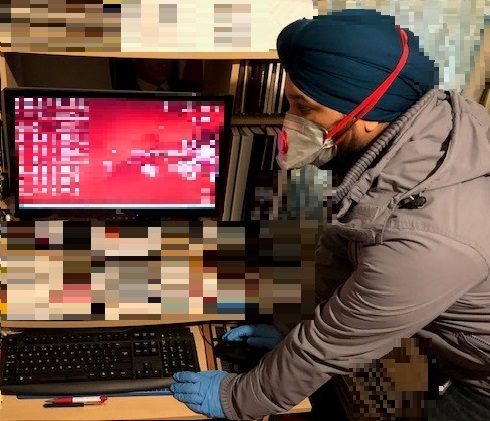

New Met Police figures show that the Online Child Abuse and Exploitation Unit (OCSAE) has arrested 45 suspected offenders and safeguarded almost 100 children during the four weeks since the UK went into lockdown – as they warned of the increased threat posed by the exponential growth in the amount of time the public are spending online.
The statistics reveal that 92 children were protected and 68 warrants executed over the month from 23 March, when the government ordered the new ‘stay at home’ measures, to 23 April. An average of ten new live investigations have been launched every week as a result of the 45 arrests over the same period.
If figures are also taken into account for the three weeks from the 2 March, when the UK was dealing with its first 40 cases of the Coronavirus, up until the start of lockdown on 23 March, the unit’s totals for the full seven week period rises to 72 arrests, 132 children protected and 123 warrants carried out.
While figures for recorded offences and referrals have remained stable or dropped since the UK has been hit by Covid-19, the Met is still receiving an average of 50 reports a week from the National Crime Agency (202 between March 23 and April 24) and officers believe that any increase in offending taking place now will not be reflected in the official figures until the months to come.
Detective Superintendent Helen Flanagan said:
“Officers have been working around the clock since the pandemic started using a variety of different tactics and resources to proactively identify and pursue online offenders and protect children and young people.
“Anyone who tries to find and/or distribute indecent images of children online should not think they will be less visible due to the lockdown – they can expect to come to police notice and face arrest, prosecution, a criminal record and possible prison time.
“Online offenders can consider themselves less harmful than ‘real life’ abusers as they hide behind a screen, but there is a vulnerable child at the heart of every indecent image or video and by viewing and distributing these, the abuse is repeated over and over again.”
Det Supt Flanagan explained that while the figures for reports have not currently increased, they anticipate the statistics could well show a rise later in the year due to the huge effect the lockdown has had on the use of the Internet across the board.
She said: “The Internet can be a great space for young people to connect, socialise and learn – but it is also used by offenders as a place to engage with children and commit serious offences – grooming, abuse, and other serious harm.
“The restrictions have led to a huge growth in Internet use, including by children doing school work or occupying themselves while parents and carers are busy – and inevitably there are a greater number of sexual predators online looking to target and groom young people.”
The Met is urging parents and young people to remain extra vigilant and educate themselves around the dangers as well as encouraging them to take steps themselves in order to mitigate the risks.
Det Supt Flanagan said: “Preventing offences occurring is always crucial and now more so than ever when there is masses of online traffic and potentially an elevated threat level.
“If you are a parent it’s never too early to start teaching your child how to stay safe online – talk to them about the dangers, make it your business to find out what they are doing online and don’t be afraid to ask questions or set boundaries.
“Be proactive about reviewing and setting safety features on devices at home – parental controls, age restrictions and monitoring features to give you oversight can all be quick effective tools to help protect the vulnerable.
“If your child starts to use the Internet in a different way, try to get an understanding of why – are their peers using the same apps, or are they being coerced to talk to strangers in a way they are uncomfortable with? A change in behaviour can be an indication that something is wrong.
“There are multiple sources of excellent advice available to help parents and young people have these conversations, such as the new Think you Know website that provides educational tools.”
The Met works closely with a range of partners across government, statutory agencies, the technology industry, and the third sector to act quickly on referrals, get images removed, and protect young people at risk.
One of these is child protection charity Lucy Faithfull, whose Stop it Now! campaign aims to raise awareness of the harm caused by viewing indecent images online and works with law enforcement agencies. Its confidential helpline and self-help website offers to support to anyone worried about their own or someone else’s behaviour – and chief executive Donald Findlater is also concerned that the current circumstances could see a rise in offences.
Donald Findlater said: “We have seen an increase in the use of pornographic sites because of isolation measures and we know this can be a precursor for some men with addictions to move into illegal child abuse material. Parents can help in tackling this and think about what their children are doing when they are being quiet in their rooms, because that lack of supervision can make them more vulnerable online.”
As internet usage in general has continued to rise year on year, it has led to an increase of indecent material and assisted this type of offending, and the Met is continually reviewing, adapting and improving its procedures and practices in order to keep pace with rapidly evolving technology in the online sphere.
Met figures for online indecent image offences as a whole released in January this year revealed that they had risen by 130 per cent over a three year period between 2016-2019.
Total recorded offences for the calendar years of 2019 and 2018 were around 2,200, compared to around 700 during the (slightly shorter) comparison period of the nine months from June 2016-March 2017.
Figures for the first three months of this year to date remain level with 2019, at around 180 offences on average per month.
The latest period operational figures covering the number of arrests, warrants and children safeguarded during the Covid-19 period are based on activities carried out by the 200-plus specialist officers in the Met’s dedicated OCSAE teams embedded in each of the 12 borough command areas, together with the central team they work under that deals with the most complex/serious cases.
The local teams, who work alongside frontline borough colleagues, were set up in January this year after the Met was able to double the number of its specialist OCSAE officers thanks to funding from the Mayor’s Office for Policing and Crime – taking its strength from 90 to a total of 208.
Referrals to teams come from multiple avenues, including the NCA (indecent images of children that are shared online via social media platforms), other police forces/agencies, education and health providers, charities, and direct reports from public.
They can also emerge from investigations into unrelated offences. For example, suspects who are initially arrested for other crimes, such as terrorism or fraud, but end up falling under suspicion of online child abuse as a result of enquiries.
The investigations are often time-consuming due to the challenging and complex nature of the work. One suspect could have thousands or even millions of images saved on multiple devices, with each one needing to be individually examined and graded.
It can take weeks from the point of referral for the report to be analysed and enough intelligence to be gathered to justify a warrant being granted by a magistrate, with offenders hiding behind a sophisticated series of remote servers and encrypted messages.
Officers also dedicate significant resources to conducting extensive enquiries in a bid to trace every victim of online abuse.
The well-being of the Met officers who view these images/videos on a daily basis as part of their investigations is given a high priority. Psychological screening is carried out prior to joining the unit and face to face support is available on a regular basis.
The OCSAE unit has recently spearheaded a drive to educate officers within the Met internally about all aspects of online indecent image offences and in the process of delivering specialist training for frontline detectives across all the different geographical command areas.
LINKS: For information about how to keep young people safe online, go to www.safe.met.police.uk, www.met.police.uk/advice/advice-and-information/caa/child-abuse/online-child-abuse;
www.ceop.police.uk/safety-centre and www.thinkuknow.co.uk.
Anyone who has any information about a child at immediate risk of harm is asked to call 999. Those with concerns can also contact the Internet Watch Foundation via www.iwf.org.uk, or the NSPCC
The confidential Stop It Now! helpline is on 0808 1000 900 or visit https://get-help.stopitnow.org.uk/

