
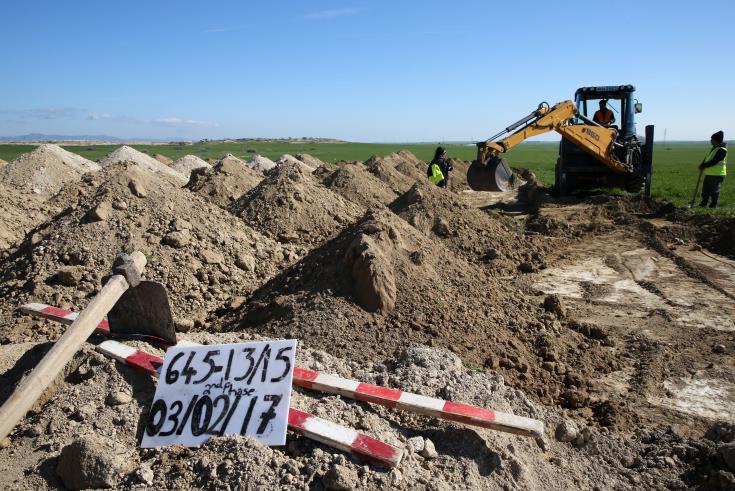

The Committee on Missing Persons in Cyprus (CMP) knows where to find information that will help its mission and is aware of people who own such information, but waited passively for decades for these people to be convinced to give it. However this did not happen, and it is time to use new ways to achieve this, President of the Cyprus Organization of Relatives of Undeclared Prisoners and Missing Persons, Nikos Sergides, has told the Cyprus News Agency (CNA).
In an interview to the Agency, Sergides underlined that “in order to convince Turkey to change its stance, actions by international organizations and decision-making centres, which will have a political cost for Turkey, are required”, and that “we expected and we are still expecting from the Third Member of the Committee on Missing Persons and by the UN Secretary General himself to intervene in a substantive and catalytic way.”
Responding to a question about the decision of the Republic of Cyprus to promote an action plan concerning the issue of missing persons, which will be put before the Council of Ministers, and about the fact that according to Presidential Commissioner, Photis Photiou, Nicosia is getting ready to undertake intense diplomatic action on this issue in decision-making centres, Sergides said that they fully agree with this.
“We hope that a well-organized effort will get underway, at last, with a view to solve the humanitarian issue of missing persons. The international factor can certainly play a significant role in promoting and solving this issue. In parallel we give particular importance to the meetings which President Nicos Anastasiades has with Turkish Cypriot leader Mustafa Akinci,” he noted.
He went on to say that “we expect from President Anastasiades to seek the soonest possible a meeting with Akinci specifically about the issue of missing persons, with a view to agree on practical and effective ways that will lead, with no further delay, to establishing the fate of all missing persons, Greek Cypriots and Turkish Cypriots.”
Asked about a letter he sent recently to the Third Member of CMP Paul-Henri Arni and what the Committee can further do to be more effective in achieving its goal which is to recover, identify, and return the remains of the missing persons to their families, Sergides said that CMP must find the necessary data and information that will assist its work.
“There was no efficiency in this field, as the results of CMP work show, and what concerns us most is that during the last years its efforts towards this direction have slowed down. We are aware of things that have been done as the campaign with the signs on the roads (calling on people who have information to give it) and other vague calls. But this is not enough or sufficient,” he added.
He went on to say that “CMP knows where this evidence is and who owns it. It waited, I would say passively for decades that maybe they would be convinced to give it. This did not happen. It is time to use new ways and not just keep waiting passively,” he added.
Sergides also said that “we have been waiting and we are still waiting from the Third Member of CMP and the UN Secretary General himself to intervene in a substantive and catalytic way.”
Asked if there are concrete ways in which Turkey can be convinced to cooperate on this humanitarian issue, giving information from its archives and allowing the unhindered research in possible burial sites, Sergides said that “it is clear that Turkey did not want, until today, to see the issue of missing persons as a humanitarian one, as it truly is, and to help resolve it. Its long-standing position has been negative and unbending,” he noted.
Sergides noted that CMP was founded in 1981, but was able to work in 2004, due to the stance of the Turkish side. “The change of the Turkish stance in 2004 was not something that happened by chance. It was a political move that took place in parallel with Turkey’s application to join the EU, since she knew that if she did not make some gestures of good will as regards the human rights violations to which the ECHR have found her guilty, her accession course could not move forward,” he added.
He noted that since then the Turkish side participates in the CMP but follows tactics which are not always helpful. “She poses obstacles which render the Committee’s work time-consuming and ineffective (military zones, relocation of remains etc). A proof that that other side is addressing this issue through political actions is also the fact that it makes some concessions just before the discussion of the issue before the Council of Europe instruments, and the UN, or the European Parliament. This leads to the conclusion that in order to convince Turkey to change its stance, actions by international organizations and decision-making centres, which will have a political cost for Turkey, are required”, Sergides said.
Invited to comment the result of the recent meeting of the Council of Europe Committee of Ministers about the issue of missing persons and the decision that was adopted, Sergides said that the decision of the Committee is a positive, even though small, step towards the right direction.
“It addresses the substance of the issue and touches upon significant problems which CMP faces today, as the hindering of its free access to the occupied areas, difficulties in finding information for burial sites, and the relocation of remains. Moreover, the tone used by the Committee shows that the long-standing tolerance that it has shown – let’s not forget that the ECHR decision was taken in May 2001 and there was no compliance by Turkey so far – cannot continue.”
In its decision, the Committee of Ministers of the Council of Europe called on Turkey to ensure that the CMP has unhindered access to military zones in the Turkish-occupied part of the island.
Cyprus has been divided since 1974, when Turkey invaded and occupied its northern third.
A Committee on Missing Persons has been established, upon agreement between the leaders of the two communities, with the scope of exhuming, identifying and returning the remains of missing persons to their relatives.