

Ancient Greek Religion
The 12 gods of Mount Olympus were the most important deities in ancient Greece. With their all-too-human qualities, the Olympian gods were capable of displaying great kindness and dishing out terrible punishments. They argued amongst themselves, had love affairs, and protected their favourite mortals down on earth but each had a more serious role to play in the ancient Greek view of the world and so they represented important ideals and features of the human condition such as justice, loyalty, wisdom, beautiful music and the changing of the seasons.
The standard 12 Olympian gods are:
The Greeks did not always agree on the 12 and some lists include Hestia, Hercules or Leto, with Dionysos often the one replaced.
The Olympian gods, led by Zeus, twice defeated the sources of chaos represented by the Titans and the Giants. These gods then, rule humanity’s destiny and sometimes directly interfere – favourably or otherwise.
Zeus (Roman name: Jupiter)
Zeus was the king of the Olympian gods and the supreme deity in Greek religion. Often referred to as the god of thunder and the ‘cloud-gatherer’, he controlled the weather, offered signs and omens and generally dispensed justice, guaranteeing order amongst both the gods and humanity from his seat high on Mt. Olympus.
Zeus is the child of Cronus and Rhea, the youngest of his siblings to be born, though sometimes reckoned the eldest, as the others required disgorging from Cronus’s stomach. In most traditions, he is married to Hera, by whom he is usually said to have fathered Ares, Hebe, and Hephaestus. At the oracle of Dodona, his consort was said to be Dione, by whom the Iliad states that he fathered Aphrodite. Zeus was also infamous for his erotic escapades. These resulted in many divine and heroic offspring, including Athena, Apollo, Artemis, Hermes, Persephone, Dionysus, Perseus,Heracles, Helen of Troy, Minos, and the Muses.
Hera (Roman name: Juno)
Hera, wife of Zeus and queen of the ancient Greek gods, represented the ideal woman and was goddess of marriage and the family. However, she was perhaps most famous for her jealous and vengeful nature, principally aimed against the lovers of her husband and their illegitimate offspring. She was notable as one of the very few deities that remained faithful to her partner and she therefore came to symbolise monogamy and fidelity.
Athena (Roman name: Minerva)
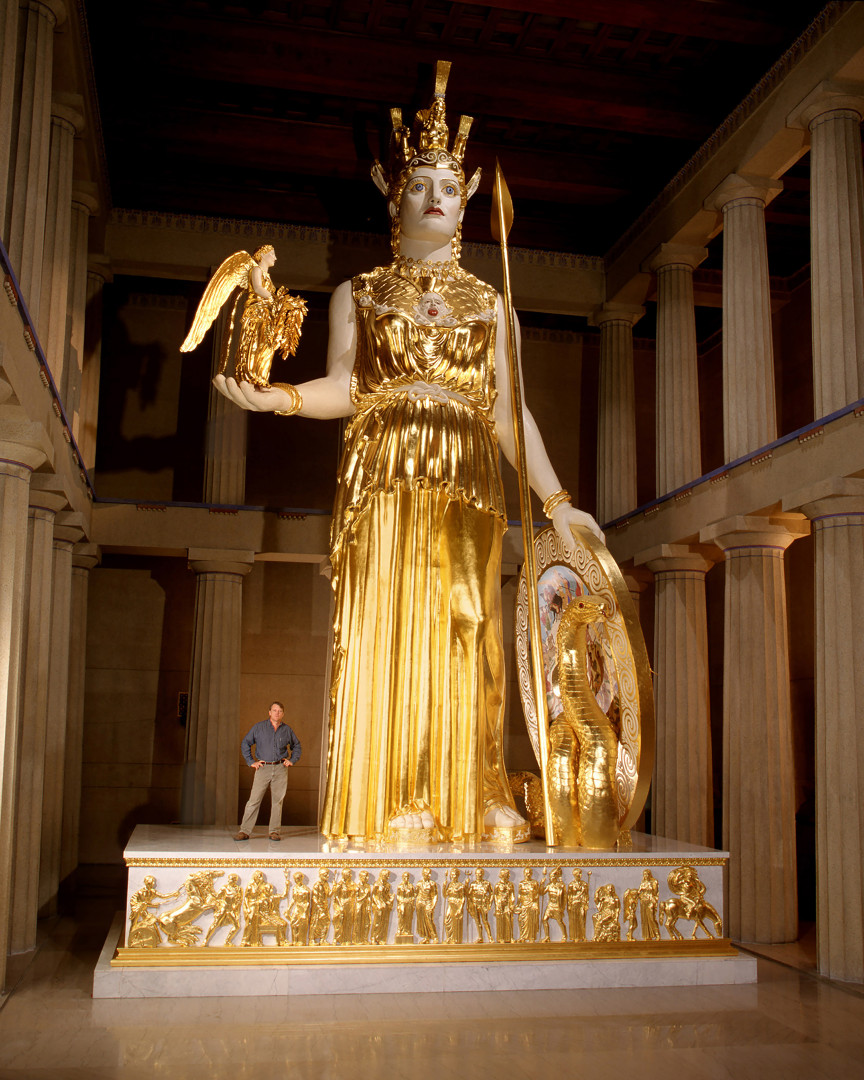
Goddess of wisdom, war and the crafts, and favourite daughter of Zeus, Athena was, perhaps, the wisest, most courageous, and certainly the most resourceful of the Olympian gods. She was regarded as the patron and protector of various cities across Greece, particularly the city of Athens, from which she most likely received her name. She is usually shown in art wearing a helmet and holding a spear. Her major symbols include owls, olive trees, snakes, and the Gorgonian. Zeus was told that his son would take his throne from him, just as he had taken power from his father Cronus. Accordingly, when Metis was pregnant, he swallowed her and Athena was born from Zeus’ head.
Apollo (Roman name: Apollo)
Apollo is one of the most important and complex of the Olympian deities in classical Greek and Roman mythology. The national divinity of the Greeks, Apollo has been recognized as a god of archery, music and dance, truth and prophecy, healing and diseases, the Sun and light, poetry, and more. He is the son of Zeus and Leto, and the twin brother of Artemis, goddess of the hunt. Seen as the most beautiful god and the ideal of the kouros (a beardless athletic youth), Apollo is considered to be the most Greek of all the gods. As the patron deity of Delphi (Apollo Pythios), Apollo is an oracular god – the prophetic deity of the Delphic. Apollo is the god who affords help and wards off evil; various epithets call him the “averter of evil”. Delphic Apollo is the patron of seafarers, foreigners and the protector of fugitives and refugees.
Medicine and healing are associated with Apollo, whether through the god himself or mediated through his son Asclepius. Apollo delivered people from epidemics, yet he is also a god who could bring ill health and deadly plague with his arrows. The invention of archery itself is credited to Apollo and his sister Artemis. Apollo is usually described as carrying a golden bow and a quiver of silver arrows.
Poseidon (Roman name: Neptune)
God of the sea and rivers, creator of storms and floods, and the bringer of earthquakes and destruction, Poseidon was perhaps the most disruptive of all the ancient Greek gods, not only for mortals but also to Zeus’ peaceful reign on Mount Olympus. Despite the above, the trident-bearing god was not always a negative force, and he did have a role as a protector, particularly to mariners, and as the patron of horses and horse breeding. To the Romans, he was known as Neptune.
Ares (Roman name: Mars)
Ares was the Greek god of war and perhaps the most unpopular of all the Olympian gods because of his quick temper, aggressiveness, and unquenchable thirst for conflict. He famously seduced Aphrodite, unsuccessfully fought with Hercules, and enraged Poseidon by killing his son Halirrhothios. Ares always took the side of Aphrodite in the Trojan War. He fought for Hector (a Trojan) until a Greek warrior pierced him with a spear that was guided by Athena. He then departed the battlefield in order to complain to Zeus about Athena’s violence.
One of the more human Olympian gods, he was a popular subject in Greek art and even more so in Roman times when he took on a much more serious aspect as Mars, the Roman god of war.
Artemis (Roman name: Diana)
Artemis is known as the goddess of the hunt and is one of the most respected of all the ancient Greek deities. It is thought that her name, and even the goddess herself, may even be pre-Greek. She was the daughter of Zeus and the Titaness Leto and she has a twin brother, the god Apollo.
Not only was Artemis the goddess of the hunt, she was also known as the goddess of wild animals, wilderness, childbirth and virginity. Also, she was protector of young children and was known to bring and relieve disease in women. In literature and art she was depicted as a huntress carrying a bow and arrow.
Artemis was a virgin and drew the attention and interest of many gods and men. However, it was only her hunting companion, Orion that won her heart. It is believed that Gaia, the primordial goddess of the earth, accidentally killed either by Artemis herself or Orion.
In one version of the stories of Adonis – who was a late addition to Greek mythology during the Hellenistic period – Artemis sent a wild boar to kill Adonis after he continued to boast that he was a far greater hunter than her.
She was worshipped across the Greek world, but her most famous cult site was as a fertility goddess at the Temple of Artemis at Ephesus, one of the Seven Wonders of the Ancient World.
Demeter (Roman name: Ceres)
Demeter was one of the oldest gods in the ancient Greek pantheon, and she guaranteed the fertility of the earth and protected both farming and vegetation. This close connection with the earth was inherited from her mother Rhea, and doubtless, she was a reincarnation of local mother Earth goddesses, commonly worshipped in rural communities in the Bronze Age. The sanctuary at Eleusis dedicated to the goddess and her daughter Persephone and the Eleusinian Mysteries practised there spread the idea across the Archaic and Classical Greek worlds that Demeter would protect her worshippers in the afterlife. To the Romans, the goddess remained popular and was known as Ceres.
Aphrodite (Roman name: Venus)
Ancient Greek goddess of love, beauty, desire, and all aspects of sexuality, Aphrodite could entice both gods and men into illicit affairs with her good looks and whispered sweet nothings. Born near Cyprus from the severed genitalia of the sky god Uranus, Aphrodite had a much wider significance than the traditional view as a mere goddess of love and sex. Worshipped by men, women, and city-state officials, she also played a role in the commerce, warfare, and politics of ancient Greek cities. In addition, Aphrodite was honoured as a protector of those who travelled by sea and, less surprisingly, courtesans and prostitutes.
Dionysus (Roman name: Bacchus)
Dionysus was the ancient Greek god of wine, merriment, and theatre. Being the bad boy of Mt. Olympus, he was perhaps the most colourful of the Olympian Gods. Despite being the son of Zeus and Semele (the daughter of Kadmos and Harmonia), Dionysos did not receive the best start in life when his mother died while still pregnant. Hera, wife of Zeus, was jealous of her husband’s illicit affair and craftily persuaded Semele to ask Zeus to reveal himself to her in all his godly splendour. This was too much for the mortal and she immediately expired; however, Zeus took the unborn child and reared him in his thigh. Most accounts then attribute the satyrs and nymphs as the carers of Dionysos in his childhood and the wise Silenus as his chief educator on Mt. Nysa, far from Hera’s wrath.
Hermes (Roman name: Mercury)
Hermes was god of trade, thieves, travellers, sports, athletes, and border crossings, guide to the Underworld. He was the second youngest Olympian god and was the son of Zeus and Maia, one of the seven Pleiades and daughter of the Titan Atlas.
As the god of boundaries and transitions, Hermes was known to be quick and cunning and had the ability to freely move between the mortal and divine worlds. It is this skill that made him a luck-bringing messenger to the gods and intercessor between mortals and the divine.
He is also the patron and protector of travellers, herdsmen, thieves, orators and wit, literature and poets, athletics and sports, invention and trade. In some myths Hermes is also depicted as a trickster where he would outwit the gods either for the good of humankind or for his own personal amusement and satisfaction.
Both Homer and Hesiod portrayed Hermes as the author of skilled or deceptive acts, and also as a benefactor of mortals.
To the Romans, the god was known as Mercury.
Hephaestus (Roman name: Vulcan)
Hephaestus was the god of fire, metalworking, stone masonry, forges and the art of sculpture. He was the son of Zeus and Hera and married to Aphrodite by Zeus to prevent a war of the gods fighting for her hand. He was a smithing god, making all of the weapons for Olympus and acting as a blacksmith for the gods. He had his own palace on Olympus where he made many clever inventions and automatons of metal to work for him. In one story, Hephaestus builds a tricky invention, which catches Aphrodite laying with the Ares, the god of war, trapping them, both in the bed to be laughed at and ridiculed by the other gods. He is similar to Athena in his giving skill and help to mortals – in his case artists. It was believed that Hephaestus taught men the arts alongside Athena. However, he was also considered far inferior to that of the goddess of wisdom.
Mount Olympus
Mount Olympus is the highest mountain in Greece. It is located in the Olympus Range on the border between Thessaly and Macedonia, about 80 km (50 mi) southwest from Thessaloniki. Mount Olympus has 52 peaks and deep gorges. The highest peak, Mytikas (meaning, “nose”, rises to 2,917 metres (9,570 ft.). It is one of the highest peaks in Europe in terms of topographic prominence.
Mount Olympus is notable in ancient Greek mythology as the home of the Greek gods, on Mytikas peak. It is also noted for its exceptional biodiversity and rich flora. It has been a National Park, the first in Greece, since 1938.
Every year, thousands of visitors admire its fauna and flora, tour its slopes, and climb its peaks. Organized mountain refuges and various mountaineering and climbing routes are available. The usual starting point for climbing Olympus is the town of Litochoro, on the eastern foothills of the mountain, 100 km (62 mi) from Thessaloniki.
The Parthenon
The Parthenon is a former temple on the Athenian Acropolis, Greece, dedicated to the goddess Athena, whom the people of Athens considered their patron.
Construction began in 447 BC when the Athenian Empire was at the peak of its power. It was completed in 438 BC, although decoration of the building continued until 432 BC. It is the most important surviving building of Classical Greece, generally considered the zenith of the Doric order]. Its decorative sculptures are considered some of the high points of Greek art. The Parthenon is regarded as an enduring symbol of Ancient Greece, Athenian democracy and Western civilization, and one of the world’s greatest cultural monuments. To the Athenians who built it, the Parthenon and other Periclean monuments of the Acropolis were seen fundamentally as a celebration of Hellenic victory over the Persian invaders and as a thanksgiving to the gods for that victory.
The Parthenon itself replaced an older temple of Athena, which historians call the Pre-Parthenon or Older Parthenon, that was destroyed in the Persian invasion of 480 BC. Like most Greek temples, the Parthenon served a practical purpose as the city treasury. For a time, it served as the treasury of the Delian League, which later became the Athenian Empire. In the final decade of the 6th century AD, the Parthenon was converted into a Christian church dedicated to the Virgin Mary.
After the Ottoman conquest, it was turned into a mosque in the early 1460s. On 26 September 1687, an Ottoman ammunition dump inside the building was ignited by Venetian bombardment during a siege of the Acropolis. The resulting explosion severely damaged the Parthenon and its sculptures. From 1800 to 1803, Thomas Bruce, 7th Earl of Elgin removed some of the surviving sculptures, now known as the Elgin Marbles, with the permission of the Turkish administration of the Ottoman Empire.
Since 1975 numerous large-scale restoration projects have been undertaken and are still on going.
Return to Greece
The Greek Government has now proposed to the British Government to put aside the question of ownership. Instead the Greeks are inviting their colleagues at the British Museum to join them with the aim of reuniting the surviving sculptures in one place: in the Acropolis Museum that has been expressly built in order to house all the Parthenon sculptures. This offer has been proposed by a number of Greek Ministers of Culture and expressly stated by Foreign Minister George Papandreou who gave evidence on 5th June 2000 to the House of Commons Culture, Media and Sports Committee.
Furthermore, Mr. Evanghelos Venizelos, the then Greek Minister pledged that when the Parthenon sculptures are returned, the Greek Government will make sure that the Duveen Galleries (at Tate Britain) would always host Greek antiquities on loan for exhibitions. Greece would be willing to send rare and even newly discovered antiquities, which have never been seen outside Greece.
The fragmented sculptures from the Parthenon, currently mainly divided between two great museums, deserve collective respect – for the good of the world.
www.parthenonuk.com
Battle of the Titans
In Greek mythology, the Titanomachy was a ten-year series of battles fought in Thessaly, consisting of most of the Titans (an older generation of gods, based on Mount Othrys) fighting against the Olympians (the younger generations, who would come to reign on Mount Olympus) and their allies. This event is also known as the War of the Titans, Battle of the Titans, Battle of the Gods, or just the Titan War. The war was fought to decide which generation of gods would have dominion over the universe; it ended in victory for the Olympian gods.
Greeks of the Classical Age knew of several poems about the war between the gods and many of the Titans. The dominant one, and the only one that has survived, is the Theogony attributed to Hesiod. A lost epic, Titanomachia, attributed to the blind Thracian bard Thamyris, himself a legendary figure, was mentioned in passing in an essay On Music that was once attributed to Plutarch. The Titans also played a prominent role in the poems attributed to Orpheus. Although only scraps of the Orphic narratives survive, they show interesting differences from the Hesiodic tradition.
Source: Mark Cartwright, www.ancient.eu and en.wikipedia.org
Photo: Replica of the Athena Parthenon statue in Nashville, Tennessee.

