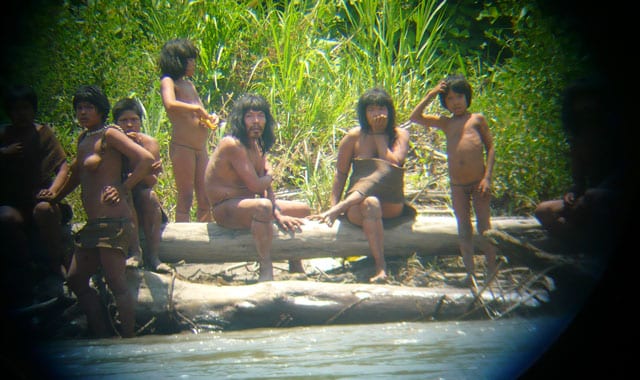

The pictures show a family of Mascho-Piro people in the Manu National Park, in remote southeastern Peru on the border with Brazil.
They were taken at the end of last year by an archaeologist and tribe supporter and published on the website of pro-native group Survival International.
But Mariela Huacchillo, from the office for Natural Protected Areas, warned even indirect contact with the indigenous people could bring in deadly viruses that do not already exist in the region – and the natives could be hostile.
Ms Huacchillo called on outsiders “to never attempt to enter in contact with these (isolated) communities”, whose people “are trying to remain apart from the outside world”.
She also urged people to not leave food, clothing or other gifts like locals or tourists sometimes do “with the goal of starting a contact with the isolated natives”.
Last October, a park ranger was lightly wounded by a blunt arrow fired by a Mascho-Piro native after getting too close to the tribe. “It was a warning,” Ms Huacchillo said.
A similar incident was recorded in 2010, when a teenager was wounded by a spear.
On their website, Survival International mentioned the death late last year of Nicolas “Shaco” Flores, a local resident who had been leaving food and gifts for a small group of Mashco-Piro natives for 20 years.
Flores was “shot by an uncontacted tribe’s arrow”, the group said.
The incident was never confirmed.
There are some 15 uncontacted native groups in Peru’s Amazonrainforest, according to government officials, with Survival International saying there are 100 uncontacted native groups around the world.
Sightings of the Mashco-Piro have increased in recent months.
“Many blame illegal logging in and around the park and low-flying helicopters from nearby oil and gas projects, for forcibly displacing the indigenous people from their forest homes,” the activist group said
Sky