
Young artists with concerns and a thirst for exploring – artistically and environmentally. Katerina Foukara and Arsenti Lysenkov “married” both – their art and their concern for the environment, and their art met recycling.
Escaping the boundaries of a personal studio and personal creation and expression, the two artists endeavoured to transpose their action into society and, through their school “Art Studio” to involve and activate their students and broader social groups.
The capping stone of their efforts was the exhibition EcoArt and FishMob, which was presented in cooperation with Hotel Almyra in Paphos, in early June this year, on the occasion of Environment Day.
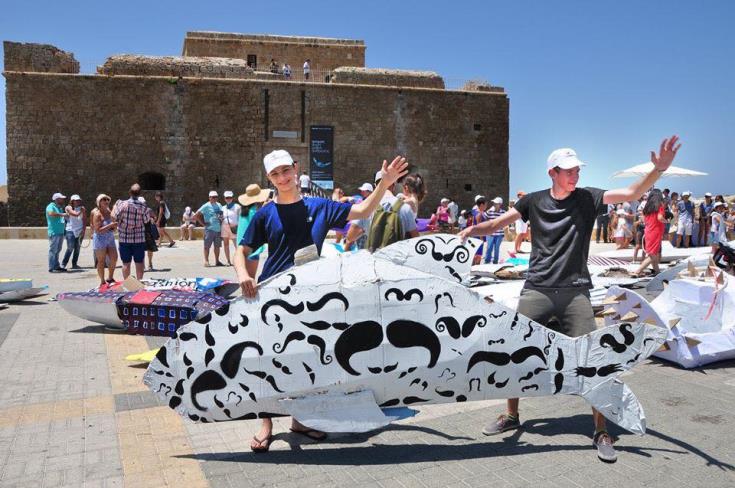
The event caught the interest of the public for its visual art and aesthetically interesting creations, as well as the environmental messages it sent. The exhibition was unique, with pieces of art made exclusively from recyclable materials, bottles, plastic, caps, juice boxes, cans, plastic cups, newspapers, bags, and anything else destined for the bin.
On the occasion of this exhibition, the Cyprus News Agency met the two artists to talk.
Katerina Foukara, who is a fourth-generation artist, has been greatly influenced in her work by the creative presence of her grandfather, Alexandros Sukhanov, in the Russian artistic area. Having assimilated the family learning cycle and the Russian school, Katerina makes here first moves in the Cypriot artistic area. In a short interview, she told CNA that the aim of this effort was to support the cultural activity in Paphos, and to contribute in sending environmental awareness messages to the public.
The exhibition, she said, involved students and adults in creative cooperation with artists, in the framework of which the participants made fish out of recyclable materials.
“The initiative’s aim is to help students create visual art pieces and specifically sculptures, using everyday waste materials,” Foukara explained.
She pointed out that this was “exceptionally great because on the one hand we give the children the idea of recycling and reusing, and on the other hand we develop their imagination and creative expression, in an original visual way, which always excites and enchants.”
Foukara explained that the rules were to create largescale fish about 2m in length with materials such as old boxes, bottles, fabrics, caps and packaging, which would otherwise end up in landfills.
“The creative restructuring of recyclable materials completes the effort to develop environmental awareness among children, and when this is done in such a beautiful way, the children adopt it as an alternative form of expression in art,” Foukara said.
Asked about the process, she said it was easy. “Firstly, we help the children determine the form of the object they will be making, such as cubes, cones, cylinders etc. In this case, the fish had a basic shape, its aerodynamic body, and when we cut this shape, namely the fish’s body, we fill it with water bottles in order to take on a three-dimensional shape,” Foukara explained.
To stabilise it, “we use tape and then we stick on the head and the tail, and then true creative imagination unfolds,” she said.
Regarding the children and their participation, Foukara said they are separated into groups and work on various details, each on one piece of the project, the scales, the fins, the eyes, mouth and teeth, so that everyone can do something.
“It is nice to break free from the realistic and help the students see nature a little differently, creating strange fish, space beings, dragons and other such beasts,” she said.
Foukara noted that this excites the students and releases them from the stress of not being able to cope.
They will then paint the sculpture, which will be used later on, after the event, in a parade and as an ornament somewhere, she said.
Foukara added that the parade with the creations, which took place in the framework of the event organised for World Environment Day, began at Hotel Almyra and passed from the port, where each participant held the fish.
The first FishMob was organised in 2014 during a similar event at Paphos Port. “We had set up an open workshop in which more than 200 people participated. The theme was fish, designed in cardboard and plastic,” she said, adding that the event was very successful.
Arsenti Lysenkov said the FishMob event was “unique”. Lysenkov, who was the curator and coordinator of the event, has been living and working in Cyprus since 2011, with his wife, artist Katerina Foukara. He studied sculpting at the Surikov Academy of Fine Arts in Moscow, at Aleksandr Rukavishnikov’s studio, having first studied at the Savitsky Art School in Penza.
“There are no similar works of art in the world,” he told CNA, during a conversation with the two artists, noting that for three weeks, Art Studio, along with many volunteers, worked very hard, creating fish out of cardboard, plastic, polystyrene and other materials.
“We designed, developed and created fish, all the imaginary and other types, sizes and colours,” he said.
The aim of FishMob, Lysenkov explained, was “to attract the attention of the people to the ecological problem of the pollution of the oceans, and to the fact that, due to the actions of people, these simple things and materials of our daily lives, including boxes and plastic bottles, enter the deepest corners of the oceans, thus harming the creatures of the oceans and seas.”
Through their interview with CNA, the two artists send the message that “we must love our common home, otherwise we will not have a clean and beautiful place to live.”
They said this problem can be solved if first and foremostly everyone acknowledges the problem of increased pollution from plastic and the people are made aware of the issue.
The second step, they said, was to educate and involve everyone in a conversation on reusing plastics.
On a final note, they expressed satisfaction that “so many families with children came to support our project, because it is very important to make our children sensitive about environmental issues at a young age.”
The massive and substantive participation of children and youths in the EcoArt and FishMob exhibition shows that the action of these two artists, Katerina Foukara and Arsenti Lysenkov, is bearing fruit, both artistically and environmentally.

** The interview is in the context of the project Rethink: Reduce- Reuse – Recycle which is funded by the EU programme LIFE+ (project code: LIFE13 INF/CY/000910) of the EU. Coordinating Beneficiary: CyBC. Partners: Green Dot Cyprus, Department of Environment, Cyprus Pedagogical Institute, CNA, Fost Plus Belgium **