Delphi, formerly also called Pytho, is the ancient sanctuary that grew rich as the seat of Pythia, the oracle who was consulted about important decisions throughout the ancient classical world.
The ancient Greeks considered the centre of the world to be in Delphi, marked by the stone monument known as the omphalos (navel). It occupies a site on the southwestern slope of Mount Parnassus, overlooking the coastal plain to the south and the valley of Phocis. It is now an extensive archaeological site with a small modern town of the same name nearby. It is recognised by UNESCO as a World Heritage Site in having had a great influence in the ancient world, as evidenced by the various monuments built there by most of the important ancient Greek city-states, demonstrating their fundamental Hellenic unity.
Origins and Location
Delphi is located in upper central Greece, on multiple plateaux along the slope of Mount Parnassus, and includes the Sanctuary of Apollo (the god of light, knowledge and harmony), the site of the ancient Oracle. This semi-circular spur is known as Phaedriades, and overlooks the Pleistos Valley.
In myths dating to the classical period of Ancient Greece (510–323 BC), Zeus determined the site of Delphi when he sought to find the centre of his “Grandmother Earth” (Gaia). He sent two eagles flying from the eastern and western extremities, and the path of the eagles crossed over Delphi where theomphalos, or navel of Gaia was found.
Earlier myths include traditions that Pythia, or the Delphic oracle, already was the site of an important oracle in the pre-classical Greek world (as early as 1400 BC) and, rededicated from about 800 BC, when it served as the major site during classical times for the worship of the god Apollo. Apollo was said to have slain Python, a “drako” a serpent or a dragon that lived there and protected the navel of the Earth. The Homeric Hymn to Delphic Apollo recalled that the ancient name of this site had been Krisa. Others relate that it was named Pytho and that Pythia, the priestess serving as the oracle, was chosen from their ranks by a group of priestesses who officiated at the temple.
Excavation at Delphi, which was a post-Mycenaean settlement of the late 9th century, has uncovered artefacts increasing steadily in volume beginning with the last quarter of the 8th century BC. Pottery and bronze as well as tripod dedications continue in a steady stream, in contrast to Olympia. Neither the range of objects nor the presence of prestigious dedications proves that Delphi was a focus of attention for a wide range of worshippers, but the large quantity of valuable goods, found in no other mainland sanctuary, encourages that view.
Apollo’s sacred precinct in Delphi was a PanHellenic sanctuary, where every four years, starting in 586 BC athletes from all over the Greek world competed in the Pythian Games, one of the four PanHellenic Games, precursors of the Modern Olympics. The victors at Delphi were presented with a laurel crown (stephanos), which was ceremonially cut from a tree by a boy who re-enacted the slaying of the Python. (These competitions are also called Stephantic Games, after the crown.) Delphi was set apart from the other games sites because it hosted the mousikos agon, musical competitions.
These Pythian Games rank second among the four Stephanitic Games chronologically and in importance. These games, though, were different from the games at Olympia in that they were not of such vast importance to the city of Delphi as the games at Olympia were to the area surrounding Olympia. Delphi would have been a renowned city whether or not it hosted these games; it had other attractions that led to it being labelled the “omphalos” (navel) of the earth, in other words, the centre of the world.
In the inner hestia (hearth) of the Temple of Apollo, an eternal flame burned. After the battle of Plataea, the Greek cities extinguished their fires and brought new fire from the hearth of Greece, at Delphi; in the foundation stories of several Greek colonies, the founding colonists were first dedicated at Delphi.
Religious Significance
The name Delphi comes from the same root as delphys, “womb” and may indicate archaic veneration of Gaia at the site. Apollo is connected with the site by his epithet Delphinios, “the Delphinian”. The epithet is connected with dolphins in the Homeric Hymn to Apollo, recounting the legend of how Apollo first came to Delphi in the shape of a dolphin, carrying Cretan priests on his back. The Homeric name of the oracle is Pytho. Another legend held that Apollo walked to Delphi from the north and stopped at Tempe, a city in Thessaly, to pick laurel (also known as bay tree), which he considered to be a sacred plant. In commemoration of this legend, the winners at the Pythian Games received a wreath of laurel picked in the temple.
Delphi became the site of a major temple to Phoebus Apollo, as well as the Pythian Games and the prehistoric oracle. Even in Roman times, hundreds of votive statues remained, described by Pliny the Younger and seen by Pausanias. Carved into the temple were three phrases: “know thyself”, “nothing in excess” and “make a pledge and mischief is nigh”. In antiquity, the origin of these phrases was attributed to one or more of the Seven Sages of Greece by authors such as Plato and Pausanias. Additionally, according to Plutarch’s essay on the meaning of the “E at Delphi” – the only literary source for the inscription – there was also inscribed at the temple a large letter E. Among other things epsilon signifies the number 5. However, ancient as well as modern scholars have doubted the legitimacy of such inscriptions.
According to the Homeric hymn to the Pythian Apollo, Apollo shot his first arrow as an infant, which effectively slew the serpent Pytho, the son of Gaia, who guarded the spot. To atone the murder of Gaia’s son, Apollo was forced to fly and spend eight years in menial service before he could return forgiven. A festival, the Septeria, was held every year, at which the whole story was represented: the slaying of the serpent, and the flight, atonement, and return of the god.
The Pythian Games took place every four years to commemorate Apollo’s victory. Another regular Delphi festival was the “Theophania”, an annual festival in spring celebrating the return of Apollo from his winter quarters in Hyperborea. The culmination of the festival was a display of an image of the gods, usually hidden in the sanctuary, to worshippers.
The theoxenia was held each summer, centred on a feast for “gods and ambassadors from other states.” Myths indicate that Apollo killed the chthonic serpent Python guarding the Castalian Spring and named his priestess Pythia after her. Python, who had been sent by Hera, had attempted to prevent Leto, while she was pregnant with Apollo and Artemis, from giving birth.
This spring flowed toward the temple but disappeared beneath, creating a cleft, which emitted chemical vapours that purportedly caused the oracle at Delphi to reveal her prophecies. Apollo killed Python but had to be punished for it, since he was a child of Gaia. The shrine dedicated to Apollo was originally dedicated to Gaia and shared with Poseidon. The name Pythia remained as the title of the Delphic oracle.
Oracle of Delphi
Delphi is perhaps best known for its oracle, the Pythia, the sibyl or priestess at the sanctuary dedicated to Apollo.
One tale of the sanctuary’s discovery states that a goatherder, who grazed his flocks on Parnassus, one day observed his goats playing with great agility upon nearing a chasm in the rock; the goatherder noticing this held his head over the chasm causing the fumes to go to his brain; throwing him into a strange trance.
Apollo spoke through his oracle. She had to be an older woman of blameless life chosen from among the peasants of the area. Alone in an enclosed inner sanctum (Ancient Greek adyton – “do not enter”) she sat on a tripod seat over an opening in the earth (the “chasm”). According to legend, when Apollo slew Python its body fell into this fissure and fumes arose from its decomposing body. Intoxicated by the vapours, the sibyl would fall into a trance, allowing Apollo to possess her spirit. In this state she prophesied. The oracle could not be consulted during the winter months, for this was traditionally the time when Apollo would live among the Hyperboreans. Dionysus would inhabit the temple during his absence.
While in a trance the Pythia “raved” – probably a form of ecstatic speech – and her ravings were “translated” by the priests of the temple into elegant hexameters. It has been speculated that the ancient writers, including Plutarch who had worked as a priest at Delphi, were correct in attributing the oracular effects to the sweet-smelling pneuma (Ancient Greek for breath, wind or vapour) escaping from the chasm in the rock. That exhalation could have been high in the known anaesthetic and sweet-smelling ethylene or other hydrocarbons such as ethane known to produce violent trances. Ancient sources describe the priestess using “laurel” to inspire her prophecies. Several alternative plant candidates have been suggested including Cannabis, Hyoscyamus, Rhododendron and Oleander. A review of contemporary toxicological literature indicates that oleander causes symptoms similar to those shown by the Pythia, and study of ancient texts shows that oleander was often included under the term “laurel”. The Pythia may have chewed oleander leaves and inhaled their smoke prior to her oracular pronouncements and sometimes dying from the toxicity. The toxic substances of oleander resulted in symptoms similar to those of epilepsy, the “sacred disease,” which may have been seen as the possession of the Pythia by the spirit of Apollo.
The Delphic oracle exerted considerable influence throughout the Greek world, and she was consulted before all major undertakings including wars and the founding of colonies. She also was respected by the Greek-influenced countries around the periphery of the Greek world, such as Lydia, Caria, and even Egypt.
The early Romans also knew the oracle. Rome’s seventh and last king, Lucius Tarquinius Superbus (died 495 BC), after witnessing a snake near his palace, sent a delegation including two of his sons to consult the oracle.
In 83 BC a Thracian tribe raided Delphi, burned the temple, plundered the sanctuary and stole the “unquenchable fire” from the altar. During the raid, part of the temple roof collapsed. The same year, the temple was severely damaged by an earthquake, thus it fell into decay and the surrounding area became impoverished. The sparse local population led to difficulties in filling the posts required. The oracle’s credibility waned due to doubtful predictions.
The oracle flourished again in the second century AD during the rule of the Roman emperor Hadrian, who is believed to have visited the oracle twice and offered complete autonomy to the city.
By the 4th century, Delphi had acquired the status of a city. Constantine the Great looted several monuments, most notably the Tripod of Plataea, which he used to decorate his new capital, Constantinople.
Despite the rise of Christianity across the Roman Empire, the oracle remained a religious centre throughout the 4th century, and the Pythian Games continued to be held at least until 424 AD. However, the decline continued. The attempt of Emperor Julian to revive polytheism did not survive his reign. Excavations have revealed a large three-aisled basilica in the city, as well as traces of a church building in the sanctuary’s gymnasium. The site was abandoned in the 6th or 7th centuries, although a single bishop of Delphi is attested in an episcopal list of the late 8th and early 9th centuries.
Ancient Delphi
Delphi was since ancient times a place of worship for Gaia, the mother goddess connected with fertility. The town started to gain Pan-Hellenic relevance as both a shrine and an oracle in the 7th century BC. Initially under the control of Phocaean settlers based in nearby Kirra (currently Itea), Delphi was reclaimed by the Athenians during the First Sacred War (597–585 BC). The conflict resulted in the consolidation of the Amphictyonic League, which had both a military and a religious function revolving around the protection of the Temple of Apollo. This shrine was destroyed by fire in 548 BC and then fell under the control of the Alcmaeonids banned from Athens. In 449–448 BC, the Second Sacred War (fought in the wider context of the First Peloponnesian War between the Peloponnesian League led by Sparta and the Delian-Attic League led by Athens) resulted in the Phocians gaining control of Delphi and the management of the Pythian Games.
In 356 BC the Phocians under Philomelos captured and sacked Delphi, leading to the Third Sacred War (356–346 BC), which ended with the defeat of the former and the rise of Macedon under the reign of Philip II. This led to the Fourth Sacred War (339 BC), which culminated in the Battle of Chaeronea (338 BC) and the establishment of Macedonian rule over Greece. In Delphi, Macedonian rule was superseded by the Aetolians in 279 BC, when a Gallic invasion was repelled, and by the Romans in 191 BC. The site was sacked by Lucius Cornelius Sulla in 86 BC, during the Mithridatic Wars, and by Nero in 66 AD. Although subsequent Roman emperors of the Flavian dynasty contributed towards to the restoration of the site, it gradually lost importance. In the course of the 3rd century mystery cults became more popular than the traditional Greek pantheon. Christianity, which started as yet one more mystery cult, soon gained ground, and this eventually resulted in the persecution of pagans in the late Roman Empire. The anti-pagan legislation of the Flavian dynasty deprived ancient sanctuaries of their assets. The emperor Julian attempted to reverse this religious climate, yet his “pagan revival” was particularly short-lived. When the Greek physician Oreibasius visited the oracle of Delphi, in order to question the fate of paganism, he received a pessimistic answer: “Tell the king that the flute has fallen to the ground. Phoebus does not have a home any more, neither an oracular laurel, nor a speaking fountain, because the talking water has dried out.”
The site was finally shut down during the persecution of pagans in the late Roman Empire by Theodosius I in 381 AD.
Abandonment and rediscovery
The Ottomans finalized their domination over Phocis and Delphi in about 1410 AD. Delphi itself remained almost uninhabited for centuries. It seems that one of the first buildings of the early modern era was the monastery of the Dormition of Mary or of Panagia (the Mother of God) built above the ancient gymnasium at Delphi. It must have been towards the end of the 15th or in the 16th century that a settlement started forming there, which eventually ended up forming the village of Kastri.
Ottoman Delphi gradually began to be investigated. The first Westerner to describe the remains in Delphi was Cyriacus of Ancona, a 15th-century merchant turned diplomat and antiquarian. He visited Delphi in March 1436 and remained there for six days. He recorded all the visible archaeological remains based on Pausanias for identification. He described the stadium and the theatre at that date as well as some freestanding pieces of sculpture. He also recorded several inscriptions, most of which are now lost.
In 1766 an English expedition funded by the Society of Dilettanti. Their studies were published in 1769 under the title Ionian Antiquities, followed by a collection of inscriptions, and two travel books, one about Asia Minor (1775), and one about Greece (1776). Apart from the antiquities, they also related some vivid descriptions of daily life in Kastri, such as the crude behaviour of the Turco-Albanians who guarded the mountain passes.
Lord Byron
A travelling destination such as Delphi naturally attracted the great Philhellene Lord Byron, who visited in 1809, accompanied by his friend John Cam Hobhouse.
The poet was inspired by this visit to write – among other things – the following verses: “Yet there I’ve wandered by the vaulted rill; Yes! Sighed o’er Delphi’s long deserted shrine, where, save that feeble fountain, all is still”.
At the same time he noticed the signatures of other visitors on the ancient columns, in second use at the monastery of Panagia; among these was the signature of Lord Aberdeen (later Prime Minister), whom Byron accused, as he did with Lord Elgin, for the mutilation and steeling of antiquities. His disgust, however, did not prevent him from leaving his own signature on the marble of the same column, nowadays standing in the Gymnasium at Delphi.
Delphi Archaeological Museum
This museum is one of the principal museums of Greece and one of the most visited. Founded in 1903, it has been rearranged several times and houses the discoveries made at the panhellenic sanctuary of Delphi, which date from the Late Helladic (Mycenean) period to the early Byzantine era.
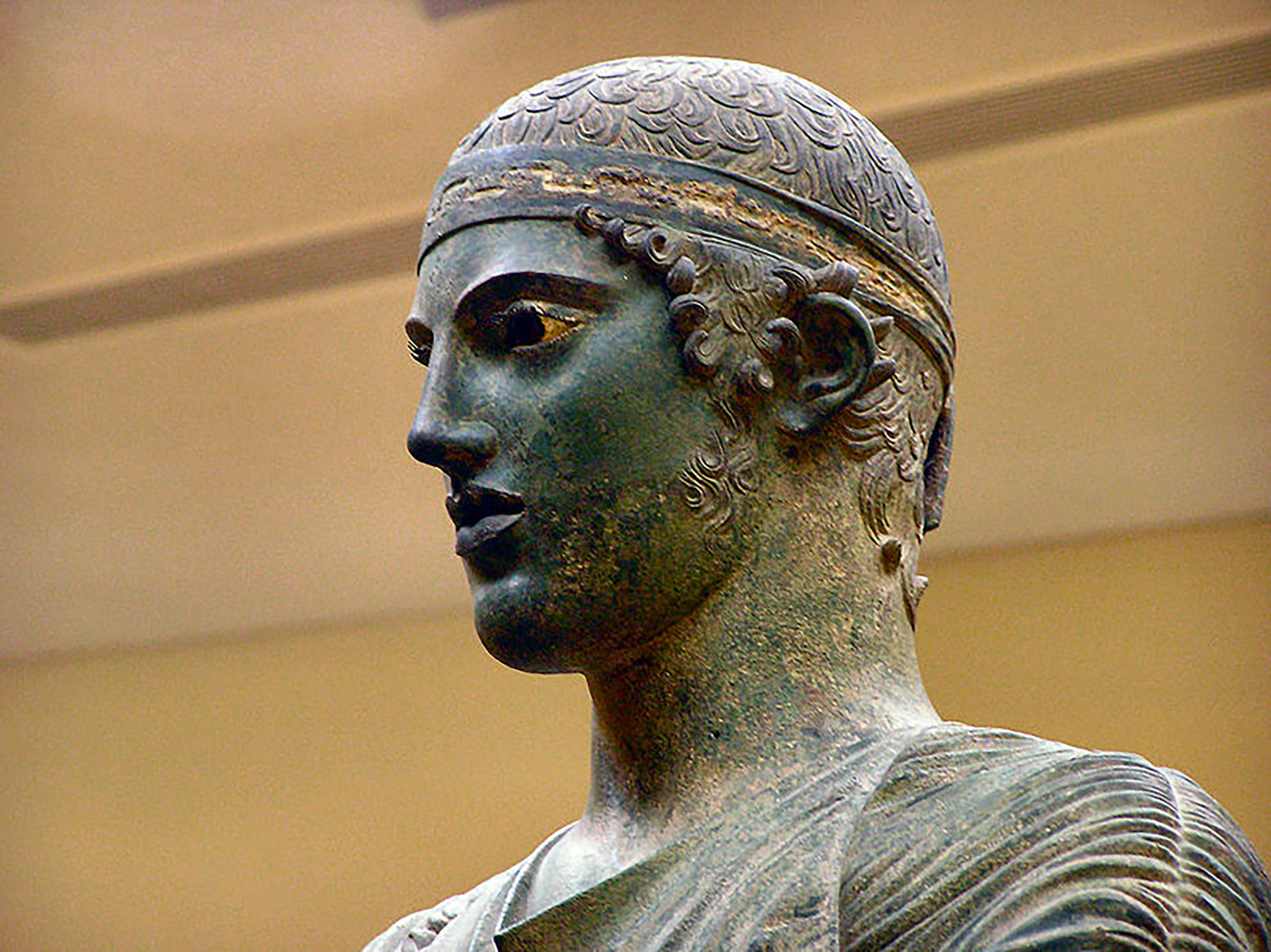
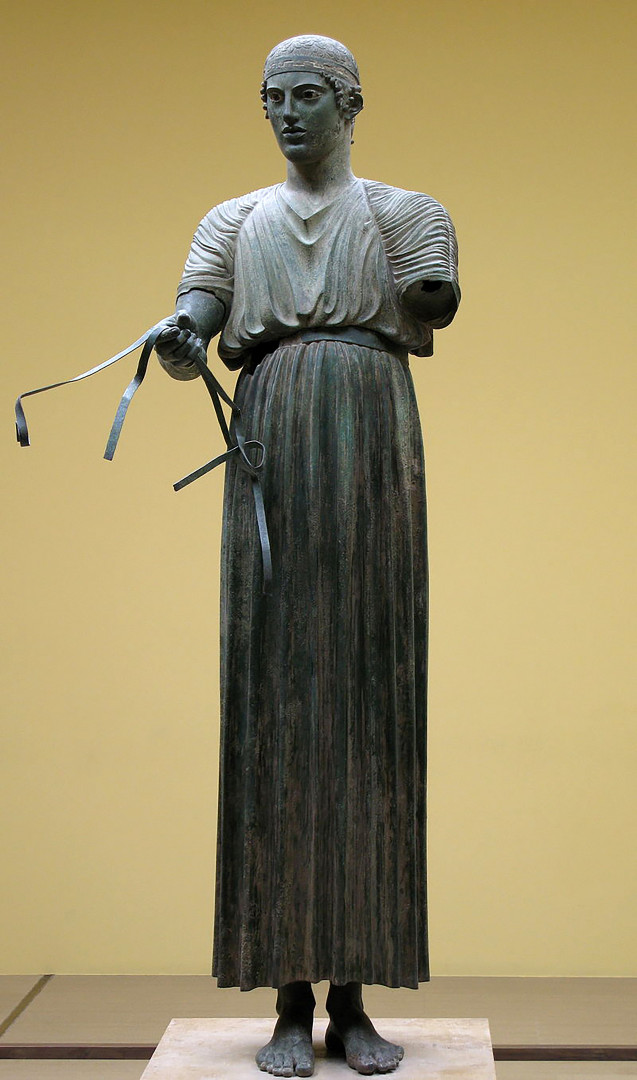
Organised in fourteen rooms on two levels, the museum mainly displays statues, including the famous Charioteer of Delphi, architectural elements, like the frieze of the Siphnian Treasury and ex votos (a votive offering to a saint or to a divinity) dedicated to the sanctuary of Pythian Apollo, like the Sphinx of Naxos.
Source: en.wikipedia.org, ancient.eu and www.odysseus.culture.gr
Images: Charioteer of Delphi – Delphi Museum
Tholos of Delphi