
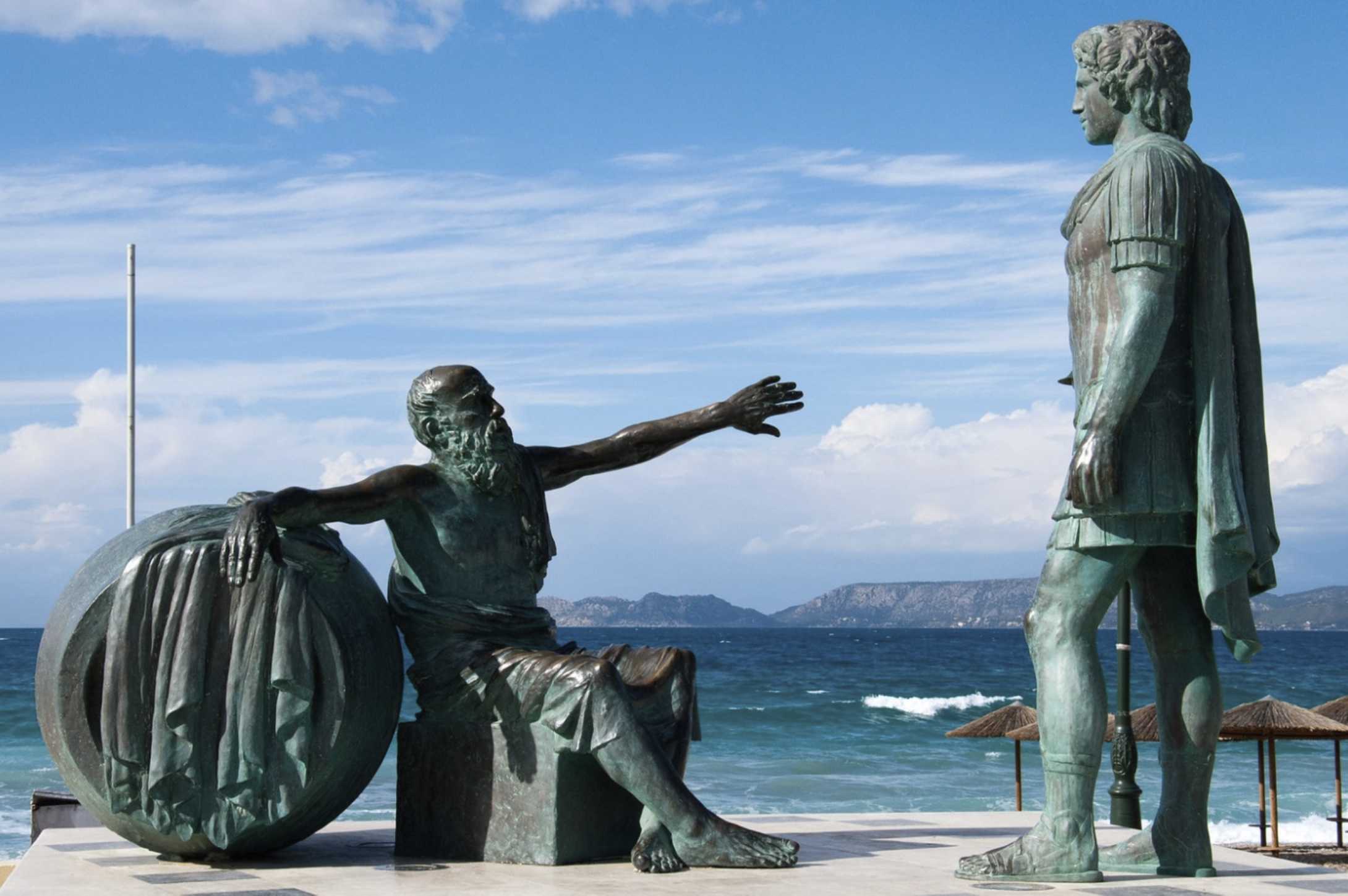

Άνθρωπον ζητώ
‘I am searching for an honest man.’
– Diogenes of Sinope
The Dog
Diogenes the Cynic was a Greek philosopher who lived in the 4th century BCE. Known for his wildly eccentric and unconventional behaviour, he embraced a minimalist lifestyle and challenged the social rules of his time.
Diogenes was born in Sinope, a Greek colony on the Black Sea coast. He was a student of Antisthenes, the founder of Cynicism, a philosophical school that emphasised self-sufficiency and the rejection of material possessions.
Diogenes became the most famous Cynic philosopher of his time, and fully embraced these teachings, as follows:-
1. Barrel: Diogenes lived in a large ceramic jar or barrel in the marketplace of Athens. He saw no need for the luxuries of a home, and considered his barrel sufficient for shelter.
2. Alexander: When Alexander the Great visited Diogenes, he asked if there was anything that he could do for him. Diogenes replied, ‘Yes, stand out of my sunlight.’ He rejected the offer of assistance, showing his disdain for power and authority. The encounter left an impression on the young king. Alexander remarked, ‘If I were not Alexander, I would be Diogenes.’
3. Lamp: Diogenes often carried around a lamp, claiming to be ‘searching for an honest man.’ This gesture was a satirical critique of the moral corruption he saw in society.
4. Nudity: Diogenes believed that clothing was unnecessary and cumbersome. He walked around naked or wearing a simple cloak, disregarding society’s expectations of modesty.
5. Public masturbation: Diogenes was known to engage in public masturbation as a way to demonstrate his indifference to the opinions of others. He expressed his natural desires without shame.
6. Alms: Diogenes would beg for money while holding a statue, symbolising that most people worship material possessions. He aimed to provoke reflection on the true value of wealth.
7. Eating: Diogenes would eat his meals in the marketplace, regardless of who was watching. He considered food a basic necessity that should be consumed without concern for social etiquette.
8. Scorn for politeness: Diogenes disregarded niceties and mocked the conventions of polite behaviour. He would belch loudly, spit at people, and even urinate in public to challenge expectations of decorum.
9. Dog-like: Diogenes often likened himself to a dog, claiming to be ‘the dog of the philosophers.’ He lived according to nature, as reflected in the behaviour of dogs.
10. Death: Diogenes died in his barrel at an old age. Legend has it that he instructed his friends to throw his body outside the city walls to be eaten by animals. This final act demonstrated his rejection of sacred customs even in death.
Despite his unconventional lifestyle, Diogenes left a lasting legacy of uncompromising individuality. He had a significant influence on subsequent generations, such as: –
Stoics: The Stoical philosophers , including Zeno of Citium, embraced similar ideas of simplicity, self-control, and indifference to external circumstances.
Epicurus: Although Diogenes and Epicurus held different philosophical views, they shared a similar rejection of material wealth and a focus on simple contentment, and both emphasised living in accordance with nature.
Renaissance: Figures such as Michel de Montaigne and François Rabelais were inspired by Diogenes’ questioning of authority.
Existentialists: Diogenes’ radical individualism influenced modern thinkers in the 19th and 20th centuries, such as Friedrich Nietzsche and Jean-Paul Sartre, who were inspired by his authenticity and the constant questioning of inherited assumptions.
While Diogenes did not have a formal philosophical school, he left a legacy of amused admiration for his audacity, and the pursuit of a simple existence.

