
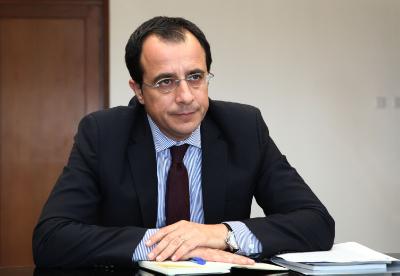

The Cypriot government spokesman Nicos Christodoulides has stated that the recently formed cooperation between Cyprus, Greece and Egypt is “serious, hopeful, and with a perspective of further empowerment”, especially now, “in difficult times” in the northeastern Mediterranean, indicating that it could expand.
Reliable sources in Athens have confirmed that other Middle-Eastern countries have “the desire to join this trilateral initiative”, and that this could be announced soon.
Athens, Nicosia and Cairo, according to CNA’s sources, are quite positive in seeing their “team” expanding. And they do underline, at the same time, that such a cooperation between countries in the area “is not a coalition against any other country”, and that it’s main objective is “to enhance stability in a very fragile region”.
Sources from Brussels also seem to be supportive of “many countries getting together for the good of peace and cooperation”.
Ankara, however, has a different point of view, regarding the formation of the “trilateral cooperation” between Cyprus, Greece and Egypt as “definitely hostile towards Turkey”.
The Cyprus government spokesman addressed an audience of Greek-Cypriot expatriates and students in Greece.
Most of his speech focused on what he called the tense situation in the area caused by “unacceptable and illegal” actions of Turkey, and on the future of the talks between the two communities in Cyprus.
Christodoulides said that Turkey “deliberately and by designed” violated last October the Republic’s internationally recognized Exclusive Economic Zone, “with an aim to create a new order” in the area, by “imposing law through power” and, in effect, by “abolishing the on-equal terms negotiation process”.
He repeated that the government of Cyprus cannot return to the negotiations table “under threat, within a regime of violence, and with the violation of all concepts of International Law and the Law of the Sea”.
Turkey has set a so called “freeze-to-freeze” term in order to withdraw its seismic vessel from Cyprus waters, and allow the negotiations to continue. This term states that all drilling in the sea area off Cyprus should be halted until a solution between the two communities is reached, and the Turkish-Cypriots have a say in the way resources are shared.
The government spokesman repeated that should the Greek-Cypriot side “resign to such blackmail”, and return to negotiations, Turkey will have made its point “and nobody can say that there isn’t a possibility that Ankara will come back again with new demands”.
Christodoulides repeated the official position of his government that all resources from the Exclusive Economic Zone of Cyprus belong to the state, and that the income from these “will benefit all legal citizens of the island”.
«Therefore», he added, «it is not through continuously doubting the existence of the Republic of Cyprus that a solution will be achieved, but only through creating the necessary fruitful conditions for an engagement in substantial and sincere dialogue can our differences be bridged. The discovery of natural gas and oil in our waters should not be cause for rivalries, but an incentive for solution and cooperation”.

