

Single White Female
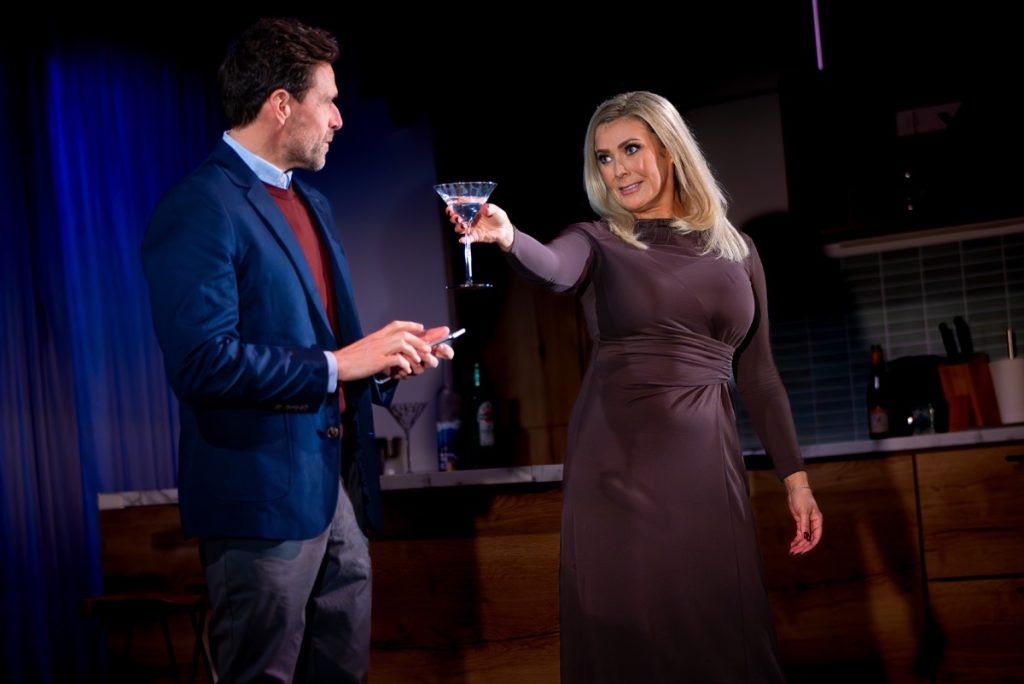
Allie is a recently divorced mum. She has just launched a tech start up and is trying to do that while being a single parent to a restless teenager. She needs cash so takes on Hedy, a colourful character, as a lodger. From that moment on life will never be the same as their apparently perfect arrangement begins to unravel. Some of you will already know that I am describing Single White Female (New Victoria Theatre, Woking), which you will know from the 1992 film with Bridget Fonda and Jennifer Jason Leigh, described as a ‘psychological erotic thriller’. Gordon Greenberg’s production, adapted for the stage by Rebecca Reid is cleverly updated with all the contemporary stuff, unsurprisingly dominated by stress and social media, smartly interwoven into John Lutz’s original novel, making it very relatable to modern life.
Lisa Faulkner, who is returning to the stage after twenty years, is compelling as Allie and she portrays her journey with an understated, subtle performance that is the perfect foil for Kim Marsh as Hedy, a woman whose smile could charm birds from the trees with utterly ruthless motives, to the extent that at several moments during the second act when you could feel, and hear, people in the audience trying to predict what would happen next and then gasp at the twists and turns which all build to a thrilling end.
Integral to making the show so believable and real to modern life is the role of Bella, Allie’s teenage daughter, specifically written for this adaptation. Those who have teen children will immediately identify the grumpy girl riddled with insecurities and a picture of capriciousness, moods that swing like a pendulum. Amy Snudden’s performance is brilliant and perfectly captures the teen world – the good, the bad and the annoying. Conversely, the inclusion of Bella’s character, which made the relationships between the three women so absorbing and complete, dilutes the need for the inclusion of Sam, Allie’s ex-husband, though Jonny McGarrity is excellent.
Greenberg gets a nice balance in his direction; it ebbs and flows skilfully, and Allie’s apartment which is the focus of Morgan Large’s set is cosy and comfortable but also claustrophobic which is ideal for how the production builds from neat and nice into something far more nefarious and nasty. Once it was over you could still sense the frisson of excitement, and shock, at how it had concluded with a hubbub of last nights conversation in Woking, a sure-fire sign this is a show that will continue to thrill audiences as the Uk tour moves on around the country. This is a bewitching femme fatale.
Single White Female – www.atgtickets.com
YLLANA
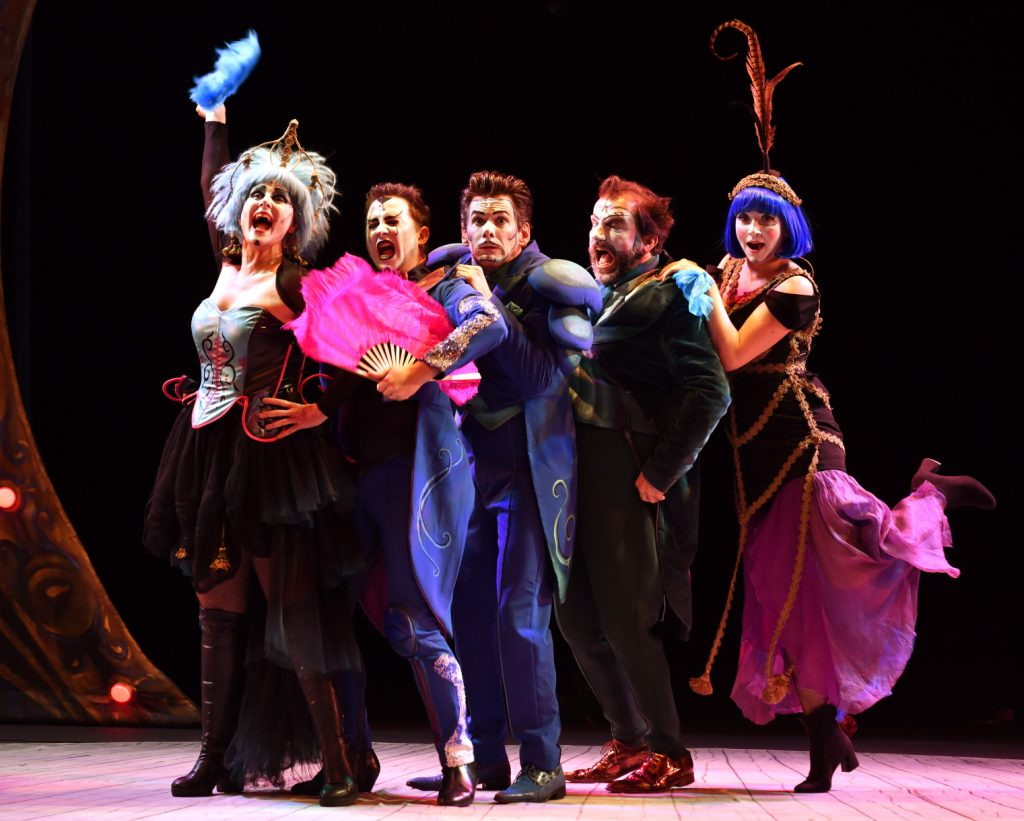
We all know ‘loco’ means mad, but as far as The Opera Locos is concerned, more like bizarre, crazy and life-affirming. Such is their current show, YLLANA. The Sadlers Wells stage features a semi-circular proscenium arch within the normal arch, which directs attention at once to the action. There are five colourful characters – Soprano, María Rey-Joly (soprano), Mezzo Soprano, Mayca Teba (mezzo soprano), Enrique Sanchez- Ramos (bass baritone) and Michael Kone (counter tenor) – all superb and all fabulously bonkers.
This is a love story between passionate proponents of their art. Soprano loves baritone, Alfredo, who has lost his original power, Tenor loves Counter Tenor and Mezzo falls for a man in the front row of the audience. All use the power of their arias to show their love, along the way citing Bizet, Puccini, Mozart, Verdi – and Frank Sinatra, Whitney Houston, Mika and A-Ha. Or, to put it another way, Carmen, Magic Flute, Turandot, Titanic, Rigoletto and Flower Duet, amongst others. There is interaction between all of them, but the conceit of the fading baritone who tries to court his love by singing – and failing to sing- Nessun Dorma is a recurring theme, as he cannot sustain the singing, thus disappointing his love. He turns to drink but then has a resurgence and gets his girl in the end – glorious! I feel that Nessun Dorma is not a love song, as the Prince’s slave is being tortured to reveal his name, but if one ignores that and assumes the Prince is singing to Turandot, then it is a love song. I have seldom heard it sung better.
The crafted costumes are fabulous, exaggerating aspects of their personalities, Baritone Alfredo has a beer belly, the ladies show their legs, Tenor Jesus Alvarez and Counter Tenor Michael Kone have exaggerated shoulders, all complementary to the marvellously OTT characters. ‘Loco’ by name and fantastically ‘loco’ by nature.
YLLANA – www.sadlerswells.com
Evening All Afternoon

Two women from different worlds and generations are thrown together. Sixty something Jennifer muses about getting old, and loses herself, deliberately, in everything she can to avoid having to come to terms with the loss of her mother. What throws her together with twenty something Jamaican American stepdaughter Delilah is a man, John. He being Jennifer’s husband, who recently became her betrothed. Anna Ziegler’s soft-hearted eighty-minute play, Evening All Afternoon (Donmar Warehouse), carefully and compassionately carves out a path of painstaking emotional disentanglement for the two women, the common denominator being bereavement and need to get support for their loss. Both struggle with trying to find, what is foolishly described to in modern day parlance, as “closure.”
Erin Kellyman’s Delilah is finding this new connection difficult. Her mother died young leaving a furnace of emotions ablaze with resentment and hurt, the thought of having to bond with another as incongruous as it is impossible in her eyes. In her own way Anastasia Hille’s Jennifer, though more worldly wise, is similarly confused and struggling to detach the umbilical cord from the maternal stranglehold that has haunted her for many years. Both women simmer with confusion and contradictions and on Basia Bińkowska’s minimalist set, with chairs, ladder and a couple of shelves, there is a distinct feeling we are peeping in on a fishbowl therapy session as each of them reveal how and why they are struggling to overcome conflicting emotions.
Grief is what unites them but the real struggle here is what it means to be a good mother. Which is like asking what is normal – there is no textbook answer for either. Zeigler’s writing, which for the most part is deft and perceptive, sometimes gets caught up in the weeds of over analysis, which coupled with moments of clumsy symbolism – rhinos at risk threw me into a frenzy of heavyweight bewilderment – make you think they have been included to create dramatic effect for what is a deeply thoughtful and sensitive piece. Neither Hille nor Kellyman require that – individually and together they turn in heartrending performances.
The initial moments when Hille messes up her approach to the recalcitrant teenager that Kellyman presents as crackle with discomfort and awkwardness. The resulting journey that takes them to a place of an adult-to-adult conversation is both witty and tender with a mutual realisation that they have more in common than not. Though their memories and recollections seem to be impaired or prejudiced by what they want to believe rather than any critical reality. After all a perfect mother does not exist and we never meet John.
Diyan Zora’s sensitive direction allows these two very fine actors to probe and blossom. Hille is a seasoned professional, and in my view much underrated, who beautifully portrays her conflicted persona, riven by guilt and doubt, while Kellyman, making her stage debut, is the perfect dichotomy of hard edged and confrontational, with the searing actuality of loss influencing her every word, the underlying distress there for all to see.
We all know ‘loco’ means mad, but as far as The Opera Locos, YLLANA (Sadler’s Wells) are concerned, more like bizarre, crazy and life-affirming. There are five colourful characters – Soprano, María Rey-Joly (soprano), Mezzo Soprano, Mayca Teba (mezzo soprano), Enrique Sanchez- Ramos (bass baritone) and Michael Kone (counter tenor) – all superb.
This is a love story between passionate proponents of their art. Soprano loves baritone, Alfredo, who has lost his original power, Tenor loves Counter Tenor and Mezzo falls for a man in the front row of the audience. All use the power of their arias to show their love, along the way citing Bizet, Puccini, Mozart, Verdi – and Frank Sinatra, Whitney Houston, Mika and A-Ha. Or, to put it another way, Carmen, Magic Flute, Turandot, Titanic, Rigoletto and Flower Duet, amongst others. The crafted costumes are fabulous, exaggerating aspects of their personalities, Baritone Alfredo has a beer belly, the ladies show their legs, Tenor Jesus Alvarez and Counter Tenor Michael Kone have exaggerated shoulders, all complementary to the marvellously OTT characters. And I have seldom heard Nessus Dorma sung better. Eat your heart out Pavarotti.
Evening All Afternoon – www.donmarwarehouse.com
The Signalman
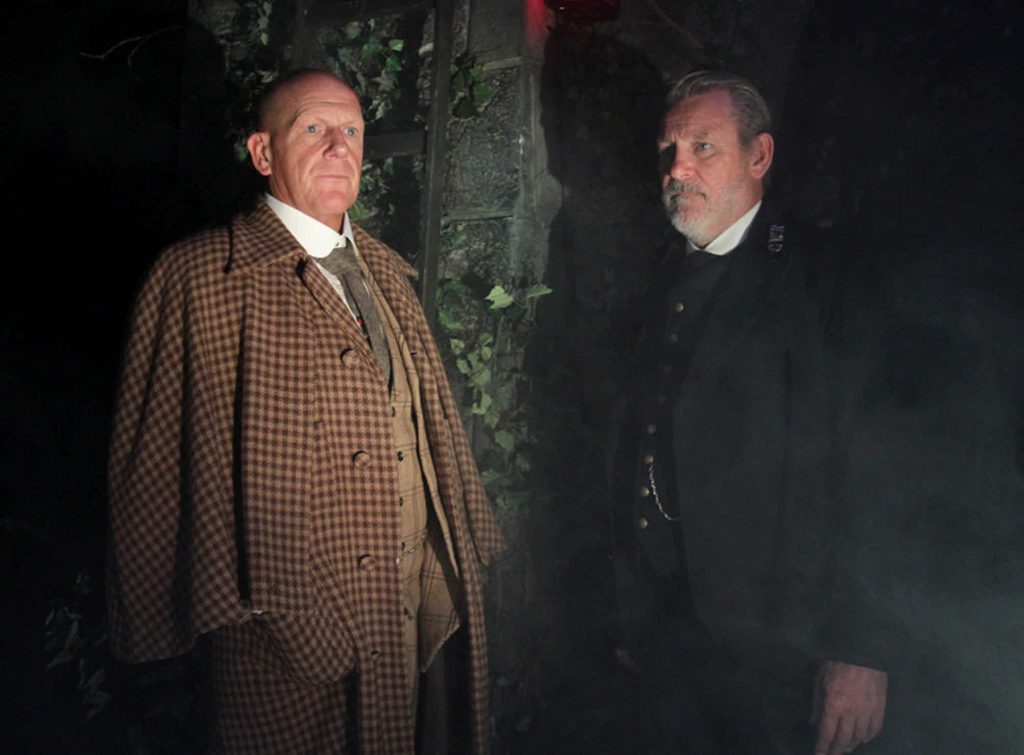
The Middle Ground Theatre Company production of The Signalman (Yvonne Arnaud, Guildford), this being a ghost story by Charles Dickens (adapted for the stage by Francis Evelyn), is storytelling of yesteryear. Imagine the scene – a small gathering around an open fire and a shanakee, sipping a pint of stout, begins to tell the tale of a railway signalman, who notices a mysterious traveller passing by his box. It is dark and tenebrous and the two men engage in conversation, mainly stories about the railways which then turn to tales of the supernatural. Another sip of stout and the shanakee is in full flow. Except in this case these two men do exist and the mystery man returns the following evening, at which point the signalman, now in a heightened state, begins to confess his fears for what the future holds. Simple enough and this being Dickens it is told in such a way as to fascinate and captivate. Simple, atmospheric and compelling. However, from the audience perspective, and me not wanting to reveal any spoilers, I shall be circumspect about what more detail I give you.
It twists and turns with the ending being particularly surprising and at one point my companion was so spooked she jumped out of her seat. I gently accused her of being a drama queen but there is no doubt she was shaken. The video projections add to the drama and for the most part are very effective – although the railway line through the tunnel was more ladder than rail track – evoking the gloom and grime of a grubby environment where all sorts of untoward things might happen. And when the set completely blacks out it is deliciously unnerving causing a deal of consternation in the audience. Such simplicity in the theatre, as with moments of complete silence where the characters refrain from any verbal communication and allow their face and bodies to convey their thoughts and feelings, are enthralling.
The two lead performances, Chris Walker (The Signalman) and John Burton (The Traveller) create natural and believable characters, the kind of chaps you can imagine meeting by a railway station on a gloomy night in Victorian England. Their portrayals are understated and neatly directed by Michael Lunney (who also designed the evocative Dickensian set). Walker is a tormented soul who slowly but surely disintegrates into a mess, battered by episodic confusion and upset. In sharp contrast Burton is full of bravado and begins with assurance and confidence but he too spirals downwards into a malaise of despondency. Together they are two very fine shanakees.
Evelyn’s adaptation, which has been slightly extended, captures the essence and psychological impact inherent in Dickens’ work and now this little-known story can be added to what is an extraordinary bibliography, this being another ghostly story.
The Signalman – www.middlegroundtheatre.co.uk

