
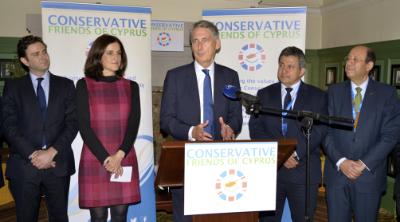

Foreign Secretary Philip Hammond said that the UK is “completely flexible” about its future as a guarantor power in Cyprus and “ready to consider any option that parties come up with”.
Addressing a ‘Conservative Friends of Cyprus’ (CFC) event at the margin of the Conservative Party’s annual conference in Manchester on Sunday evening, Mr Hammond also said that his government is working with international partners in order to financially underpin a settlement, helping to cover the “eye-watering” sums needed to settle outstanding property issues.
In an event attended by members of the British government, Conservative MPs and MEPs as well as members of the party and of the UK Cypriot community, the Foreign Secretary said that in a meeting in New York last week the UNSG special envoy Espen Barth Eide confirmed Hammod’s own feeling over the last 12 months “that the settlement of this long-running problem is now something which is genuinely within our grasp.”
The Foreign Secretary commented that “we have in President Anastasiades and Mr Akinci two people who get on well together, who have a clear objective to make a legacy of themselves of reuniting the island.” He continued by saying that there also exists the “acquiescence” of the Greek government, as well as “the active encouragement” of the Turkish government.
As he noted, he “rechecks” that every time he speaks to his Turkish opposite numbers, as had done on Sunday morning with the Turkish Foreign Minister. Hammond added that Prime Minister Cameron had “grilled” President Erdogan in New York last week on this issue.
As for the UK role, the Foreign Secretary said his country is determined to help in any way it can: “We are of course one of the guarantor powers of Cyprus’s constitution and we are completely flexible about our future role and relationship to Cyprus in that respect. If it helps, we will consider any option that parties come up with.
“We know that the resolution of outstanding property issues is likely to require considerable financial input and we have undertaken to work with our partners in the EU, with the United States, to ensure that international community is able to mobilise to support a settlement with the necessary financial underpinning” said Philip Hammond.
He commented that an “eye-watering sum” would probably be needed, but noted that he had talked about this to his American counterpart John Kerry “a couple of months ago” and they had both agreed that it is worth the financial support if a rare long-running problem in the region were to be solved. “I think you can rely on both the USA, the UK, the EU to come together to support a settlement,” he told the event.
Hammond said that following more effort over the next 4-5 months there is a possibility of a referendum next year in Cyprus on a solution: “It will be a historic moment. There is a window of opportunity now, if we miss it the stars may never align in the same way again… So I very much hope that we are on the brink of something really historic here.”
He also made a reference to “additional benefits” from a solution to the Cyprus issue, such as the “fundamental” change in the discussion between EU and Turkey a change in the way NATO works.
Philip Hammond described the relationship between Britain and Cyprus as “really very important”, pointing to the help provided by London to Nicosia in dealing with recent financial challenges, as well as to the close cooperation over the reform of the EU, as both countries are keen advocates of completing the single market in services.
He also praised the contribution that the Cypriot community in Britain makes to the country’s civic life and to political discussions.
Minister for Europe David Lidington told guests he genuinely believes that “what we have seen over the last 6 or 7 months is more hopeful, gives greater real cause for optimism than anything we have seen since the days of the Annan Plan or even before.”
President of the CFC Theresa Villiers, a cabinet member and north London MP, said the UK Government is “committed to do all it can to support Cypriots at this crucial time in the search for a solution” and added that the Cypriot community should be proud of the “significant role it played in delivering a Conservative government”.
Referring to the Conservative Friends of Cyprus she congratulated Chairman Jason Charalambous and founder Ian Twinn and their supporting team for successfully re-launching the organisation, commending their “real ambition to reach out” and ensure that strong relations with Cyprus are “top of the Conservative agenda.”
Charalambous said that Cyprus is “a strong and reliable ally to Britain, most pointedly within the EU,” and added that hope over the Cyprus issue settlement is on the horizon, with progress at very good and positive pace.
Conservative MEP Dr Charles Tannock said that after the election of Akinci as leader of the Turkish Cypriot community there has been “a completely different approach, far humbler and far more optimistic” by representatives of the so-called ‘TRNC government’.

