
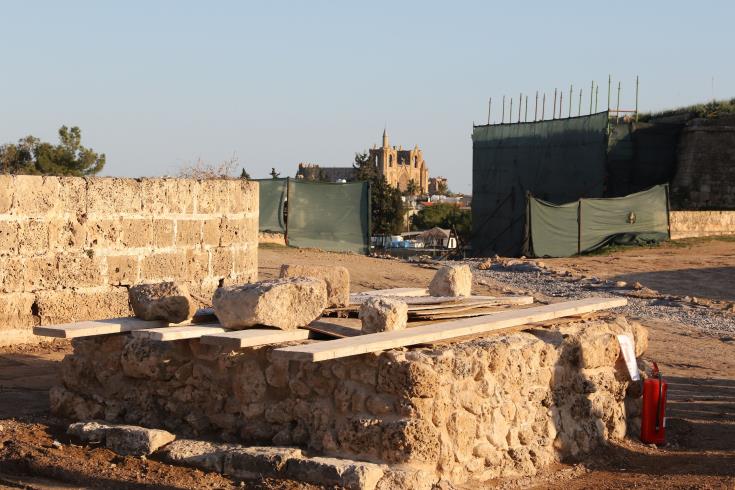

Joined by Jakhongir Khaydarov, the new Head of Office for UNDP in Cyprus, the Technical Committee on Cultural Heritage (TCCH) and UNDP conducted its first visit to the conservation sites in the Famagusta area within the framework of the “Support to cultural heritage monuments of great importance for Cyprus” project funded by the European Union (EU) and implemented by the United Nations Development Programme (UNDP).
During the visit, Khaydarov, members of the Technical Committee on Cultural Heritage and UNDP, toured the Kampanopetra and the Agios Epiphanios basilicas in Salamis as well as the opus sectile floor of the Saint Barnabas basilica in the area. The group then visited improvement works at the Martinengo bastion courtyard, where a team of experts composed of archaeologists and conservators, made up of both Greek Cypriots and Turkish Cypriots, are beginning Phase III of conservation works to structurally support, and physically protect the monument, a UNFICYP press release said.
Khaydarov said the beginning of conservation works at the Salamis archaeological site and the courtyard of the Martinengo Bastion “are the fruits of a very successful partnership between the Technical Committee on Cultural Heritage, UNDP and the European Union. Monuments and sites preserved and restored through this partnership are able to return to having a powerful role in building bridges between people.”
In his remarks, Takis Hadjidemetriou, Co-Chair of the Technical Committee on Cultural Heritage said that with the completion of the works in the surrounding area, the Martinego Bastion will be accessible to visitors. Martinego Bastion is the most important part of the walls of Famagusta and one of the most important examples of military architecture in the world. The Technical Committee on Cultural Heritage is proud of its contribution to the maintenance of the monument”.
On his part, Ali Tuncay, Co‐Chair of the Technical Committee on Cultural Heritage said “Salamis archaeological site and the historic walled city of Famagusta are both pearls of the Mediterranean. Protection of cultural heritage is a fundamental basis on which intercultural dialogue and cooperation can be established. As the Technical Committee on Cultural Heritage, we are dedicated to preserving this rich cultural heritage for future generations and as well as humanity”.
Since 2012, 88 cultural heritage sites island-‐wide have been conserved, structurally supported, physically protected or restored by TCCH and UNDP, with funding from the EU.
Approximately €22.4 million have been provided by the European Commission to implement the priorities of the Technical Committee on Cultural Heritage for the preservation of the island-wide cultural heritage in Cyprus. The European Union is the biggest supporter of the work of the Technical Committee on Cultural Heritage in Cyprus.