
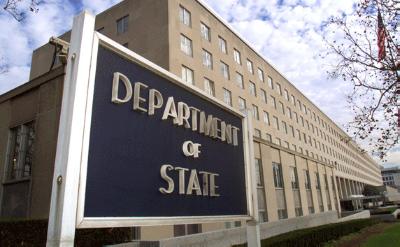

The 2015 State Department Report on Cyprus said the most significant problems in the Republic of Cyprus remained trafficking in persons for sexual exploitation and labour, police abuse and degrading treatment of persons in custody and asylum seekers, and violence against women, including spousal abuse.
The Cyprus 2015 Human Rights Report comprises two parts, one on the Republic of Cyprus, which refers to the government-controlled areas of the island, and one on “The area administered by Turkish Cypriots”, as the State Department calls the areas of the island occupied by Turkey since 1974. As it is underlined in the report, the US does not recognise “TRNC”, the Turkish Cypriot preudostate, unilaterally declared in 1983, “nor does any country other than Turkey”.
The State Department said in the report that the Republic of Cyprus is a constitutional republic and multiparty presidential democracy, noting that in 2013 voters elected President Nicos Anastasiades in free and fair elections. “In 2011 voters elected 56 representatives to the 80-seat House of Representatives in free and fair elections. Civilian authorities maintained effective control over the security forces,” it is added.
According to the report, other problems during the year included prison overcrowding, lack of separation of pretrial detainees from convicted criminals, prolonged detention of asylum seekers and irregular migrants in prison-like conditions and deportation of rejected asylum seekers before they had an opportunity to appeal their asylum decision. Moreover, lack of full access to and administration of some religious sites, government corruption, incidents of violence against children, instances of discrimination and violence against members of minority ethnic and national groups and societal discrimination against lesbian, gay, bisexual, transsexual and intersex (LGBTI) persons.
Moreover it is noted that the Cyprus government investigated and prosecuted corruption and officials who committed violations.
The report said, inter alia, that there were several allegations of police abuse during the year, and that “the ombudsman, who also acts as the country`s national preventive mechanism under the Optional Protocol to the UN Convention against Torture, received several complaints of maltreatment, discriminatory and degrading behaviour, including complaints of verbal, physical and sexual abuse, from inmates in the Central Prison.”
Furthermore, it is noted that prison and detention centre conditions, including detention centres for asylum seekers and undocumented migrants pending deportation, did not meet international standards, and prison overcrowding was a problem.
As regards property restitution, the report said that during the year, Turkish Cypriots filed 22 court cases, seeking to reclaim property located in the government-controlled areas, including 17 filed with the Supreme Court, and that of the Supreme Court cases, six applications challenging the Ministry of Interior`s decision to block the sale of properties were dismissed on technical or procedural grounds. The other cases were pending trial as of the end of the year.
Moreover, it is stated that during the year, the government initiated several investigations against public officials on suspicion of corruption, and the President publicly declared zero tolerance of corruption.
The report also said that there were reports of violence against Turkish Cypriots as well as some incidents of verbal abuse or discrimination against non-Greek Cypriots and that on November 16, protesting students threw rocks at several cars with Turkish Cypriot license plates in Nicosia and injured two of the occupants.
As regards the occupied areas, the report said that the most significant problems reported during the year included trafficking in persons, societal discrimination against lesbian, gay, bisexual, transgender and intersex (LGBTI) persons and absence of a system to handle asylum applications or protect the rights of asylum-seekers.
Other problems reported during the year included mistreatment of persons in detention and in prison, overcrowding in prisons and poor prison conditions, lack of separation of incarcerated adults and juveniles, limited access to some places of worship, vandalism and removal of religious icons from vacant places of worship, including some sites that were damaged, close to collapse, or had been converted to other uses.
Moreover, corruption and cronyism in the executive and legislative branches, domestic violence against women, restrictions on freedom of speech and expression and pressure and censorship against journalists that interfered with their objective reporting, and failure of authorities to introduce and enforce adequate labour health and safety standards.

