

War film is a film genre concerned with warfare, typically about naval, air, or land battles, with combat scenes central to the drama. Some of the greatest war films use war as a backdrop to look at larger issues such combat, survival, escape, camaraderie, sacrifice, the futility and inhumanity of battle, the effects of war on society, and the moral and human issues raised by war.
The best directors have used the war film genre to explore men at both their best and worst, and make no mistake; the war movie is almost always about men.
Finally, some war films – particularly those made during the classic 50’s and 60’s Hollywood – are simply adventure films with war providing a compelling setting and situation.
No matter what type of film, there’s no denying that the following list are some of the best war movies ever.
The Bridge on the River Kwai (1957)
David Lean’s much-lauded epic shuffles elegantly among three perspectives: that of Japanese commandant Saito (Sessue Hayakawa), the merciless overseer of a POW camp; British Col. Nicholson (Alec Guinness), Saito’s prisoner and stalwart rival; and U.S. Navy man Shears (William Holden), a cynical soldier who miraculously escapes from Saito’s camp, only to be conscripted to return and destroy the bridge the inmates are building.
It’s a big prestige picture that won seven Oscars including Best Picture and Best Director.
Paths of Glory (1957)
Paths of Glory deservedly launched Stanley Kubrick to the highest level of prestige.
A hill raid goes horribly awry, and a fearsome French general (George Macready) wants answers. Unable to accept low morale as the cause, he arbitrarily demands that three innocent soldiers stand trial for cowardice, with their outraged colonel (Kirk Douglas) serving as their defence attorney.
Lawrence of Arabia (1962)
A bored general staffer, T. E. Lawrence (Peter O’Toole, in the role that made him a star) talks his way into a transfer to Arabia. Once in the desert, he befriends Sherif Ali Ben El Kharish (Omar Sharif) and draws up plans to aid the Arabs in their rebellion against the Turks and the Ottoman Empire. No one is ever able to discern Lawrence’s motives in this matter: Prince Feisal (Alec Guinness) dismisses him as yet another “desert-loving Englishman,” and his British superiors assume that he’s either arrogant or mad. Using a combination of diplomacy and bribery, Lawrence unites the rival Arab factions of Feisal and Auda Abu Tayi (Anthony Quinn). After successfully completing his mission, Lawrence becomes an unwitting pawn of the Allies, as represented by Gen. Allenby (Jack Hawkins) and the diplomat Dryden (Claude Rains), who decide to keep using Lawrence to secure Arab cooperation against the Imperial Powers.
The film won seven Academy Awards, including Best Picture and Best Director.
The Great Escape (1963)
The Great Escape is the true story of Allied prisoners plotting to break out of Nazi detention camp. Bartlett (Richard Attenborough) is the British officer who masterminds the escape. Out of 250 prisoners, only 76 manage to escape, and the number soon dwindles to two dozen. Hilts (Steve McQueen) and company must get through Nazi occupied territory. McQueen rides a motorcycle through heavy gunfire in a spectacular action sequence to avoid certain death at the hands of the enemy.
Dr. Strangelove or: How I Learned to Stop Worrying and Love the Bomb (1964)
Stanley Kubrick’s painfully funny take on Cold War anxiety is one of the fiercest satires of human folly ever to come out of Hollywood.
Royal Air Force Captain Lionel Mandrake (Peter Sellers), timidly trying to stop a nuclear attack on the USSR ordered by an unbalanced general (Sterling Hayden); the ineffectual and perpetually dumbfounded U.S. President Merkin Muffley (Sellers), who must deliver the very bad news to the Soviet premier; and the titular Strangelove (Sellers) himself, a wheelchair-bound presidential adviser with a Nazi past.
A Bridge Too Far (1977)
It’s late 1944, and the Allied armies are confident they’ll win the World War II and be home in time for Christmas. What’s needed, says Field Marshal Montgomery, is a knockout punch, a bold strike through Holland, where German troops are spread thin, that will put the Allies into Germany. Paratroops led by British Major General Robert Urquhart (Sean Connery) and American brigadier General James Gavin (Ryan O’Neal) will seize a thin road and five bridges through Holland into Germany, with paratroops led by Lieutenant Col. John Frost (Sir Anthony Hopkins) holding the most critical bridge at a small town called Arnhem. Over this road shall pass combined forces led by British Lieutenant Gen. Brian Horrocks (Edward Fox) and British Lieutenant Col. Joe Vandeleur (Michael Caine). The plan requires precise timing. It also has one critical flaw: Instead of a smattering of German soldiers, the area around Arnhem is swarming with crack SS troops. Disaster ensues.
The Deer Hunter (1978)
The Deer Hunter was co-written and directed by Michael Cimino about a trio of steelworkers whose lives were changed forever after fighting in the Vietnam War. The three soldiers are played by Robert De Niro, Christopher Walken, and John Savage, with John Cazale (in his final role), and Meryl Streep, playing supporting roles.
The story takes place in Clairton, Pennsylvania, a working-class town south of Pittsburgh, and in Vietnam.
The film won five Academy Awards.
Apocalypse Now (1979)
Fans of director Francis Ford Coppola know this to be his last fully realized work.
In Vietnam in 1970, Captain Willard (Martin Sheen) takes a perilous and increasingly hallucinatory journey upriver to find and terminate Colonel Kurtz (Marlon Brando), a once-promising officer who has reportedly gone rogue. In the company of a Navy patrol boat filled with street-smart kids, a surfing-obsessed Air Cavalry officer (Robert Duvall), and a crazed freelance photographer (Dennis Hopper), Willard travels further and further into the heart of darkness.
Platoon (1986)
Chris Taylor (Charlie Sheen) leaves his university studies to enlist in combat duty in Vietnam in 1967. Once he’s on the ground in the middle of battle, his idealism fades. Infighting in his unit between Staff Sergeant Barnes (Tom Berenger), who believes nearby villagers are harbouring Viet Cong soldiers, and Sergeant Elias (Willem Dafoe), who has a more sympathetic view of the locals, ends up pitting the soldiers against each other as well as against the enemy.
The movie was written and directed by Oliver Stone, who fought in Vietnam.
Full Metal Jacket (1987)
Stanley Kubrick’s film concentrates on a group of raw Marine volunteers. The first half details the volunteers’ harrowing boot-camp training under the profane, power-saw guidance of drill instructor Sgt. Hartman (R. Lee Ermey).
Part two takes place in Nam, as seen through the eyes of the now thoroughly indoctrinated marines.
Schindler’s List (1993)
Steven Spielberg’s film stars Liam Neeson as Oskar Schindler, a German businessman in Poland who sees an opportunity to make money from the Nazis’ rise to power.
A remarkable work by any standard, this searing historical and biographical drama is about a Nazi industrialist who saved some 1,100 Jews from certain death in the concentration camps. Marked by a brilliant screenplay, and three staggeringly good lead performances (Neeson, Ben Kingsley and Ralph Fiennes) and an attitude toward the traumatic subject matter that is both passionately felt and impressively restrained, this is the film that won over audiences and critics alike and went on to win seven Oscars including Best Film and Best Director.
Principal photography took place in Kraków, Poland, over the course of 72 days in 1993.
Saving Private Ryan (1998)
Steven Spielberg’s WWII drama weds an intimate story to the sweep of history.
Captain John Miller (Tom Hanks) takes his men behind enemy lines to find Private James Ryan, whose three brothers have been killed in combat. Surrounded by the brutal realties of war, while searching for Ryan, each man embarks upon a personal journey and discovers their own strength to triumph over an uncertain future with honour, decency and courage.
The Thin Red Line (1998)
Directed by Terrence Malick, the film is an adaptation of James Jones’s 1962 novel about the battle for Guadalcanal and how war reveals the compassion and violence within nature itself. Breath – taking shots of grass, trees and birds compete with equally stunning vistas of men lunging into the slaughter of combat. Wall-to-wall voiceovers ruminate about evil and love while the on-screen actors play out variations on the same.
Downfall (2004)
Charting the last 10 days of Hitler’s life, from his 56th birthday on April 20th, 1945 to his suicide on April 30th, the film uses multiple characters to show the chaos of a country coming apart at the seams, from Hitler’s henchman under the streets of Berlin, to the soldiers and civilians fighting and dying as the Soviet Army ravaged the city above.
Downfall takes place almost entirely inside the bunker beneath Berlin where Hitler and his inner circle spent their final days, and died. It ventures outside only to show the collapse of the Nazi defense of Berlin, the misery of the civilian population and the burning of the bodies of Hitler, Eva Braun, and Joseph and Magda Goebbels.
The film was based in part from Traudi Junge’s true story, from her memoirs, Until the Final Hour.
Valkyrie (2008)
A proud military man, Col. Claus von Stauffenberg (Tom Cruise) is a loyal officer who serves his country all the while hoping that someone will find a way to stop Hitler before Europe and Germany are destroyed. Realizing that time is running out, he decides that he must take action himself and joins the German resistance. Armed with a cunning strategy to use Hitler’s own emergency plan – known as Operation Valkyrie – these men plot to assassinate the dictator and over-throw his Nazi government from the inside. With everything in place, with the future of the world, the fate of millions and the lives of his wife and children hanging in the balance, Stauffenberg is thrust from being one of many who oppose Hitler to the one who must kill Hitler himself.
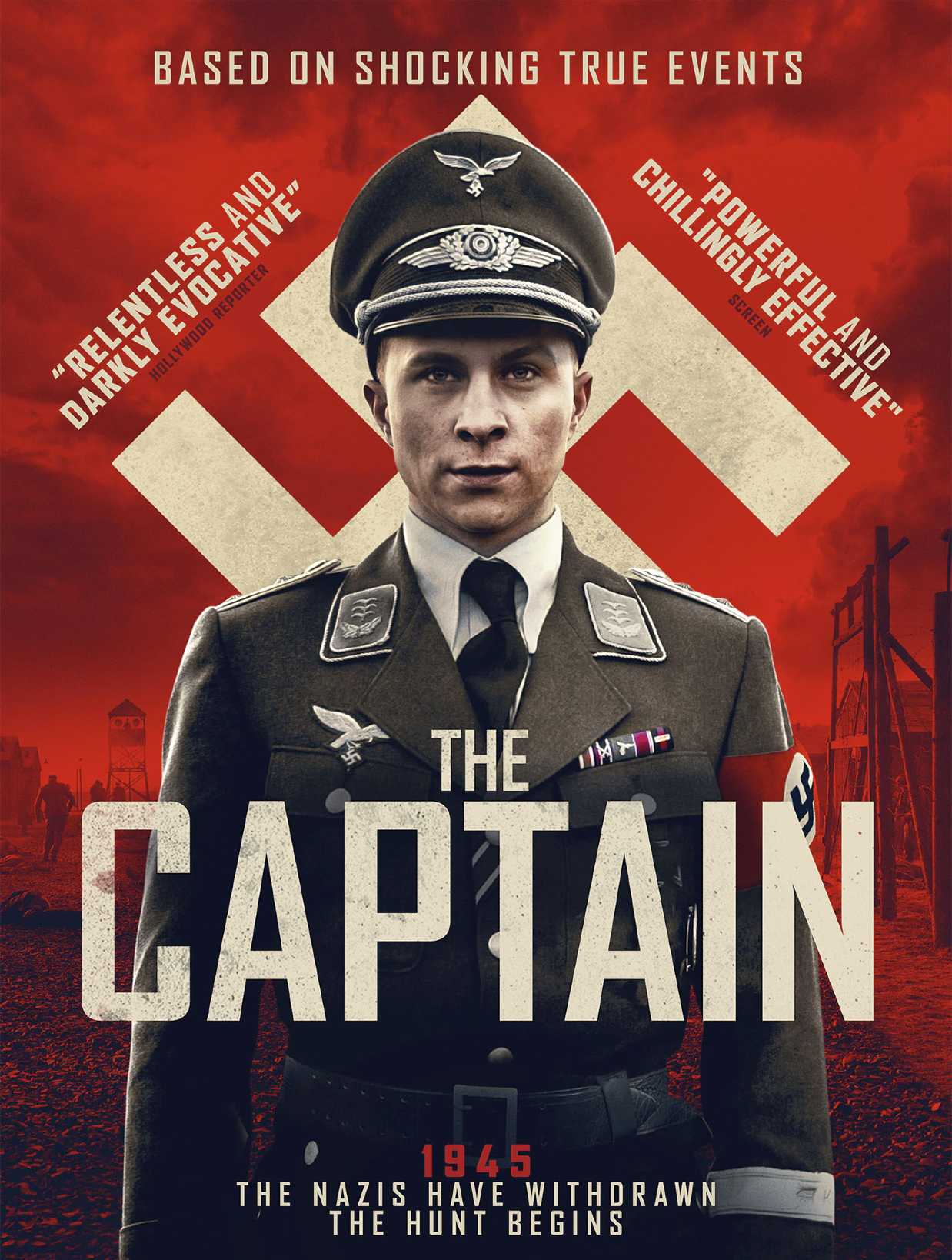
The Captain (2017)
Based on a true story – a German army deserter finds a Nazi captain’s abandoned uniform during the final weeks of World War II. Emboldened by the authority it suddenly grants him, he amasses a band of stragglers that cedes to his every command – (despite the suspicions of some). Citing direct orders from Hitler himself, he soon takes command of a camp that holds German soldiers accused of desertion – and begins to dispense harsh justice.
The Captain makes chillingly persuasive points about the dark side of human nature – and underscores how little certain tendencies ever really change.
Source: timeout.com, rottentomatoes.com, pastemagazine.com, ranker.com and variety.com

