

Themistocles
Themistocles was an Athenian politician and general. During the first Persian invasion of Greece he fought at the Battle of Marathon (490 BC) and was possibly one of the ten Athenian strategoi (generals) in that battle.
In the years after Marathon, and in the run-up to the second Persian invasion of 480–479 BC, Themistocles became the most prominent politician in Athens. He continued to advocate for a strong Athenian navy, and in 483 BC he persuaded the Athenians to build a fleet of 200 triremes. During the second invasion, he effectively commanded the Greek allied navy at the battles of Artemisium and Salamis in 480 BC.
Due to his subterfuge, the Allies successfully lured the Persian fleet into the Straits of Salamis, and the decisive Greek victory there was the turning point of the war. The invasion was conclusively repulsed the following year after the Persian defeat at the land Battle of Plataea.
After the conflict ended, Themistocles continued his pre-eminence among Athenian politicians. However, he aroused the hostility of Sparta by ordering the re-fortification of Athens, and his perceived arrogance began to alienate him from the Athenians. In 472 or 471 BC, he was ostracised, and went into exile in Argos. The Spartans now saw an opportunity to destroy Themistocles, and implicated him in the alleged treasonous plot of 478 BC of their own general Pausanias. Themistocles thus fled from Greece. Alexander I of Macedon temporarily gave him sanctuary at Pydna before he travelled to Asia Minor, where he entered the service of the Persian king Artaxerxes I. He was made governor of Magnesia, and lived there for the rest of his life.
Miltiades
Miltiades was a brilliant Athenian military strategist and statesman who successfully brought about Athenian victory over the Persians at the Battle of Marathon.
He was chief magistrate under the tyranny at Athens in 524 BC, and in 516, with the tyrants’ support, he went to seize power in the Chersonese area of Thrace. Shortly afterward he captured Lemnos. But the advancing power of Persia stopped this portion of his adventuresome career.
Because of his unrivalled experience in Persian warfare, the people elected him one of the 10 generals who took office in July 490, when the Persian fleet was already on the way.
When the Persian army landed at the Bay of Marathon, Miltiades proposed in the Assembly that the Athenians provide themselves with supplies and set out and meet the enemy at once instead of holding Athens and waiting for help from Sparta. His proposal was adopted. On the evening after the Persian landing, heavily armed Athenian infantry moved into the Plan of Marathon and blocked the Persian advance. The following day the Persian army moved into position and offered battle.
By this time 1,000 Plataeans had joined the 10,000 or so Athenians, and it was not known whether aid was coming from Sparta; yet Miltiades advised engagement. The voting of the 10 generals was equal, but the polemarch, Callimachus, broke the tie in favour of Miltiades. While Miltiades waited for an opportunity to meet the enemy under favourable terms, news came that the Spartans would march out when the moon was full. But before the Spartans arrived, Miltiades saw a good opportunity and at dawn ordered an attack. He was successful.
Miltiades took command of a naval offensive in the Cyclades in 489. In an unsuccessful attack on Paros, he was wounded. He died soon afterward as a result of his wound.
Leonidas
Leonidas I, Spartan king whose stand against the invading Persian army at the pass of Thermopylae in central Greece is one of the enduring tales of Greek heroism, invoked throughout Western history as the epitome of bravery exhibited against overwhelming odds.
In 480 Leonidas commanded the small Greek force that resisted the advance through Thermopylae of the vast army of the Persian king Xerxes. For two days Leonidas withstood Persian attacks; he then ordered most of his troops to retreat, and he and his 300-member royal guard fought to the last man. This episode made a deep impression on the Greek imagination and gave rise to the legend that Spartans never surrendered.
Cimon of Athens
Cimon, Athenian statesman and general who played an active part in building up the Athenian empire in the period following the Greco-Persian Wars and whose conservatism and policy of friendship with Sparta were opposed to the policy of Pericles.
His conspicuous valour in the victorious sea fight with the Persians at Salamis led soon to his election as strategus – one of Athens’ 10 annual war ministers and generals. In 478 he helped the Athenian statesman and general Aristides to secure the transference from Sparta to Athens of the leadership of the Greek maritime states, which had been recently liberated from Persia, and he became the principal commander of the Delian League.
Epaminondas of Thebes
Epaminondas was a Greek general of Thebes and statesman of the 4th century BC who transformed the Ancient Greek city-state of Thebes, leading it out of Spartan subjugation into a pre-eminent position in Greek politics. In the process he broke Spartan military power with his victory at Leuctra and liberated the Messenian helots, a group of Peloponnesian Greeks who had been enslaved under Spartan rule for some 230 years after being defeated in the Messenian War ending in 600 BC.
A mere twenty-seven years after his death, a recalcitrant Thebes was obliterated by Alexander the Great. Thus Epaminondas is today largely remembered for a decade of campaigning that sapped the strength of the great city-states and paved the way for the Macedonian conquest.
Seleucus Nicator
Seleucus served in Alexander’s campaigns; rising to high command. He was arguably the most successful of the so-called Diadochi (“Successors”). He fought but eventually came to agreement with Chandragupta Maurya, the great Indian leader; giving-up the Punjab in return for 500 war elephants. With these he helped defeat Antigonus One-Eyed at the battle of Ipsus, the greatest battle of the Successor Wars. He ended up with the largest portion of the former Persian Empire; before defeating another rival Diadochi, Lysimachus, at the Battle of Corupedion at the age of 79! At the time of his death, he was the titular ruler of all of Alexander’s Empire except Egypt.
Antigonus One-Eyed
The most successful of the Diadochi in the first 20 years of conflict following the death of Alexander, Antigonus Monophthalmus (“One-Eyed”) nearly reunited the dead conqueror’s vast empire under his leadership. He faced and defeated the equally brilliant Eumenes of Cardia, who led an army that included veterans of Alexander’s army. He was known for innovative tactics as well as audacious and rapid marches, even in the dead of winter; catching his foes unprepared. He was already old (nearly 60) when Alexander died, or might have achieved far more.
Pyrrhus of Epirus
Upon becoming ruler at the age of 12, Pyrrhus allied himself with Demetrius, son of Antigonus I Monophthalmus of Macedonia. Dethroned by an uprising in 302 BC, Pyrrhus fought beside Demetrius in Asia and was sent to Alexandria as a hostage under the treaty between Ptolemy I Soter and Demetrius. Ptolemy befriended Pyrrhus and in 297 restored him to his kingdom. At first Pyrrhus reigned with a kinsman, Neoptolemus, but soon he had his colleague assassinated.
In 294 he exploited a dynastic quarrel in Macedonia to obtain the frontier areas of Parauaea and Tymphaea, along with Acarnania, Ampholochia, and Ambracia. Corcyra and Leucas were given to him in a marriage dowry. Next, he went to war against his former ally, now Demetrius I Poliorcetes of Macedonia. Pyrrhus took Thessaly and the western half of Macedonia and relieved Athens from Demetrius’s siege, but was driven back into Epirus by Lysimachus in 284.
In 281 Tarentum asked for Pyrrhus’s assistance against Rome. He crossed to Italy with about 25,000 men, and in 280 won a complete, if costly, victory over a Roman army at Heraclea. In 279 Pyrrhus, again suffering heavy casualties, defeated the Romans at Ausculum in Apulia. He then crossed to Sicily and, as “king of Sicily,” conquered most of the Punic province except Lilybaeum. However, his despotic methods provoked a revolt of the Greek Sicilians, and in 276 he returned to Italy. In 275 he suffered heavy losses in a battle against Rome at Beneventum.
The next year he defeated the new Macedonian ruler, Antigonus II Gonatas, whose troops hailed Pyrrhus as king. Suddenly abandoning Macedonia, however, he launched an unsuccessful attack on Sparta to restore Cleonymus (272). Pyrrhus was killed in a night skirmish in the streets of Argos.
Philip II of Macedon
Philip II reigned over Macedonia from 359 to 336 BC He became the head of an empire that was expanded by his son and successor, Alexander the Great.
He used skilled military and diplomatic tactics to expand his country’s territory and influence, and ended up dominating almost of all of his neighbouring Greek city-states. He was assassinated in July 336, at the approximate age of 46, and was succeeded by his son Alexander.
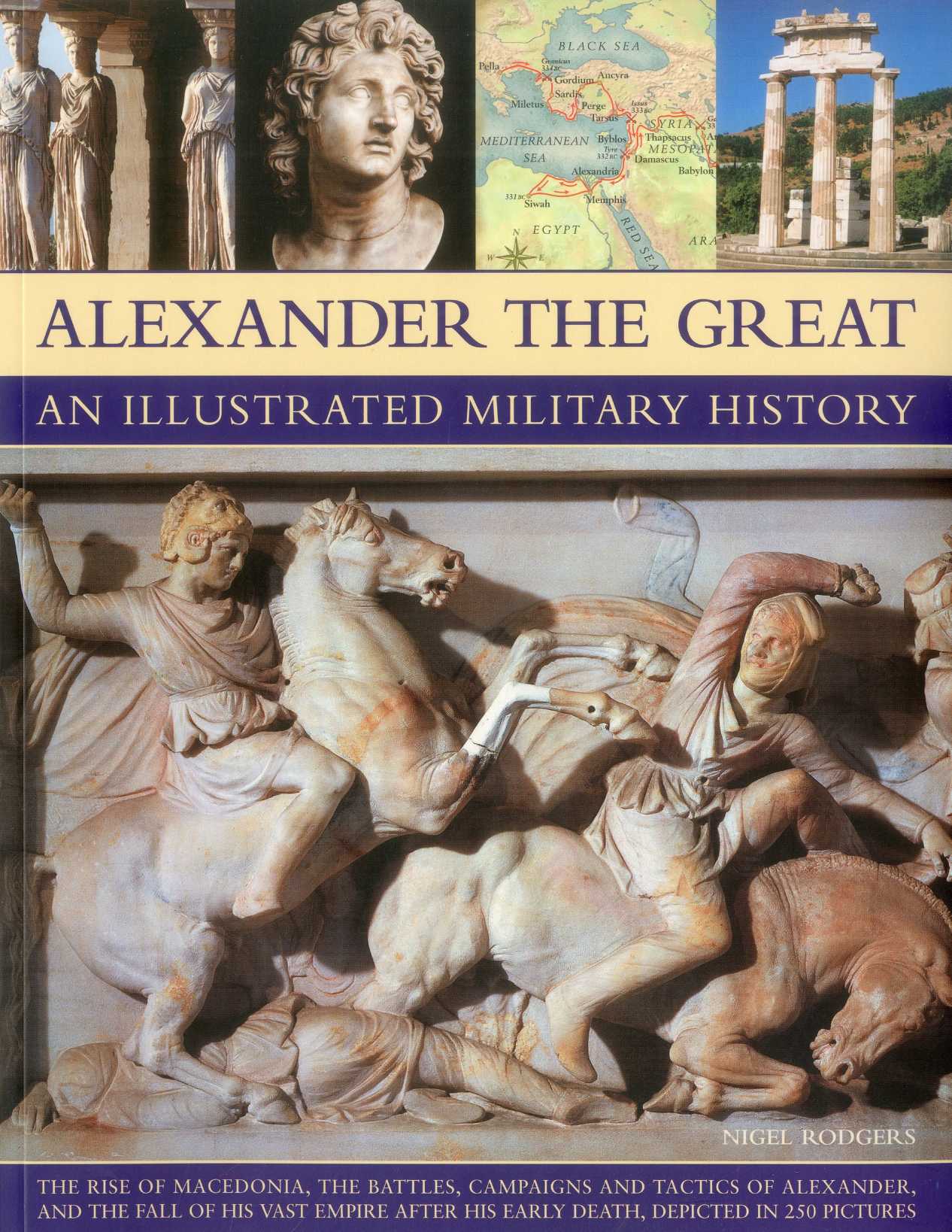
Alexander the Great
By every measure of generalship Alexander excelled all others. His performance set the bar by which all others generals have been measured ever since. In battle or in siege, he was ever victorious; leading his army in four very great battles and as many great sieges. He habitually led from the front, which makes the control he exercised in battle all the more impressive.
Strategically, his campaigns were masterfully conducted; so much so that he made it look easy.
A master of logistics, in 10 short years he crossed the ancient world, conquering an empire that stretched from the Adriatic Sea to the Indus River in India; and from the Danube River to the upper-reaches of the Nile. Only once, in Gedrousia, did his army run short on supplies; and that because plans to supply his forces by sea came awry. Not only a great commander of war, he was a very great leader of men. Even his enemies, once defeated, admired and joined him as faithful subjects. His charisma is unmatched, and his army was fiercely devoted to their leader. They followed him across the known world, through scorching deserts and over the highest mountains in the world. In India they found themselves in an alien land, facing monstrous beasts the like of which men of the West had never seen (elephants). Yet they never lost confidence in their young king-and-commander; and he led them to his greatest tactical masterpiece at the Hydaspes River against King Porus. Finally, exhausted, they refused to march further east; his only defeat. Had he lived longer (he died at 33) he might well have conquered both Carthage and Rome.
Source: deadliestblogpage.wordpress.com en.wikipedia.org britannica.com

