

“Apart from the known and the unknown, what else is there?”
– The Homecoming
Michael Caine tells the story of a fellow struggling actor friend, in the provincial English theatre of the 1950s. He was called David Baron and he confided to Caine that he was going to start writing plays using his real name. “What’s your real name?”, Caine asked him. “Harold Pinter” came the reply.
Pinter comes from an Ashkenazi Jewish lineage from Odessa and Poland, who settled in East London. He was evacuated many times during the wartime London bombings (Blitz) of 1940-1941. This life-and-death intensity left Pinter with profound memories of loneliness, bewilderment, separation and loss: themes that appear in his work.
Over the next 50 years, he wrote 29 plays, 15 dramatic sketches, several film screenplays and was awarded the 2007 Nobel Prize in Literature. The word ‘Pinteresque’ entered the Oxford English Dictionary, meaning: “having a sense of menace and featuring dialogue marked by many pauses.”
Impact
I was bowled over by Pinter’s plays at school. Alongside the canon of Macbeth and Pride and Prejudice, we studied The Dumb Waiter. We were delighted by the sinister, punchy banter of Ben and Gus: “Aston Villa”, “Macaroni Pastitsio” and “Scampi!” were not words we normally found in literature. We could relate.
Perennially revived, plays such as The Homecoming, Betrayal and The Birthday Party are classic audience favourites. As well as piercing dialogue, Pinter had a comic flair for slapstick, such as the fast-paced exchanging of hats in The Caretaker. Pinter appropriated this from Samuel Beckett’s Waiting for Godot. Beckett had himself borrowed this device, honouring the 1930s Marx Brothers films.
Politics
Pinter loved Bach, cricket, theatre and fighting injustice. He became a vocal critic of the West and had an anxiety about its influence in the world. Contrasting the muscular style of his late political works (he died in 2008), with the lyrical ambiguity of his early dramas, Pinter said, “When writing about war, about bombs being dropped: you don’t bugger about, you just write it as it is.”
With the great American playwright Arthur Miller, Pinter went to Turkey for the writers’ organisation, PEN International, to support persecuted writers. At a reception in the American Embassy, the Ambassador excused Turkish repression, saying, “Mr Pinter, you must understand the military reality, the diplomatic reality, the political reality.” Pinter replied, “The reality I’m talking about is the reality of an electric current on your genitals.” The shocked Ambassador stuttered, “Sir, you are a guest in my house.” Pinter (bad cop) and Miller (good cop) were immediately escorted off the premises. They had to hitch a lift from the French Ambassador to get to their hotel – via the French Embassy for a glass of champagne.
Theatre
Pinter’s late play, Mountain Language, is a lean, biting drama about the persecution of the Kurds in Turkey, and the ban on their language. After its National Theatre run, it was staged, in a Kurdish translation, in Pinter’s native East London. A performance that he himself attended, as a guest of the Kurdish and Middle Eastern Women’s Organisation.
Pinter spoke favourably about European theatre audiences, comparing them to English ones: “In Holland, or France, nobody coughs at the theatre. But, back home, that’s all you hear. There’s a distinctive contempt that the English have for the theatre.”
When Pinter won the Nobel Prize, he received this note from fellow East London playwright and friend, Arnold Wesker: “Congratulations. Glad they chose one of the Hackney Jewboys.”
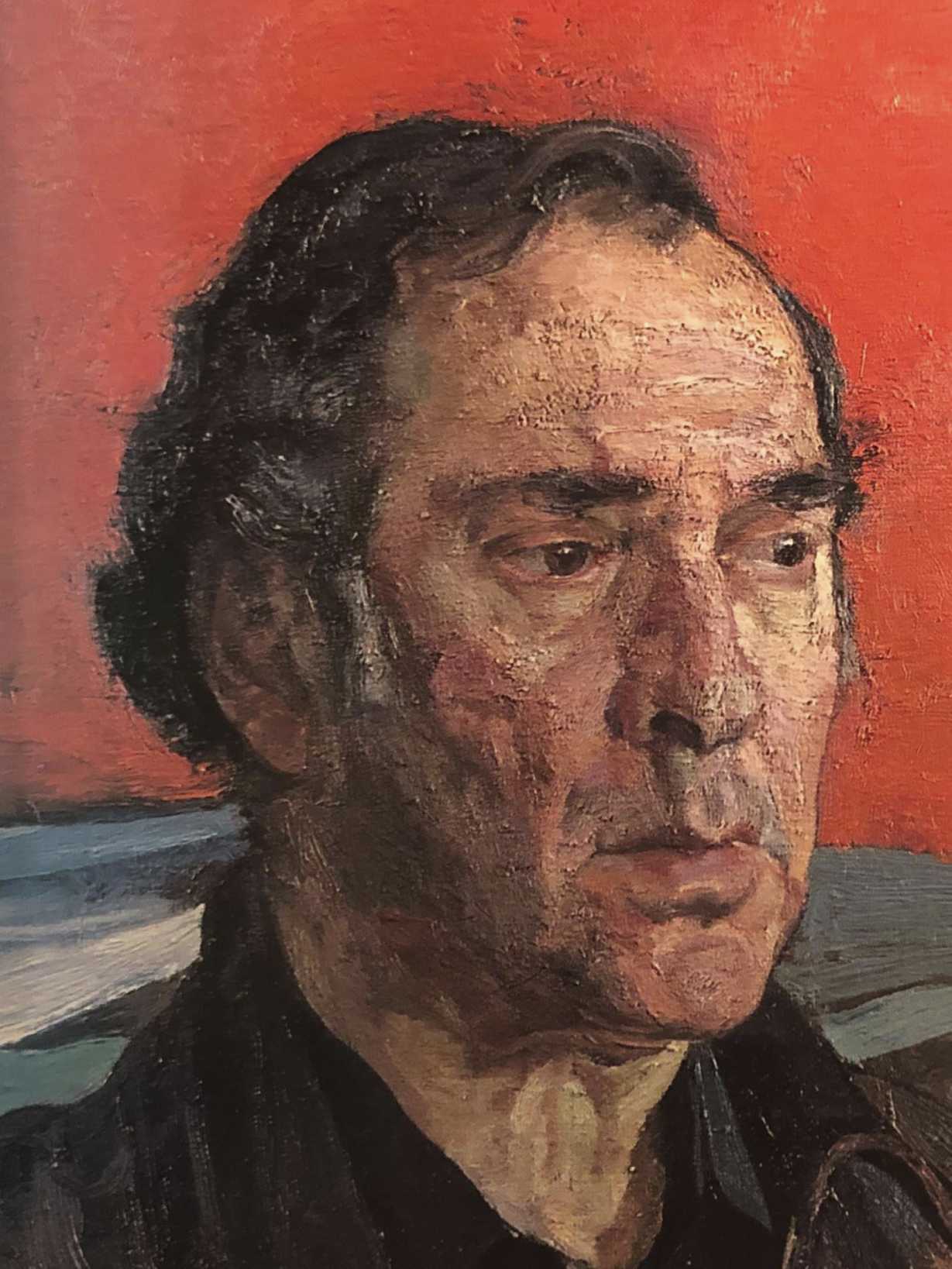
(Painting of Harold Pinter by Justin Mortimer, National Portrait Gallery)
James Neophytou
