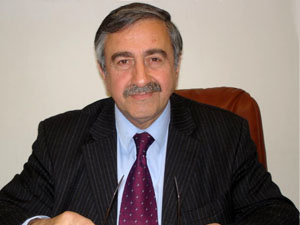

They will be meeting twice a week”, Turkish Cypriot daily Kibris newspaper (09.06.16) reports that Turkish Cypriot leader Mustafa Akinci has argued that the Turkish Cypriot side discusses seriously a federal solution at the negotiating table. Upon his return yesterday to the occupied area of Cyprus after his meeting with President Anastasiades within the framework of the negotiations for finding a solution to the Cyprus problem, Akinci was asked to comment on the allegation that the positions of the Turkish side at the negotiating table aim at a confederation. “The issue of the confederation has started coming before us in an unnecessary and meaningless manner”, he argued noting that the confederation could constitute a limited and narrow cooperation between two separate, independent and recognized states. He added:
“The unitary state is the opposite of the confederation. We could also come out and allege that the proposals of the Greek Cypriot side are close to the unitary state. We did not do this. As Turkish side we preferred to discuss these issues at the negotiating table. We want to continue behaving in this manner. Saying that some thoughts we put forward aim at a confederation, spreading this and ensuring that it is conveyed to the public in this manner is not the correct stance. There is no such reality. Whatever we do is in harmony to the Framework Agreement of the 11th of February 2014. Whatever we do are proposals in harmony to the spirit of a federal structure. We are aware of the fact that what is feasible on this island is a bi-zonal bi-communal federation of two founding states based on political equality. The proposals we submit should not be described as confederation. There is no such intention and stance. We are aware of the fact that this is not possible. However, the other side should stay away from unitary state approaches. We will not establish a unitary state in Cyprus. We will establish a united federal Cyprus”.
Akinci went on and said that the leaders will be meeting every Tuesday and Friday in June and that during the meeting of the 17th of June they will discuss the authorities of the federal government and look for convergences on remaining points of disagreement as regards this issue. He noted that they will also meet on the 1st of July and that they will prepare a similar program for July as well.
Referring to the issue of the Greek Cypriot negotiator, Akinci recalled that the voting for electing the President of the UN General Assembly, in which the Greek Cypriot negotiator Ambassador Andreas Mavroyiannis is a candidate, will be held on 13 June and added: “If Mavroyiannis is elected there will be an issue of appointing a new negotiator by the Greek Cypriot side. If he remains at his duty, it will continue with him. Of course this issue concerns the south. They will decide who their negotiator will be, but this is also a part of the agenda. After the 13 [of June] we will see what will happen”.
Akinci said that as a person who had many times underlined how important the period by the end of the year is, yesterday he established that all sides have the same sensitivity and expressed his satisfaction with this. “I can say that both Mr Anastasiades and the UN exhibit the same understanding on the issue of using this period of time in the most productive manner, of finding a solution by the end of the year if this is possible and of not transferring the problem to the future generations”, he noted describing this common understanding as “extremely important” for him.
Replying to a question regarding the preparation of a joint document with the points of disagreement between the two sides, Akinci argued: “There was a common understanding that the preparation of such a document is not needed. We know where convergences exist and where disagreements exist. Of course, we could continue and prepare these by ourselves for ourselves. However, it would be wise for us to concentrate on the points of disagreement. This is what we decided to do. We will not attempt to prepare a new document. This is not necessary”.