
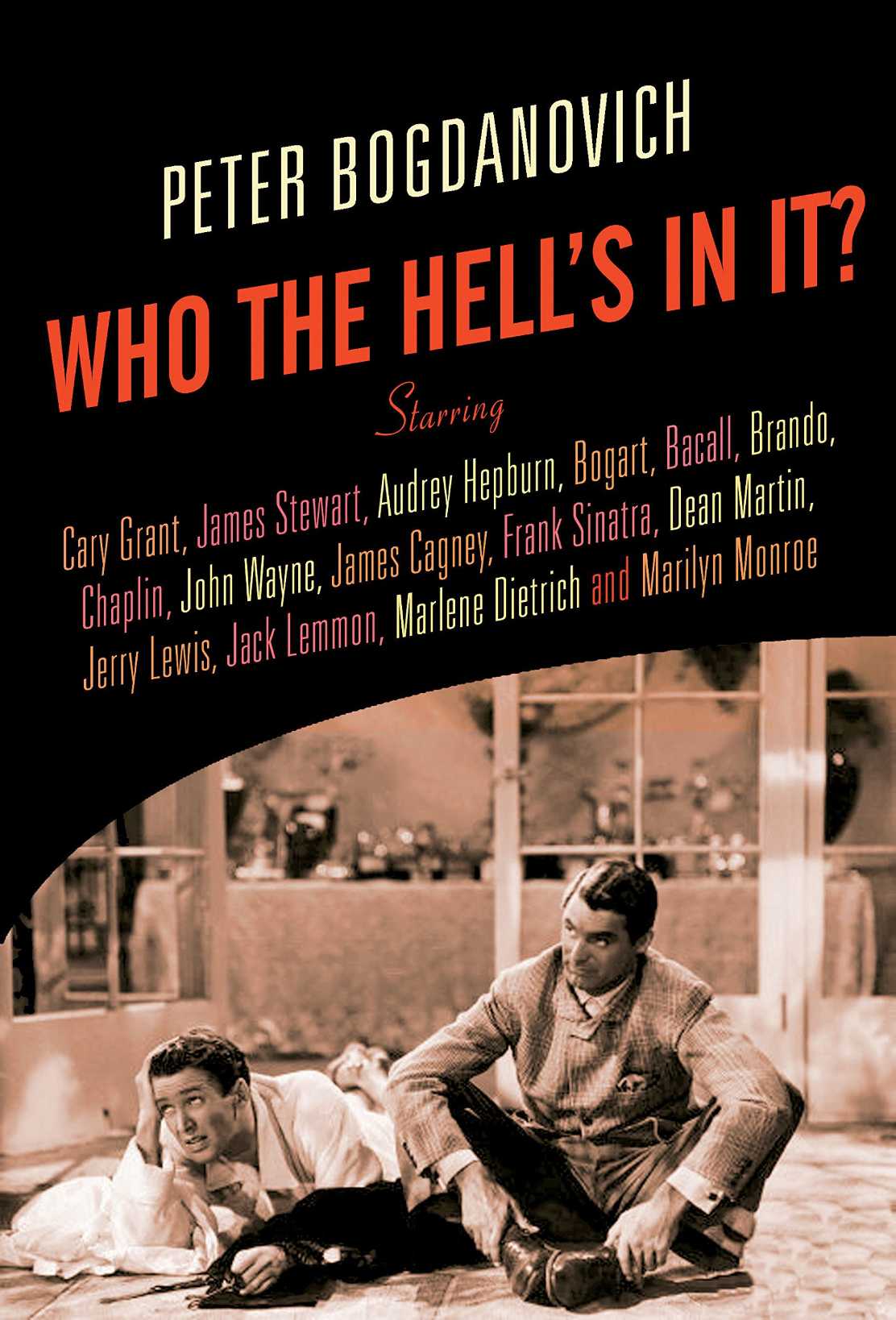

Just as he did with Who The Devil Made It?, Peter Bogdanovich is keeping history alive with Who The Hell’s In It? He was there at the crossroads, between the Old and New Hollywoods, as an actor, then as a repertory programmer, a critic, a director, and a confidante. And always as a fan, whose love for movies has only increased over the years. There are so many wonderful memories contained in these pages, so many lovingly rendered details, so many engrossing stories. And somehow, all of the actors and actresses here, from Brando to Clift, from John Wayne to John Cassavetes, seem at once human and larger than life. Who The Hell’s In It? is indispensable – Martin Scorsese
From Peter Bogdanovich – director, screenwriter, actor, and cinema scholar – 26 fascinating portraits of Hollywood’s most acclaimed movie actors and actresses: stars whom he has known, admired, and occasionally worked with.
With an acute and affectionate eye, Bogdanovich shows us Marlon Brando, refusing to play the same from one picture to the next, yet ever recognisable as the great actor, in spite of himself; Jerry Lewis, whose goofy comedy represented the nine-year-old in all of us; and Cary Grant, the epitome of screen elegance, benignly aware that in life even he could never live up to his own legend.
Bogdanovich captures brilliantly – in their own words and his – the personality, the work, the style and the enduring iconic appeal of America’s movie greats.
His feature films as director include Targets, The Last Picture Show, What’s Up Doc? Paper Moon, Daisy Miller, Saint Jack and Mask.
He has published books about Orson Welles, Howard Hawks and John Ford.
This book contains portraits and conversations with Hollywood stars such Lauren Bacall, Humphrey Bogart, James Cagney, Charlie Chaplin, Montgomery Clift, Marlene Dietrich, Henry Fonda, Audrey Hepburn, Boris Karloff, Dean Martin, Marilyn Monroe, River Phoenix, Sidney Poitier, Frank Sinatra, and James Stewart, among others.
These twenty-six portraits and conversations are unsurpassed in their evocation of a certain kind of great movie star that has vanished. Bogdanovich’s book is a celebration and a farewell.
Excerpts from the book:
AUDREY HEPBURN
At the age of thirty-four, she was approved by Cary Grant, age fifty-nine, to play opposite him in one of his last pictures Stanley Donen’s delightful 1963 Charade.
Grant actually retired only three years later because he felt he was getting too old to be a leading man opposite young women. With Audrey, however, the age difference was totally acceptable: she always seemed far wiser and more mature than her years, yet at the same time retained a kind of sacred innocence. In the last twenty years of her life she was most frequently associated with the free-spirited, unpredictable and inimitably stylish Holly Golightly in Breakfast at Tiffany’s, a girl born in the South.
In the movie, when she says, “ I love New York,” you love it all for the magic she herself brings to the mythology of a great melting pot. Blake Edwards – one of the best filmmakers of the last fifty years – understood this profoundly while making the picture. It’s clear by the way he brings Hepburn into the film at the very beginning: an empty, early dawn Fifth Avenue: a single cab: a tall, striking, unmistakable figure gets out, walks toward Tiffany’s in a long shot, and Hepburn’s title – card fades in, the “Moon River” theme playing with all the utter confidence of certain nostalgia. From start to finish, Edwards knew it: this was Hepburn’s picture, and he is never away from her for long. She is timeless.
MARLON BRANDO
The first and only star I ever asked for an autograph was Marlon Brando; he was also the first star I had met. It was around New Year’s 1954, I was fourteen, and had just seen a matinee at New York’s City Center starring José Ferrer in a heavy drama, The Shrike. Outside on the darkening winter sidewalk, I was looking at the posters proclaiming the production “a major cultural event,” when I glanced up the street toward Seventh Avenue, and instantly from about a half-block away recognised the person coming toward me. My heart started beating faster as I quickly turned back to the poster. I felt I had to talk to him: it was Marlon Brando, for God’s sake, and if I didn’t get an autograph, no one would believe I had just seen him walking up 55th Street toward Sixth Avenue.
I knew Brando was in town shooting the longshoreman drama On the Waterfront, with Elia Kazan directing (and for which Brando would win his first Best Actor Oscar), but I didn’t know until I saw the film eight months later that he was wearing his costume home: soon-to-be-familiar-to-the-world gray checkered jacket, work pants and motorcycle boots. I glanced again; when he was just a few feet away, absorbed in thought, hands shoved into the jacket’s side pockets, I turned and approached him, saying, “Mr. Brando, may I have your autograph?”
He didn’t alter his step a fraction, looked at me briefly, and just kept walking as he said, fairly deadpan, with that slightly nasal Midwestern twang, “Yeah.” I fell in step with him, starting to search for a pad and pencil I knew I had somewhere, which is what I muttered. Brando looked over at me, still walking, and said, not unpleasantly, “You got a pen?”
I repeated that it was on me someplace and, to fill the moment, said enthusiastically that I had just seen José Ferrer in The Strike. Had he seen it?
“Yeah,” he said, “I thought it stunk.”
I stammered something meek, finally found the pencil and small pad, handed them over. Still without hesitating or changing his stride, Brando signed his name lengthwise on the pad, first name above the second, then gave it and the pencil back to me. I thanked him and, still a bit thrown by his comment on the Ferrer production, couldn’t’t really get it together for another remark, mind speeding the whole time to a kind of blurred blank. I would later recognise that same strange look of stasis on people asking for my autograph. The mind goes into overload–there is suddenly so much to talk about that no words at all can formulate themselves.
At this point in his career, Brando was already a kind of legend and yet he had appeared only in two successful Broadway plays (in the original Life with Father and in Kazan’s production of Tennessee Williams’ A Streetcar Named Desire) and five films, of which two (Fred Zinnemann’s The Men, and Laslo Benedek’s The Wild One, both produced by Stanley Kramer) had done poorly at the box office. When I ran into him on the street, I’d seen four of those five film performances more than once: seen him as Stanley Kowalski in Kazan’s film version of A Streetcar Named Desire (Brando’s first Oscar nomination); in the title role for Kazan’s Viva Zapata!, written by John Steinbeck; as Marc Antony in the all-star Joseph Mankiewicz – John Houseman production of Shakespeare’s Julius Caesar; and as the rebel biker in The Wild One, the first biker film, essentially the start of the modern Western.
Brando’s first picture, The Men, had not been in circulation since its small initial 1950 release; Brando as a paraplegic was such a dud financially that when it was reissued (not until 1957, to cash in on Brando’s extraordinary popularity in the mid-fifties) the title was changed to Battle Stripe to make it seem like a new war film. The public wasn’t fooled and the movie fared no better. The Wild One (despite the success of Streetcar and moderate winners Zapata and Caesar) had recently opened in New York as the top half of a one-week double-bill, a sure sign that the studio didn’t think it would work commercially.
Meanwhile, Brando is brilliant in both, and was already by this moment in time the hippest actor there was, the most influential, most imitated, most controversial, most respected by other actors. Since I wanted very much to be a professional actor, my awe in his presence essentially rendered me speechless though my mind was racing with all those many images of Brando I had already accumulated. The whole truth is that in those early teenage days I was a popular mimic at school, doing impressions of a number of stars, Brando prominent among them, and to such a degree that within a year or so some students started calling me Marlon.
For years I treasured the little piece of paper with Brando’s signature on it, carrying it in my wallet long into my twenties (though now it’s lost). That evening, on the bus home, I felt a kind of magical sense of being special, of being among the chosen; why else would I be lucky enough to have had such an encounter? My inside pocket glowed like hot gold with the proof it contained of the miracle, the benediction. Certainly, I’d never felt anything like this before. Perhaps it’s the sudden proximity to genius, talent or celebrity; the old thing about the spotlight falling on you because you’re momentarily illuminated by the star’s glow: reflected glory. I have felt it many times since that chance meeting with Brando but never again with the kind of intense mystery of the first experience.
CARY GRANT
“President Kennedy called me once from the White House for precisely that reason!” Cary Grant was answering a question of mine, grinning broadly, buoyant as a kid. We were in his Beverly Hills living room toward the end of January 1985, soon after he had turned eighty-one: though in no way looking much over sixty-five, he had only another year and a half to live.
“My secretary told me the President was on the line,” Grant went on cheerily, “so naturally I was curious why he was calling and picked it right up – said, ‘Hel-lo!’ The President said he was sorry to bother me – I said not at all – and he told me that his brother, the Attorney General, was on the line with us, too. So I said “Hel-lo” to the Attorney General as well, and then I asked what I could do for them. “Well,” the President said, “Bobby and I were just sitting here in the Oval Office talking, and we both decided that we wanted very much to hear Cary Grant’s voice – we wanted to hear you speak!”
MONTGOMERY CLIFT
Peter Bogdanovich recalls meeting the actor Montgomery Clift four years after Clift had been involved in a car accident, which left him partially disfigured.
A Rolls Silver Cloud pulled up in front of the New Yorker movie theater one afternoon around four, and a tall, stately woman got out, followed by a thin, frail man whom I immediately recognised as Montgomery Clift. As though in somewhat of a trance, the two of them – the lady, we found out later, was Mrs. Walter Huston – made their way into the theatre, where we were running a couple of Hitchcock pictures. One of them was I Confess (1953), starring Clift, and I guess that was the reason they had come all the way up to 89th Street and Broadway that gray spring day in 1961.
Here it was about eight years after Clift had acted in it, and I Confess was on the screen; I was standing at the back of the theatre watching. About halfway through, I saw Clift come up the aisle, slumped over, weaving a little. At the back, he lit a cigarette and turned to look at the screen again. I came up and said I worked there. He was polite. I said I liked the picture and asked if he did.
The huge image on the screen at that moment of his pre-accident beauty must have seemed to mock him. He turned away and looked at me sadly. “It’s…hard, you know.” He said it slowly, hesitantly, a little slurred. “It’s very…hard,” he said. I nodded. He looked back at the screen.
A few steps away was a “request book” Talbot (the cinema owner) had set up for his patrons. It was a large lined ledger in which audiences were encouraged (by sign and trailer) to write down what movies they would like to see. I told Clift about the book and said I wanted to show him something. He followed me over, puffing his cigarette absently. I leafed through the book quickly and found the page on which I had noticed a couple of days before that someone had scrawled in large red letters: “ANYTHING WITH MONTGOMERY CLIFT!”
The actor stared at the page for several moments. “That’s very…nice,” he said, and continued to look down. “That’s…very nice’” he said again, and I realised he was crying. He put his arm around me unsteadily and thanked me for showing it to him. Then he turned and walked back down the aisle to his seat.
When the picture was over, he and Mrs. Huston came out of the theatre. I was standing outside. He waved to me gently and they got back in the Rolls-Royce and it was driven away. He made only two films more before he died five years later at the age of forty-six – a lost poet from Omaha, Nebraska, the most romantic and touching actor of his generation.
JERRY LEWIS
Jerry Lewis to Bogdanovich on the first laugh Lewis ever got onstage: “I was five years old. My mum and dad had a tux made – I worked in the borscht circuit with them – and I came out and I sang, ‘Brother, Can You Spare a Dime?’ the big hit at the time . . . It was 1931, and I stopped the show – naturally – a five-year-old in a tuxedo is not going to stop the show?
And I took a bow and my foot slipped and hit one of the floodlights and it exploded and the smoke and the sound scared me so I started to cry. The audience laughed – they were hysterical . . .
So I knew I had to get the rest of my laughs the rest of my life, breaking, sitting, falling, spinning.”
penguinrandomhouse.com
Copyright © 2004 by Peter Bogdanovich
About the Author
Peter Bogdanovich is often held up as a cautionary tale of Hollywood arrogance, Icarus with big frames and a neckerchief. In a hurry since adolescence, at 16 he talked his way into acting classes with Stella Adler; at 20, he persuaded Clifford Odets to let him direct one of his plays Off Broadway; and he went on to befriend and write about the golden-age movie directors he idolised, like Orson Welles and John Ford.
As soon as Bogdanovich became a director in his own right, his self-assurance didn’t endear him to some of the town’s young auteurs or old legends. “I don’t judge myself on the basis of my contemporaries,” he told the New York Times in 1971. “I judge myself against the directors I admire – Hawks, Lubitsch, Buster Keaton, Welles, Ford, Renoir, Hitchcock. I certainly don’t think I’m anywhere near as good as they are, but I think I’m pretty good.”
And so, as the story goes, Bogdanovich directed two arguably perfect films, The Last Picture Show and Paper Moon, along with the hit screwball comedy What’s Up, Doc?, only to see his career run aground after a series of flops. But contrary to the legend, Bogdanovich never disappeared or stewed in defeat for long, and he has enjoyed no fewer than three critically hailed comebacks with Saint Jack (1979), Mask (1985), and Cat’s Meow (2002), as well as significant late-career success as a documentarian, as with 2007’s Tom Petty documentary, Runnin’ Down a Dream.
Bogdanovich has also shown himself to be a surprisingly supple actor in such roles as The Sopranos’ shrink-to-the-shrink, Dr. Elliot Kupferberg, and Netflix recently released a completed version of Welles’s long-unfinished The Other Side of the Wind, in which Bogdanovich, in the thick of his ’70s success, played a version of himself named Brooks Otterlake, a role Welles wrote to explore the fraught Oedipal themes of their own relationship.
Source: vulture.com and en.wikipedia.org
