
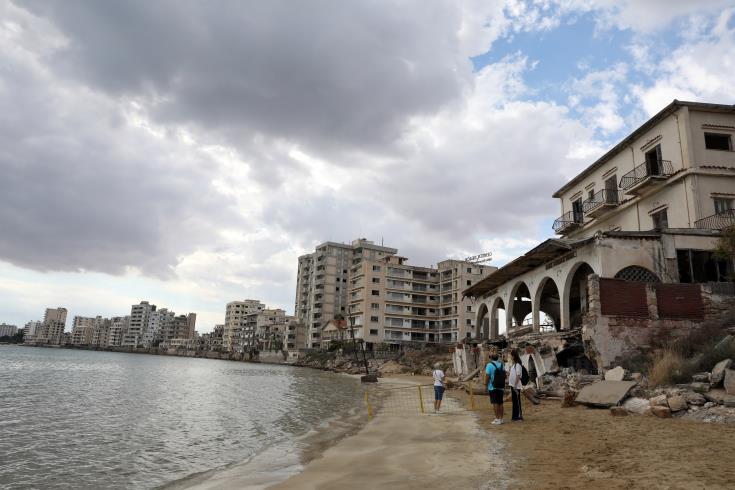

The options papers on possible responses by the EU to Turkey’s actions in Varosha will be presented at the next Foreign Affairs Council in December 13th, HRVP Josep Borrell said, adding that the process towards preparing this document has begun and that the document is expected to be ready to be included in COREPER’s agenda later next week.
Borrell said that during the discussion on Varosha, which took place under current affairs, he informed the Council of Turkey’s unilateral moves, noting that they are contrary to United Nations Security Council resolutions and put UN efforts towards a solution in Cyprus at risk.
The HRVP noted that the member states expressed their strong solidarity to Cyprus and added “now we have to convert this to concrete proposals to address the situation”.
“To do that, we have agreed to initiate the process so that the action paper is presented as soon as possible at COREPER,” Borrell added, noting that it is up to the Council Presidency to decide on the agenda.
He pointed out that the aim is for this process to be completed by December to ensure that it will be presented at the next FAC meeting.
Responding to a question on the contents of the options paper, Borrell said it will include options based on all available information as well as intelligence that has been gathered. He added that “we’ll have to wait” and added “but not much”.
According to diplomatic sources, the options paper will be made up of two sections, one outlining the situation in the fenced off area of Varosha and one setting out the options that the EU has to respond.
According to the same sources, during the discussion Borrell made extensive references to a report by the Commission’s information gathering services, which records the situation in Varosha and occupied Famagusta in detail.
This document reportedly had to be completed before the process of preparing an options paper could be completed.
Foreign Minister Nikos Christodoulides had expressed the country’s displeasure over the delay in the process, and added that the EU should send a message that such actions by Turkey should not be accepted, according to the same sources.
Even though it cannot be ruled out that the document will be ready before December and be approved through a written procedure, this is currently a remote possibility.
Diplomatic sources say that the aim of the Cypriot side is for the options to include political and legal options rather than targeted sanctions. These options could include limiting the progress of the positive agenda between Turkey and the EU or freezing funding from the European Investment Bank.
France, Greece, Spain, Malta and Slovenia as the country acting in the role of the presidency supported the need for the options paper to move forward, sources say.
Belarus and instrumentalisation
————
Regarding the situation on the borders between Belarus and Poland and the Belarusian regime’s instrumentalisation of migration, the Foreign Ministers arrived at a political decision to extend the current sanctions framework on Belarus in order to also include this aspect.
The working groups of the Council will work on the basis of this decision in order for specific decisions to be taken during the next FAC.
Borrell said in a statement after the meeting that this decision will allow the EU to sanction Belarus over its attempt to instrumentalise migrants.
According to diplomatic sources, Greece suggested that the expansion of the criteria on sanctions be carried out horizontally, so that the EU can put sanctions also on other countries that attempt to instrumentalise migration.
During his intervention in the meeting, Greek Foreign Minister Nicos Dendias noted that the Lukashenko regime is essentially following Turkey’s example. He also is reported to have argued that if the EU had responded effectively to Ankara during the Evros incident, Belarus would not have followed Turkey’s example.
If the proposal moves forward, then instrumentalisation of migration would be added to the EU’s regime for imposing sanctions to protect human rights and the rule of law. However, this proposal is still in its initial stages.
The Cypriot Foreign Minister supported Greece’s proposal, making references to the difficult situation in the country due to mass migrant arrivals through the occupied areas.