
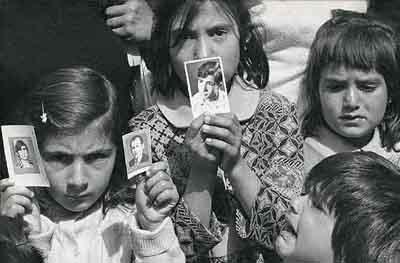

Greek Cypriot member of the Committee on Missing Persons in Cyprus (CMP) Nestoras Nestoros has said that the remains of 34 missing persons have until now been identified in 2015, noting that the Committee is focusing both on the quality of the tests carried out and the quantity of the remains handed over to the families.
In statements to CNA, Nestoros said that the number of missing persons identified could be more than 100 “if we gave the relatives a couple of bones of their beloved ones.”
Nestoros explained that in the cases of mixed bones (e.g massive graves) the number of the individuals profiles which they concern is being determined through tests. He noted however that when skeletal samples fail to come up with a DNA identification or the DNA distinctiveness is low “then we deem that we must continue our efforts. Because on one hand those who have failed may concern the profiles of other missing persons and on the other hand we have to be able to give the families as many bones as possible,” he noted.
Moreover he said that after the conclusion of the genetic tests, the lab experts evaluate whether they must send new samples from other mixed bones that have not been identified. “Our aim is to exhaust all scientific means with a view to return as much remains as possible,” Nestoros added.
Furthermore he said that in the case of complete skeletons, when the DNA distinctiveness is low then more genetic material is sent for DNA tests.
Nestoros said that when the remains are handed over to each family, relatives are also given a comprehensive report comprising the anthropological findings, genetic tests and a comprehensive archeological report in Greek, English and Turkish.
He noted that according to the recommendations of foreign experts, CMP implements a pilot programme with a view to determine whether it should change the protocols of its anthropological tests in the cases in which mixed bones are discovered.
According to Nestoros, excavations are being carried out currently in nine areas, two in the government controlled areas and seven in the Turkish occupied areas.
Asked about the information provided to CMP, Nestoros said that no information is given and called on everyone who participated in the burial of people or has any information to give to the Committee to do so. He noted that from the 444 Greek Cypriots who have been identified 281 were found buried in different places from where they reportedly had disappeared and could have been buried.
