
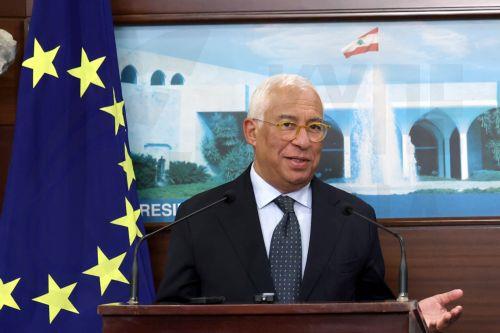

The deployment of forces by Greece, France, Italy and Spain to protect Cyprus is “a powerful example of European autonomy and steadfast solidarity,” the President of the European Council, Antonio Costa said speaking at the European Union Ambassadors Conference in Brussels.
In his speech to the EU’s diplomats, he outlined the framework of European foreign policy in a world that, as he noted, is becoming increasingly multipolar and unstable, stressing that the European Union must defend the rules-based international order. “We must defend the rules-based international order. We must uphold the principles enshrined in the United Nations Charter and in our Treaties. Violations of international law must not be accepted, whether in Ukraine, Greenland, Latin America, Africa, Gaza or the Middle East,” Costa stressed.
The President of the European Council described the war in the Middle East as one of the most worrying developments for Europe and the international community, pointing out that Iran bears significant responsibility for the tensions in the region. “The war in the Middle East is of the utmost concern. Iran is for sure responsible for the root causes of this situation. Attacks by Iran and its proxies, like Hezbollah, against its neighbours, including Cyprus, a member state of the European Union, must stop,” he stressed.
In this context, he placed particular focus on the response of European countries to protect Cyprus, describing it as an example of European solidarity and strategic autonomy. “The rapid response from Greece, France, Italy and Spain, sending military forces to protect Cyprus, is a powerful example of European autonomy and steadfast solidarity,” he noted, adding that during a recent video conference with partners in the Middle East and the Gulf region he expressed the European Union’s “full solidarity and support.”
At the same time, he called on all sides to exercise restraint and return to diplomacy. “The European Union calls on all parties to exercise maximum restraint and return to the negotiating table. Protecting civilians, ensuring nuclear safety and respecting international law is crucial. We must avoid further escalation,” he warned, underlining that such a development would threaten the Middle East, Europe and the global economy.
Costa also referred to the situation in Iran, stressing that the European Union supports the Iranian people and their rights, while rejecting the logic of a military solution. “The European Union stands with the long-suffering people of Iran. We support their right to live in peace and determine their own future,” he said, adding that “freedom and human rights cannot be achieved through bombs. Only international law upholds them.”
President Costa also warned that the conflict in the Middle East is creating geopolitical benefits for Russia, which, he said, is exploiting the situation to the detriment of Ukraine. “So far, there is only one winner in this war, Russia. It steadily undermines Ukraine’s position by flouting international law. It gains new resources to finance its war against Ukraine as energy prices rise and benefits from the diversion of military capabilities that could otherwise have been sent to support Ukraine,” he said.
Concluding, he stressed that in a world where geopolitical confrontation is returning, the European Union must remain committed to its values and to international cooperation. “This multipolar world requires multilateral solutions, not spheres of influence where power politics replace international law,” he said.
CNA/EK/GV/2026
