
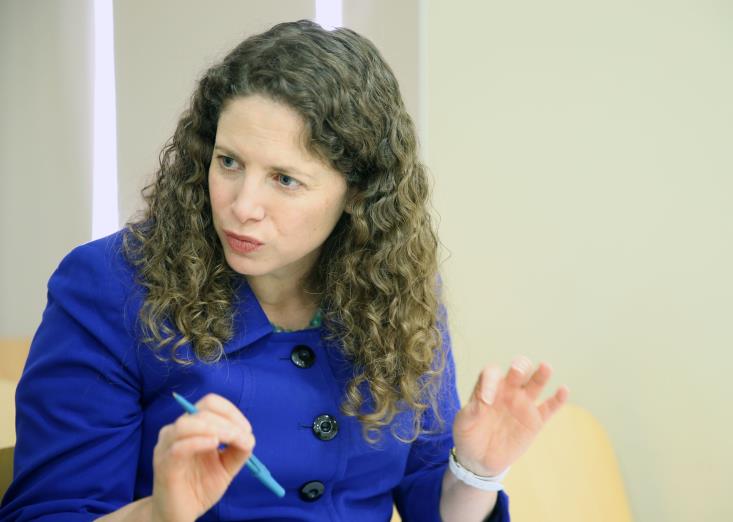

There must be accountability for the destruction of cultural heritage, said human rights expert Karima Bennoune, underlining the need to find the truth about acts of destruction in Cyprus. Such destruction of cultural heritage is “a grave injustice” and a kind of “cultural erasure”, the independent expert to the UN has pointed out.
In an interview with the Cyprus News Agency, Bennoune welcomed the recent opening of a case at the International Criminal Court (ICC), in The Hague, against a jihadi leader who is charged with the destruction of cultural heritage in Mali. Without taking a position on the ongoing proceedings however, she said “the case is a wonderful precedent for the idea that there must be accountability”.
With regard to the relevance of this case to Cyprus, she noted that “the jurisdiction of the ICC is not retroactive and so addressing events of the past would not be possible”.
Bennoune explained that individual accountability is less likely with the passage of time and embraced, instead, the idea of finding ways to “clearly and collectively establish the historical record of the destruction” that has taken place in Cyprus in the past.
Last week, the human rights expert concluded her ten-day fact finding mission to Cyprus, in her capacity as UN Special Rapporteur for cultural rights. In her interview with CNA, Bennoune noted that in her final report to the UN Human Rights Council, next March, she will suggest tasking historians and cultural heritage experts from both sides to work together, in order to document cultural heritage destruction.
They can find ways to document and establish the truth about such destruction, which did so much harm to people, she added.
According to Bennoune, the challenge is to do it in a way that is universal, by bringing together the narratives that recognize the cultural harm suffered by all, their long-term meaning for Cyprus and what possibilities there may be for transcending them. This is something you can only do, once you have come to terms with the truth itself, she underlined.
The Turkish Cypriot side has recently announced additional restrictions which would limit access to Turkish-occupied churches for religious functions to once a year. These restrictions were not extended to the monasteries of Apostolos Barnabas and Apostolos Andreas and to the church of Ayios Mamas, all in Turkish-occupied northern part of Cyprus.
Asked about the additional restrictions, Bennoune said she was “surprised and disappointed that such restrictions would be announced at any time” and in particular during her stay in Cyprus.
She added that she raised with the Turkish Cypriot side her “serious concerns” about the attempted restrictions and expressed concerns about the status quo ante as well. “At least things have not gotten worse, it will now be a question of interpretation,” she added.
In her preliminary findings, the UN Special Rapporteur identified both positive aspects, as well as persisting challenges in Cyprus.
“It has to be clear that culture and cultural heritage are not optional activities but central activities for the enjoyment of human rights” she said and underlined the dire finances at the Department of Cultural Services of the Ministry of Education, following a 45% budget cut.
Other challenges include education and the effort to introduce a curriculum promoting inclusion and equality in both sides, as well as the ongoing effort to restore cultural heritage.
There are also some issues, Bennoune called “de facto access” to cultural heritage in the free areas of the Republic of Cyprus, consisting of administrative difficulties in accessing sites, such as cemeteries, that also need to be addressed.
And although she agreed that there is still a long way to go, Bennoune said she has encountered a lot of good will, that gives her hope that these challenges will be tackled.
In order to stop seeing the “other” as a threat, the UN Special Rapporteur emphasized that the voices of tolerance, that understand the universality of Cyprus` cultural heritage, need to be magnified by the media and the authorities, so they are louder than the voices of intolerance.
Bennoune was also asked about the education of enclaved Greek Cypriots in Turkish-occupied Rizokarpaso, at the northeastern tip of Cyprus. She said she would give further consideration to this matter, but noted nonetheless that it is “absolutely an issue of cultural rights”, since people need to have access to education in relevant languages, as well as access to text books which are produced with the highest standards of objectivity and include the history of all.
