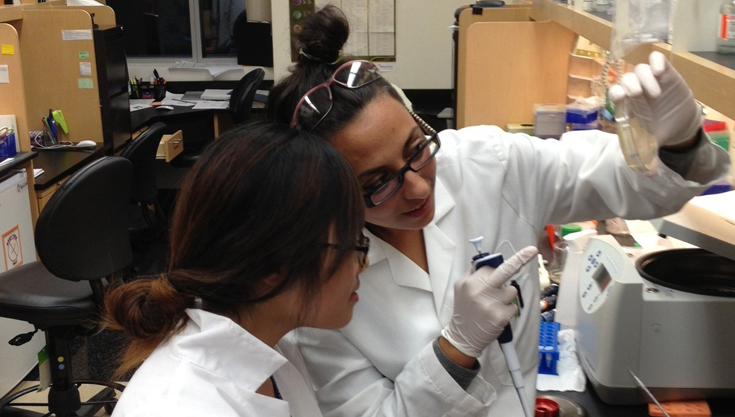
A team of researchers, including a young Cypriot Post-doctoral research fellow, has recently published an article concerning the “rebirth” of liver cells.
Dr Constantina Christodoulou, a post-doctoral research fellow at the Harvard Stem Cell Institute at Boston Children`s Hospital (USA), has talked to CNA about the new evidence suggesting that it is possible to cure a chronically diseased liver, by reverting back live cells to young stem cells which can lead to the rebirth of the liver.
The research, under Dr Fernando Camargo, was published in the journal Cell and showed that the reprogrammed liver stem cells can then differentiate back into functional mature hepatocytes that can be transplanted and rescue mice with diseased livers.
According to Dr. Christodoulou, this discovery weakens the long-held scientific debate of the existence of inactivated stem liver cells that become active upon damage and facilitate liver regeneration.
In her interview with CNA, she also said that it is very likely that other organs possess the same type of cell plasticity, adding that understanding the underlying mechanisms that can affect the plasticity of a particular cell type and its regeneration capacity should be a major future scientific goal for different organs.
The full text of the interview follows:
Q. Recently you have published a research on liver. Can you give us some details?
A. Our article focuses on the role of Hippo signaling pathway in maintaining the different cell fates within the liver. Upon switching on Yap, the main Hippo pathway gene regulator, mature hepatocytes, that consist 90% of liver, can be converted into stem cell-like cells. As known, stem cells within each organ can give rise to many different mature cell types within that tissue. Importantly, these reprogrammed liver stem cells can then differentiate back into functional mature hepatocytes that can be transplanted and rescue mice with diseased livers.
Q. Which was the team which contributed to this research?
A. Our team is part of the Harvard Stem Cell Institute at Boston Children`s Hospital and is led by Fernando Camargo, Ph.D., associate professor in the particular institute. The published biological findings were mainly carried out by the Cell`s paper first co-authors Dean Yimlamai, M.D., Ph.D, and Constantina Christodoulou, Ph.D of Boston Children`s Hospital.
Q. What are the benefits for the medical research community?
A. The Hippo signaling pathway is a regulator of liver size; upon its inactivation the liver obtains a massive size and with time becomes carcinogenic. Our unexpected findings suggest that when this pathway is switched off in mature hepatocytes they can be reprogrammed. This means that they can turn back in time and be converted into stem cell-like cells that are functional and can facilitate the regeneration of a diseased liver. The liver has been extensively studied for its regenerative ability. Even if 75% of the liver is removed the mature cells left can replicate and re-create a liver of its original size and functionality. Our findings suggest that there is a second mechanism via which the liver can be regenerated when damaged in a more subtle way. Importantly, this mechanism weakens the long-held scientific debate of the existence of inactivated stem liver cells that become active upon damage and facilitate liver regeneration.
Q. How can the results of your research help patients?
A. Scientists have been trying for years to use liver cell transplants especially for liver genetic disorders. Up to date all attempts have been unsuccessful due to the source of cells as well as the extremely limited culturing ability of these cells outside the body. Our data are now suggesting that perhaps we need to re-examine the transplantation strategy followed thus far and suggest that we can use the unlimited source of cells of the patient, revert them back to stem cells that have regeneration capacity, correct them for any mutations followed by patient transplantation that will not involve transplant rejection due to incompatibility with the donor transplant tissue. Thus in the future we are turning to patient-specific treatments as well as future discovery of drugs that target Hippo pathway and can be used in liver disease patients.
Q. Can the outcome of your research be applied to other cases?
A. It is very likely that other organs possess the same type of cell plasticity in which a mature cell can be reprogrammed into a stem cell-like cell via the manipulation of a signaling gene cascade. Thus, understanding the underlying mechanisms that can affect the plasticity of a particular cell type and its regeneration capacity should be a major future scientific goal for different organs.