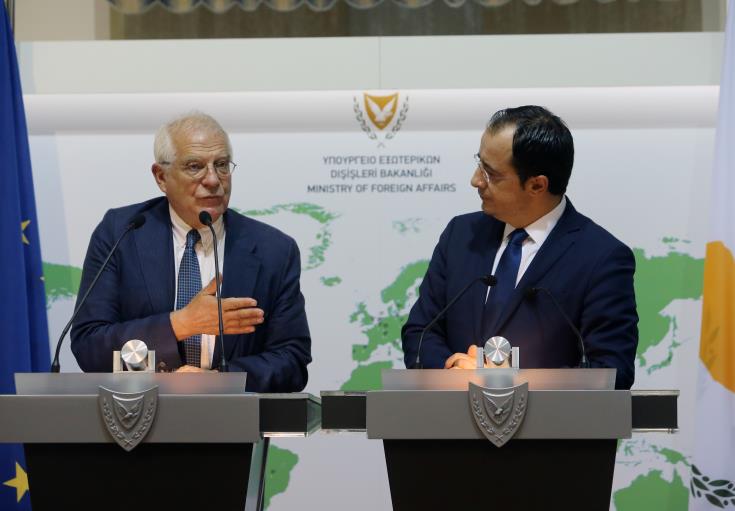

EU High Representative for Foreign Affairs and Security Policy and Vice-President of the European Commission, Josep Borrell has sent a message of “strong solidarity” from Nicosia, noting that Cyprus’ concerns are EU concerns.
Borrell was speaking after having had a meeting with Cyprus’ Foreign Affairs Minister Nikos Christodoulides, at the Ministry of Foreign Affairs in the context of a two day visit he is paying Cyprus.
“I come to Cyprus after having heard the strong message delivered by President of the Republic Nicos Anastasiades at the last European Council and also having heard you many times at the Council of Foreign Affairs, to discuss recent events and the deteriorating situation in the Eastern Mediterranean, mainly because of exploration and drilling operations performed by Turkey in contested areas,” Borrell said.
Replying to journalists’ questions immediately after the statements were made a member of the EU official’s staff clarified that by the use of the word “contested” Borrell meant the fact that Turkey is contesting those areas.
“I wanted to come and see for myself, to listen to Cyprus’ concerns and to work our way out of this complex situation,” he added.
To start, he noted, “let me underline that the EU is firmly supportive of the Republic of Cyprus and its sovereignty and sovereign rights.”
“My message is a message of a strong solidarity. Cyprus’ concerns, your concerns, are EU concerns,” he stressed.
You have difficult relations with Turkey in general these relations are currently facing important and difficult challenges, he added.
Borrell continued pointing out that on “the Turkish drilling the EU is continuously demonstrating its unwavering support to and its solidarity with Cyprus as expressed in various European Council conclusions and statements and most recently in the Foreign Affairs Council in May and also showed in concrete measures taken.”
He also said that “I think also that we have to say that we need to try to do our best and I know that you are also very much interested on improving the relations with Turkey through an open dialogue in order to try to avoid an escalation that could be very damaging for all of us.”
“For that the delimitation of EEZs and the continental shelf must be discussed in good faith, fully respecting international law and the principle of good relations between good neighbours.
Because at the end of the day, he said, “we should try to be good neighbours and that is why the EU was invented, to foster good neighbourly relations and to find solutions through dialogue and negotiations.”
“In this respect we welcome the invitation by the government of Cyprus to Turkey to negotiate in good faith the maritime delineation between their relevant coasts and on that we will also be engaging, because regional stability is a priority in the EU and I hope that the next Foreign Affairs Council, with your contribution, will help clarify the options and the way forward in order to solve these problems and improve our relations with Turkey,” Borrell noted.
On his part, Christodoulides said that “the timing of your visit is not a coincidence.”
“It is deliberate, intended to send a clear message that the European Union, a Union of 27 member states, is present and engaged in the Eastern Mediterranean, and stands united behind its member states in the face of threat and aggression, not just with words but with actions,” he stressed.
Cyprus’ Foreign Affairs Minister said that during their meeting he had the opportunity “to inform and discuss in-depth with Josep Turkey’s escalating provocations and illegal activities in Cyprus’s maritime zones.”
“I informed him about Turkey’s illegal drilling operation in block 6 of our exclusive economic zone, which has been duly delimited with neighbouring countries and subsequently licensed to European companies, fully in accordance with international law,” he added.
“Rather than responding to the invitation by the Government of Cyprus to negotiate in good faith the maritime delimitation of the maritime zones between the relevant coasts, in line with international law, an invitation welcomed by the EU, Turkey has chosen its preferred path of gunboat diplomacy,” Christodoulides pointed out.
According to Cyprus’ FM “there can be no doubt that Turkey’s actions in Cyprus’s maritime zones cannot be seen in isolation.”
Rather, he said, “they constitute a pretext, and form part of an alarming behavior by Turkey in the region, where Turkey is implementing a revisionist policy that is enforced through the use of force.”
“With Josep we also discussed how in light of Turkey’s behavior, the whole spectrum of EU-Turkey relations continues to be detrimentally affected,” he noted.
This, he informed, “is an issue that will be discussed at the upcoming Foreign Affairs Council.”
“On our side it is clear and self-evident that a necessary prerequisite for any meaningful engagement with Turkey is to cease its illegal activities, and respect the sovereignty and sovereign rights of all member states,” he said.
Christodoulides also said that they also “talked about specific ways in which in the face of escalation by Turkey, the EU will respond firmly and decisively, implementing and enhancing its existing decisions, within the framework agreed by the Council.”
Cyprus has been divided since 1974, when Turkish troops invaded and occupied its northern third. Turkey has ignored numerous UN resolutions calling for the withdrawal of the Turkish troops and respect of the integrity and sovereignty of the Republic of Cyprus.
Turkish drill ship “Yavuz” arrived last April in the exclusive economic zone (ΕΕΖ) of Cyprus, after Ankara announced another attempt to drill a well in blocks licensed to European companies. This is the 6th time Turkey attempts to drill within the EEZ and continental shelf of the Republic of Cyprus, this time in an area that covers part of exploration blocks 6 and 7, which have been licensed to ENI and TOTAL.
In a statement on May 15, EU Foreign Ministers deplored the fact that Turkey has not yet responded to EU calls to cease such activities and reiterated their call on Ankara to show restraint, refrain from such actions, and respect the sovereignty and sovereign rights of Cyprus, in accordance with international law. EU Foreign Ministers also reaffirmed previous Council and European Council conclusions, notably those of June 2019 and October 2019 on Turkey’s continued illegal activities in the Eastern Mediterranean.