
President Christodoulides says competitiveness is a turning point for EU autonomy
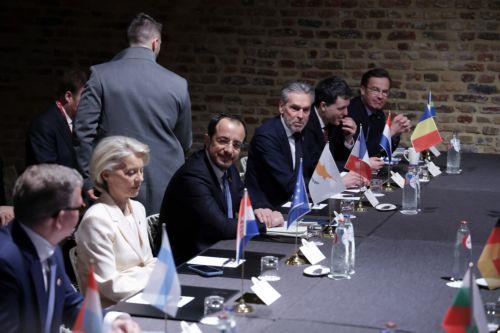
Strengthening the competitiveness of the EU constitutes a strategic turning point for Europe’s future and is directly linked to its strategic autonomy and independence President of Cyprus, Nikos Christodoulides, said on Thursday during the informal Summit at Alden Biesen Castle, in Belgium.
He referred to the example of Cyprus and how national reforms lead to high growth rates, historically low unemployment, investment in social policy and contribute to achieving autonomy and strengthening competitiveness. The President presented at the informal Summit the eight concrete proposals of the Republic of Cyprus for strengthening the EU’s competitiveness, with the aim of reaching decisions with clear timelines.
According to a government source who spoke to the Cyprus News Agency (CNA), following the introductory remarks by Mario Draghi to the table of the 27 EU leaders, the President stressed that a more competitive Europe means a stronger, more resilient Union, better able to act autonomously in the international environment, underlining that these two objectives are inextricably linked.
President Christodoulides noted that accelerating European integration is required across all key policy areas, with emphasis on completing the Single Market, promoting a genuine Energy Union, creating a Savings and Investments Union, and deepening the Capital Markets Union. He stressed that, in an environment of growing geo-economic competition, the European Union must move swiftly and decisively in order to remain a globally relevant power.
As regards the role of Cyprus Presidency of the Council of the EU, the President underlined that competitiveness constitutes a central political priority for Nicosia, noting that an informal Competitiveness Council has already taken place in Cyprus and will be followed by the formal Council in Brussels, with a view both to preparing and to following up the leaders’ discussions, in order to shape concrete outcomes and decisions.
The President then presented the eight proposals of the Republic of Cyprus for strengthening the Union’s competitiveness, stressing the need for decisions with clear timelines.
Ηe pointed out that the first key direction is the simplification of the regulatory framework. He stated that reducing bureaucracy and administrative burden is crucial for businesses – particularly small and medium-sized enterprises – for citizens and for attracting investment. He noted that the Presidency is working to advance the Commission’s relevant simplification packages and to achieve political agreements within the six-month term, adding that the principle of simplification must run across the entire EU acquis and future legislative work.
With regard to reducing strategic dependencies, the President stressed the need to diversify and secure access to markets through an expanded network of trade agreements. He noted that free trade agreements have not only economic but also geopolitical importance and welcomed progress on agreements with key partners, highlighting the need to conclude agreements, among others, with the United Arab Emirates, the countries of Southeast Asia and Australia. He made special reference to the agreement with India, which he described as historic, both because of the size of the market and the strategic prospects it creates, including the promotion of the India–Middle East–Europe Corridor (IMEC). At the same time, he underlined the need to intensify dialogue with the United States in the trade field and to modernise the global trading system.
The President noted that the third pillar is technology and innovation. He stated that Europe is losing significant human capital to third countries due to difficulties in scaling up technology companies, and underlined the need to create a favourable ecosystem for research, innovation and investment in cutting-edge technologies. He stressed the importance of establishing freedom of knowledge and innovation as a fifth European freedom, as well as the need to invest in artificial intelligence infrastructure and to secure critical raw materials for European industry.
Referring to energy, the President underlined that high energy prices constitute a serious challenge for households and businesses, with a direct impact on competitiveness. He stressed that the interconnection and modernisation of European networks are of crucial importance for reducing costs and ensuring strategic independence. He noted that the Presidency is working to advance the relevant European package on grids, with the aim of accelerating cross-border interconnections. Now is the time, he emphasised, to build a genuine Energy Union.
The President also stated that European resources must primarily strengthen the European productive base, including in the defence sector. At the same time, he stressed that the Union is a credible power, with a range of instruments at its disposal, enabling it to respond proportionately and in unity in cases of coercion or threats. “We will not exclude anyone in this effort,” he added, “but any third country wishing to participate in European programmes must meet specific criteria and share collective responsibility.”
With regard to the new Multiannual Financial Framework, the President noted that it must reflect the priority of competitiveness and referred to the objective of the Cypriot Presidency to achieve substantial progress on the European Competitiveness Fund, recalling the broader objective of reaching a political agreement on the overall MFF within the year.
President Christodoulides further stressed that competitiveness must remain firmly on the agenda of the European Council, with clear political guidance, specific timelines and swift implementation, so that results are felt by citizens and businesses. By December 2026, he said, we must ensure that decisive and tangible steps of progress have been achieved.
The President also underlined that European action must go hand in hand with national reforms. In the case of Cyprus, he noted that reforms in taxation, education, justice and digitalisation, together with the attraction of investment, have led to strong growth, low unemployment and a significant reduction in public debt, allowing for greater support to social policies and a strengthening of defence. He referred to maintaining this course through the forthcoming pension reform and the further strengthening of foreign investment. He underlined that economic indicators confirm this trajectory, with growth estimated at 4% for 2026 – among the highest in the EU – youth unemployment at historically low levels, and public debt reduced to 50%.
At the same time, he stressed that fiscal stability enables the strengthening of social policy, health and housing, while also allowing for increased defence spending and investment in young people’s skills. The President also emphasised that national reforms and action at EU level work in a complementary manner, enhancing each other’s effectiveness.
In concluding his remarks, the President stated that the slogan of the Cypriot Presidency, “An Autonomous Union, open to the world”, is fully aligned with today’s discussion, and stressed that strategic autonomy does not mean isolation, but rather the ability to act independently when needed, as well as resilience. He underlined that Europe possesses the economic strength, human capital and institutional foundations to remain a global leader, and that what is required is political will, strategic clarity and bold decisions.