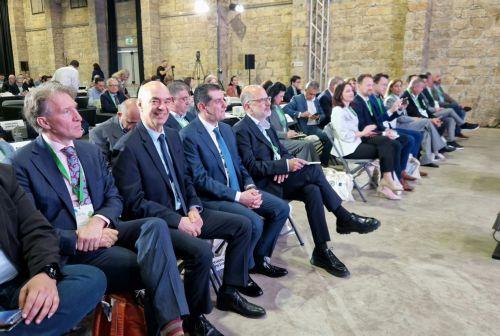

At the same time, both ministers, as well as Limassol Mayor Yiannis Armeftis, expressed their hope that Limassol would become a model for the transition to climate neutrality and resilience in the Mediterranean region.
In his opening remarks, Alexis Vafeadis first invited the European delegates to convey the message that, despite the turbulent situation in the eastern Mediterranean, Cyprus is operating as usual and life is proceeding normally, “we are running our conferences as scheduled and we intend to do that”.
Referring to the European initiative for Climate-Neutral and Smart Cities by 2030, in which the Municipality of Limassol is participating, he said that it “highlights the crucial role that coastal cities are called upon to play in addressing climate change and advancing the transition towards a sustainable future.”
Pointing out that in Cyprus, and particularly in Limassol, heavy reliance on private cars has led to traffic congestion and high greenhouse gas emissions, which affect citizens’ quality of life, he emphasized that “promoting sustainable mobility is a key priority for the Ministry.”
A central instrument in this direction, he continued, is the implementation of the Sustainable Urban Mobility Plan, particularly for Limassol, “which constitutes a comprehensive, strategic framework for transforming the way we move within the city”.
Noting that climate neutrality requires coordinated action, adequate resources, and strong cooperation among all levels of governance, Alexis Vafeadis expressed his conviction that “Limassol has the potential to become a model city for the green transition in the Mediterranean.” “Its dynamic character and international orientation allow it to play a leading role in adopting innovative sustainable mobility solutions,” he added.
On his part, Energy Minister Michalis Damianos emphasized that “Cyprus is and remains a safe and secure place” and urged the European delegates “to pass this on to everyone when you go back home.”
He noted that, as Cyprus holds the Presidency of the Council of the EU “and unfortunately, while part of our country remains illegally occupied,” the message is clear: the green transition is the cornerstone of European autonomy, resilience, and competitiveness.
For Limassol, he continued, “a dynamic city at the crossroads of Europe and the Mediterranean and a vital centre of economic activity, climate neutrality is no longer a distant policy goal; it is a living blueprint for a sustainable Blue City”.
Damianos emphasized that the Ministry of Energy, Commerce, and Industry is committed to ensuring that Limassol has the infrastructure to match its ambitions and is moving “beyond the era of isolated energy systems through two critical pillars”.
The first, he explained, concerns smart grids and digitalization and includes accelerating the modernization of the electricity system through the rollout of Advanced Metering Infrastructure and Smart Meters, as well as state-of-the-art Geographic Information Systems and advanced Distribution Management Systems. “Smart grids and energy storage are essential to enable higher penetration of renewable energy and to manage demand more efficiently,” he noted, adding that Limassol is perfectly positioned to become a hub for these smart energy systems, integrating clean power with digital technologies and electrified transport.
The second pillar, he added, concerns the creation of energy communities, which allow citizens to produce, consume, and share their own solar power (photovoltaics), thereby strengthening energy independence while lowering costs for households and businesses alike.
“The green transition must also be a fair transition,” he said, noting that “our policies aim to ensure that households, municipalities, and businesses all benefit from the opportunities created by clean energy”.
Michalis Damianos also spoke about initiatives and actions promoted by the Ministry, while supporting local authorities, and conveyed that Limassol’s path toward climate neutrality by 2030, is ambitious but the city continues to move forward.
Welcoming the international delegates, Limassol Mayor Yiannis Armeftis said that the city, in addition to its long history and strong identity, has chosen to stand at the forefront of Europe’s transition towards a climate-neutral future.
“In Limassol, climate neutrality is not treated as a narrow environmental target. We see it as a broader transformation agenda, one that concerns economic resilience, social cohesion, innovation, governance, public health and quality of life”, he stressed.
Among other things, Armeftis noted that no city can achieve this transition on its own and that “it will be achieved only if we succeed in building a new alliance, between local authorities, national government, European institutions, academia, the private sector and civil society”.
This, he emphasized, is the approach that Limassol is promoting, through synergies and partnerships that implement specific projects aimed at transforming the city across multiple sectors, such as sustainable mobility, energy transition, urban regeneration, green and blue infrastructure, the circular economy, and digital innovation.
The real challenge for all Mission Cities, he noted, is “not only to articulate sound strategies, but to create the conditions for those strategies to become implementable, investable and socially supported realities “.
Through the conference, he added, Limassol is sending a clear message that “Europe’s cities are not only the places where the consequences of the climate crisis are felt most strongly. They are also the places where solutions can be designed, tested and scaled”.
The opening ceremony was followed by panel discussions, while on tomorrow’s final day of the conference, the keynote speaker will be EU Commissioner for Fisheries and Oceans, Costas Kadis.