
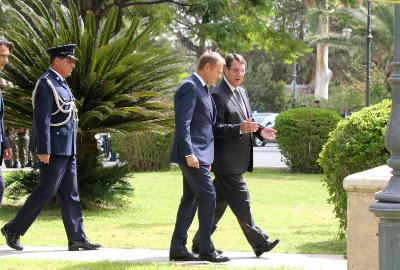

European Council President Donald Tusk welcomed the resumption of settlement talks in Cyprus and noted that the next three months will be critical to eliminate obstacles to the necessary mutual understanding and trust.
It is a historic moment that should not be missed, said the EU top official, while hearing President Anastasiades reiterate his commitment to turn Cyprus into a modern model of cooperation and coexistence.
Tusk was received on Friday by the President of Cyprus Nicos Anastasiades, during his first official visit to the island and discussed the Cyprus issue, migration and the Middle East peace process. Moreover, he was briefed by the President over the country`s financial adjustment progress and regional energy developments.
In statements after the meeting, at the Presidential Palace in Nicosia, Tusk assured that the EU will continue its “full and resolute support to the settlement process within the UN framework”.
“I see a real chance to solve this with both parties committed to achieving a lasting solution,” said Tusk and expressed EU readiness “to provide whatever practical support both parties and the UN would find most useful”.
He characterized the current settlement talks “a historical moment” at hand, which “should not be missed” and said he was ready to do “whatever it takes not to miss this one”, to the benefit of Cyprus and of Europe.
Tusk said moreover that they spoke about migration and the Middle East peace process, while assessing the role of Cyprus as a regional player.
On the refugee crisis, Tusk noted that “Cyprus is a good example of a country that is ready to help and show solidarity”, while extending his gratitude to President Anastasiades for his “constructive contribution to help resolve crises in our neighbourhood”.
He noted that “the time has come to take decisions”, referring to the upcoming emergency session of Justice and Home Affairs Ministers, next Monday, and said that “a concrete, positive sign of solidarity and unity” was expected.
Tusk said that following his contacts with member states in the last few days, he felt more hopeful that “we are closer to finding a solution based on consensus and genuine solidarity”.
Without such a decision, he warned, he would have to call an emergency meeting of the European Council before the end of September.
On the Middle East peace process, the European Council President noted the initiative of President Anastasiades to engage the European Council, by extending a separate invitation to the Israeli Prime Minister and the Palestinian President to attend a meeting of the 28 heads of states and government, in Brussels.
Tusk said that his visit in the region, prior to Cyprus, builds on this initiative and thanked the Cypriot President for his help and advice. Before arriving to Cyprus, Tusk had contacts in Israel and Palestine, as well as in Turkey.
Finally, the EU official said that they discussed economic developments in Cyprus, and added that he was “pleased to hear how the efforts by the people of Cyprus are bringing positive results”.
In his statements, President Anastasiades said that the Cyprus problem is a European problem which requires European solutions.
He reiterated his strong commitment to work tirelessly with Turkish Cypriot leader Mustafa Akinci in order to reach a viable settlement that will reunite Cyprus and the people in a bizonal, bicommunal federation.
He described the future solution as one that will safeguard and respect human rights and fundamental freedoms and which will be in compliance with EU law and principles.
Elaborating on settlement efforts, President Anastasiades said his vision was to put an end to the unacceptable status quo and to achieve the reunification of the country and its people.
“I believe that Cyprus can become a modern model of ethnic, cultural, religious and linguistic cooperation and coexistence” the President underlined.
He thanked Tusk for the strong and frank interest of the EU to assist these efforts, while noting that “the Cyprus problem is also a European problem, which requires European solutions”.
The President also said the EU constituted “the best safeguard and guarantee of human rights and fundamental freedoms” of all Cypriots, and referred to the involvement of Pieter Van Nuffel, the European Commission’s special envoy for Cyprus in the UN-led inter-communal talks.
The President also noted Ankara`s vital role and responsibility in reaching a settlement. “I sincerely hope that Turkey will demonstrate genuine political will by contributing concretely to the efforts to reach a settlement, as soon as possible” he added.
Talking on migration, President Anastasiades said that Cyprus is committed in contributing to a fair burden sharing within the EU, while noting that “no EU member state can be left alone to deal with this crisis”, referring in particular to Greece and Italy.
He further welcomed the comprehensive package presented by President Juncker in his State of the Union Address and remarked that the European response to the humanitarian crisis must be within the spirit of solidarity and should be based on common EU principles.
Speaking about the Middle East peace process, he noted moreover that Cyprus is ready to facilitate EU efforts in every way possible. “There is an urgent need to revive the Middle East peace process” he said while underlining the need for the EU to work closely with regional moderates, such as Egypt and Jordan, and assume an active role in addressing the region’s challenges.
“Cyprus is ready to facilitate the EU’s efforts in every way possible” the President said and expressed his full support to President Tusk’s efforts towards this goal.
Finally, President Anastasiades briefed Tusk on Cyprus` economic recovery, while the two sides also talked about recent energy developments in the region, in light of their potential to reinforce EU efforts to address energy needs.
Cyprus, in close cooperation with the EU and other countries in the region, is working in developing synergies in order to achieve this goal, President Anastasiades concluded.
Cyprus has been divided since 1974 when Turkey invaded and occupied its northern third. UN-led talks, aiming to reunite the island under a federal roof, resumed on May 15, this year.
