
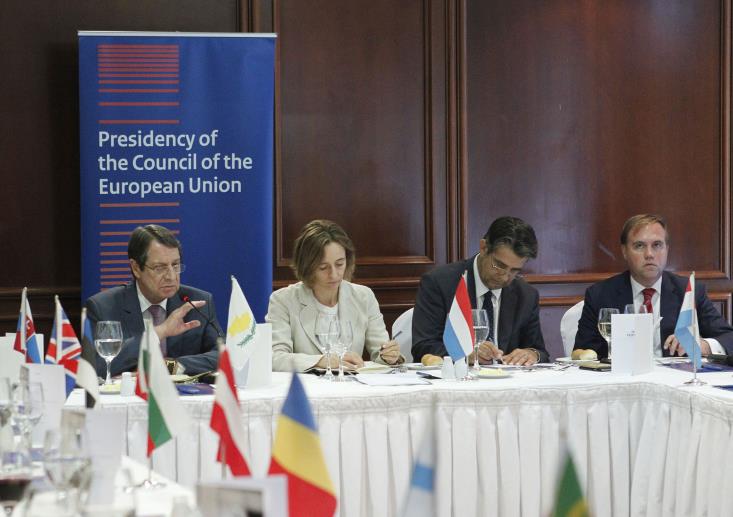

A settlement of the Cyprus problem in 2016 is still possible, if both sides engage with seriousness, discussing and submitting constructive proposals on all pending issues, in a spirit of mutual respect and through avoiding actions that jeopardise the trust between the two sides and the good climate in the negotiations, Cyprus President Nicos Anastasiades said on Thursday, addressing a lunch for the EU Heads of Mission in Nicosia, on the occasion of the conclusion of the Dutch EU Presidency.
Anastasiades said that “Turkey’s contribution in tangible terms in these negotiations is vital,” stressing that “there is no solution that can be reached without Turkey’s input and we do expect that Turkey will take concrete steps towards this end, taking also into account the benefits of such a development.”
Citing the many, as he noted, benefits of such a development, Anastasiades said that “a solution will, for example, enable Turkey to claim a much needed foreign policy success, particularly in light of the collapse of the ‘zero problems with neighbours’ policy. It will boost EU-NATO and EU-Turkey relations. Moreover it will enable Turkey to be part of the strong regional cooperation that has unfolded in the region, including in the field of energy but also security.”
Let alone, he added, “the financial benefits Turkey will have after the solution stopping the economic hemorrhage to support the illegal regime or the presence of more than 40 thousand troops on the island.”
“I will repeat that I remain optimistic that a settlement in 2016 is still possible, if both sides engage with seriousness, discussing and submitting constructive proposals on all pending issues, in a spirit of mutual respect and through avoiding actions that jeopardise the trust between the two sides and the good climate in the negotiations,” Anastasiades underlined.
The President congratulated the Netherlands on progressing on the priorities it had set as Presidency of the Council, noting that “during these very challenging times for our common home, the Netherlands led the boat skillfully in very turbulent waters.”
He said that the Netherlands managed to exhibit pragmatism and determination while managing multiple crises “in a difficult political context characterized by existential challenges, such as the immigration crisis at the EU borders, the rise in Euroscepticism and populism, the looming threat of Brexit and the continuing economic crisis.”
“On migration, I would like to commend you for continuously highlighting the humanitarian dimension of the management of the migratory pressures and for pursuing the reform of the Common European Asylum System. This will provide the Union with the necessary tools so that future migratory pressures will be tackled timely and effectively, in a spirit of solidarity and fair responsibility sharing,” he remarked.
In addition, he praised the Dutch Presidency for maintaining focus on the Internal Market and especially on pressing on with the implementation of the Digital Single Market and the Capital Markets Union. Enhancing the EU’s competitive edge, bolstering growth and innovation and creating jobs is a prime deliverable for the Union’s citizens, he added.
The President also referred to the forthcoming referendum in the UK, noting that “it is high on our agenda these days. Even though the decision belongs to the citizens of the United Kingdom, I believe that we all share the view that the consequences of the June 23 referendum will be felt throughout Europe and beyond.”
In this respect, he added, “Cyprus is strong and clear in its message: we are all better off with the UK remaining a Member of the European Union and we remain fervent advocates of maintaining the unity and cohesiveness of the Union.”
Referring to the ongoing developments on the Cyprus problem, and making clear that his intention is to avoid any kind of blame-games and provide a realistic account of the situation, Anastasiades said that “progress can be identified in aspects of the chapters of Governance, Economy, European Union and Property. However, fundamental differences still persist which relate to the prolongation of the unacceptable long-standing status quo as well as on different perceptions by the two sides on some aspects of the federal nature of united Cyprus.”
He noted that “substantial discussions have yet to take place on the chapters of “Territory” and “Security and Guarantees”. As it is understandable, our efforts should concentrate on reaching a comprehensive settlement on all Chapters, taking into account their overall linkage.”
The interdependence of chapters, he noted, is illustrated by the following two examples: the territorial readjustments are linked with the restitution of immovable property and the Security arrangements are linked with the unacceptable status quo and the fact that the events of 1974 have created a justified sense of insecurity within the Greek Cypriot community.
Further, it will be a paradox if an EU member-state’s sovereignty, territorial integrity and constitutional order will be constrained by anachronistic systems of guarantees by third countries and the presence of foreign troops in the island, the President added.
“At the same time, we should bear in mind that the combination of the capacity of united Cyprus as a member-state of the EU and the provision of the Joint Declaration of February 11, 2014, that the constituent states will exercise their powers free from encroachment by the federal government, provide adequate safeguards both as regards the protection of fundamental rights and human rights of all the people of Cyprus and the redundancy of maintaining any system of guarantees,” the President noted.
Anastasiades said that in addition to the above, the leaders have yet to start discussing issues which are fundamental and constitute an integral aspect of the comprehensive settlement.
These are, as he noted, time-lines for the withdrawal of foreign troops, time-lines for the implementation of the various dimensions of the Cyprus problem and establishing safeguards for the smooth implementation of the settlement, day 1 of the Settlement and what it would entail, drafting the Federal Laws and Legislation, drafting the Federal Constitution and the Constituent State Constitutions, list of International Treaties binding on United Cyprus, Federal Executive (size and ratio in the Council of Ministers, Competences of Executive Institutions) and Internal Security Arrangements. “All these should be negotiated before the solution comes to a final proposal,” the President added.
Furthermore, he said that “the IMF and the World Bank still need time to complete their technical assessment and studies with regards to the financial viability of the settlement. Based on what I have presented and despite that it is reasonable to assess that thorough preparation and considerable work is still required in order to present to the people of Cyprus a clear plan with no constructive ambiguities and no gaps, I am of the strong opinion that if we concentrate our discussions and focus our aspirations to the settlement that we envision to reach based on what has already been agreed, then I am hopefully that a solution could be reached by the end of 2016.”
He noted that “following yesterday’s meeting with the Turkish Cypriot leader, my dearest friend Mustafa Akinci and the methodology that has been agreed for our future meetings, I am confident that more rapid progress can be achieved in the coming months.”
He noted that this is due to the fact that they decided to intensify the negotiating process through holding meetings twice a week and they created 9 thematic clusters and during our meetings each of these thematic clusters will be discussed. Therefore, our discussions will be targeted, results-oriented and practical rather than merely theoretical, he noted.
“Thus, through this approach in the near future we will thoroughly discuss all pending issues on the Chapters of Governance, Economy, European Union and Property so as to minimize the gaps and have as little divergences as possible, brainstorm on the Chapters of Territory and Security, so as to have an understanding of the basic positions of the two sides and embark on detailed negotiations on the very sensitive issues which I have outlined, such as Day 1 of the Settlement and Drafting of the Federal Laws and Legislation,” he added.
The President also emphasised the importance of the upgraded role of the EU in the negotiating process, noting that “Cyprus is and will remain an EU member state and we are adamant in our position that we must approach all issues on the table through the prism of the EU; we must strive to reach a solution that is compatible with EU law, values and principles.”
“The upgraded role of the EU in the negotiating process aims precisely to ensure the above and establish that reunited Cyprus will be a functional and effective EU member state. It is for this reason that safeguarding the EU’s four freedoms is a sine qua non,” he added.
He noted that he is fully aware of the weight of history on his shoulders to strive to reunite the country and its people, creating the most credible prospects for prosperity for Greek and Turkish Cypriots in a modern European country. “To this end, we need the strong support of the international community, including of course, and always, the EU and our EU partners in. This support encompasses conveying the message to Turkey that it needs to grasp the opportunity offered by the current juncture in the negotiations, acknowledge its own historic responsibility and contribute concretely to the process,” he added.
Cyprus has been divided since 1974, when Turkey invaded and occupied 37% of its territory. Anastasiades and Akinci have been engaged in UN-led talks since May last year, with a view to reunite the island under a federal roof.

