
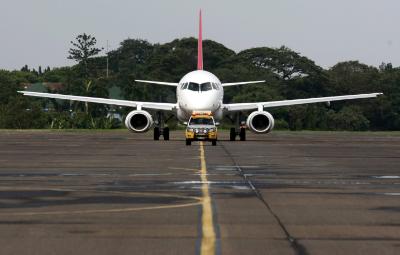

Nicosia was among the “most constraining” air control centers in 2013, being responsible together with Warsaw, Barcelona and the Canary Islands for 28% or air traffic delays in Europe, despite the fact that the four centers control only 6.9% of the air traffic. The average delay per flight over Cyprus was 2.16 minutes in 2013, when, according to aviation experts, each minute of delay costs airliners 76 euros, aggregating an additional cost of 65 mln euros each year.
The days for which delays exceeded one minute are three times more for Nicosia than for Warsaw, which ranks as second-worst. According to Eurocontrol`s 2013 Performance Review Report, published in early June, in 198 days out of 365, delays at Nicosia`s control center exceeded one minute. The percentage of flights delayed for more than 15 minutes was 6%. In comparison, Warsaw recorded similar delays for 62 days in 2013, Barcelona 40 and the Canarias 37. The average delay per flight for Warsaw was 0.54 minutes, 0.47 for Barcelona and 0.44 for the Canarias. Flights delayed more than 15 minutes were also significantly lower for the rest of the air control centers.
In Warsaw such delays concerned 1.5% of its total flights, in Barcelona 1.3% and in the Canarias 1.2%. The report states that Nicosia was planning to widen its capacity for 2013, serving 59 aircraft per hour, satisfying thus hourly traffic almost in full. It is added, however that this did not happen, resulting in significant delays for airspace users. On another note, according to the safety audit results of the International Civil Aviation Organisation, Cyprus stands at 67,1% in relation to the effective implementation of safety oversight systems.
The average of 185 audited countries stands at 62%, with the Republic of Korea ranking first with 98.6% and Djibuti last with 4.1% Speaking to Cyprus News Agency, Christos Petrou, Adviser to the President of Cyprus for Civil Aviation matters and Executive Director of the Mediterranean Institute of Flight Safety, said that flight safety levels for Cyprus were satisfactory, adding that there is room for improvements. He referred in particular to the “outdated” institutional structure of the Civil Aviation Department in Cyprus, noting that this creates a series of problems in infrastructure, organizational matters, while resulting to shortages in air traffic controllers.
Petrou added that among the 40 members of Eurocontrol, only Cyprus and Greece still retain state-run services to control air traffic. He noted moreover the need to have effective and flexible services to implement constantly revised security instructions in a swift manner, while referring to the overhaul of the Civil Aviation Department, noting that Cyprus is “on the right track”. Commenting on the Eurocontrol report, Petrou said that delays result to an extra cost of 65 mln euros for airliners per year, while the cost per minute is 76 euros. He said moreover that airliners appear willing to pay more for route charges to Cyprus – which are estimated today at 46 mln per year – in order to have better services and avoid delays. According to Petrou, the situation is improving, with less delays in 2014.
