
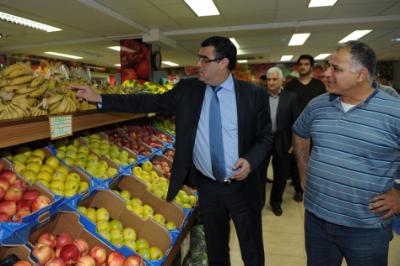

Minister of Agriculture, Natural Resources and the Environment Nicos Kouyialis has said that the economic turmoil that hit the country has undoubtedly affected the local agricultural sector, adding however that prospects are promising and there is room to further develop all sectors of agricultural economy.
In an interview with CNA, Kouyialis noted that the ministry is doing its utmost to address the adverse repercussions for Cypriot citrus growers affected by the Russian embargo on agricultural and fisheries products.
The minister expressed satisfaction with the fact that the issue of the registration of halloumi (Cypriot traditional cheese) as a protected designation of origin (PDO) is at its final stages, noting that he expects some positive results by the end of this year.
With regard to Cyprus’ water resources, he said that in view of the drought and water scarcity problems which the country faces and the forecast for less rainfall in the area due to climate change, the Agriculture Ministry focuses on the maximum use of recycled water as an alternative water resource, with a view to securing reliable water quantities for irrigation and water efficiency purposes.
Kouyialis said that the fields of agriculture, farming and fisheries can become profitable and sustainable employment sectors, but need to adapt to the new technologies and address in a scientific way the problems which Cyprus faces, such as the high production cost, water shortage and the domestic market.
“We are working to support our farmers,” he said, noting that a total of 47.7 million euros have been allocated to the agricultural sector, from 2013 to date, 37.6 million of which have come from European funds.
Furthermore he noted that the Council of Ministers approved the allocation of 240 million euros to the agricultural economy for the period 2014-2020, through the new Agricultural Development Programme expected to be approved by the European Commission.
He said that 53 million euros will be allocated to the fisheries sector on the basis of two projects approved by the Council of Ministers, out of which 40 million come from the EU.
With regard to the environment, he said that they aim at green growth, a low emissions economy and the creation of many jobs through green development in the economy.
Referring to the recent EU Agriculture and Fisheries Council, which discussed the Russian embargo on EU agriculture and fisheries products, Kouyialis said that it was particularly important for Cyprus and that “we stressed the need to further support affected farmers,” and take more measures with a view to “radically and decisively address the adverse consequences for European farmers.”
Kouyialis stressed the need to open third markets, especially those of EU neighbouring countries for these products, through common funds, noting that Cyprus has managed to sell some of these products to neihbouring Arab countries.
He recalled that Cyprus managed to amend a plan that did not provide for financial aid to citrus growers and expressed hope that the country will be able to absorb most of the 4 million euros ear-marked for Cypriot producers.
Asked about the process underway to register halloumi as a protected designation of origin (PDO), he noted that the registration which is in its final stages will open new horizons for cattle raising and cheese making in Cyprus, recalling that halloumi exports raise 70 million euros every year.
Asked about the problem of water shortage, Kouyialis said this is one of the biggest challenges that Cyprus has to face.
He said that Cyprus does not face any problem with the water supplies for domestic purposes as it can buy water from the desalination units if need be, however it faces a long-standing problem as regards water for irrigation purposes.
He said the ministry is currently working on a seven-year plan for the construction of the necessary infrastructure with a view to use recycled water as of 2017, expressing hope that by 2020 they will be able to provide 40 million m3 of recycled water that will cover approximately 25% of the total irrigation needs.
