
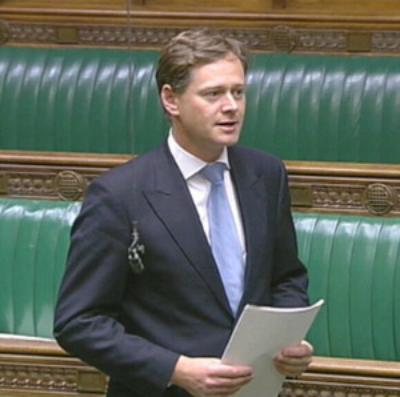

Cypriot President Nicos Anastasiades’s four – day visit to London this week is a further opportunity to see how the peace process in Cyprus can resume, Matthew Offord MP, head of the British All Party Parliamentary Group (APPG) for Cyprus, told CNA. He also said that Turkey’s accession to the EU can not be considered until the Cyprus issue is resolved.
“I am hopeful that with his visit to London President Anastasiades will have an opportunity to speak not only with the Prime Minister but also with the Foreign Secretary to try and see if there is any opportunity, any chink of light to ensure that the peace process resumes and continues, so that we get an agreement acceptable to all of the island. I see the President’s visit as a further opportunity and the next step in the process,” said the Conservative MP in an interview with the Cyprus News Agency.
Asked what he would consider a successful visit, Mr Offord replied: “I think any commitment to go the extra mile, to seek that the negotiations resume. In some way to onsider issues that may not have been acceptable in years gone by and try to negotiate a passage that results in that negotiation becoming something more tangible, which in time does lead to a united island of Cyprus.”
The MP for Hendon in north London, with the numerous Cypriot constituents, provided assurances that the Cyprus issue is high on the current UK government’s agenda.
“It is part of the coalition agreement; it is there in black and white. So it is one of the huge priorities for this government. This is one of the issues that the coalition government have said they would address and resolve in this parliament and some of us are still pushing for that to happen.”
Commenting on whether the UK could do more to facilitate a settlement, he remarked that the country is not a colonial power in Cyprus. “But if we were invited by one side or the other to provide technical assistance, diplomatic assistance, I would like to see the UK taking that role,” he noted.
He also pointed out that although “there is certainly a discussion to be held in the future about the governance arrangements” of the British bases in Cyprus, he doesn’t think they could be considered in isolation of the 13 other overseas territories of the UK. “Do I think they would change anything at the negotiations? No, I don’t,” added the British MP.
According to Matthew Offord, although the UK does have a responsibility towards Cyprus as a guarantor power and because of the bases areas, its ability to exert pressure and influence over Turkey, as it has been asked to do, is rather limited. “The only leverage that we really have over them would be their possible accession to the EU. To say to the country that it could only possible occur if there is a resolution for the island. And before that happens there are obviously some red lines that need to be addressed: the missing, the property rights, the right to return, three issues at least,” he told CNA.
He underlined that “I don’t think there is any possibility that it [the EU accession] can even be considered until the Cyprus issue is resolved. So I am very pleased the Minister for Europe (David Lidington) maintains this position. I recently asked him some parliamentary questions and he certainly gave me the impression that he still maintains these concerns”.
With regard to the EU role on the Cyprus problem, Mr Offord commented that there could be a role to be played, but it would have to be on the basis that they were invited by both sides, as Turkey is not part of the EU. The Conservative MP was critical of the failure of the United Nations to solve the problem of a divided country of the western world: “I would have expected and hoped that the UN would have done a lot more than they have done. I would like to see UN SG Ban Ki-moon take more of an interest rather than looking at other parts of the world.”
Referring to the role of confidence building measures in Cyprus, such as the return of Famagusta to its lawful inhabitants, Matthew Offord noted that similar tactics in other places of the world, such as Iran and Northern Ireland have borne fruit. “I think where confidence measures can be achieved is in areas that there is joint concern; so particularly I think about people that are missing. I think the identification of the location of graves would go a long way on both sides to provide good will. This could be one of the first steps that could lead us on that path, which may end up with places like Famagusta being returned,” said Mr Offord.
As for the gas discoveries in the Cyprus Exclusive Economic Zone, Matthew Offord said he believed it could be a game-changer: “I think it would give Cyprus a leading role in that part of the world and I mean not only working with Turkey but also working with countries like Israel in the production of carbons. It would be a great opportunity to bring people together in regards to boosting the island’s economy.”
The Conservative MP also expressed his satisfaction with the immediate response of the UK government in providing assistance to Cyprus and Cypriots living in the UK after the financial and banking turmoil followed by the Eurogroup decisions on Cyprus last spring.
As for the role of the APPG for Cyprus, he explained that the member Parliamentarians are able to “say things and even do things that a minister of this government is not able to do”. As an example, he gave his and his colleagues’ talks with people on both sides of the divide in Cyprus during a visit, which gave them the opportunity to see their problems and concerns from up close.
“As an APPG we can have these conversations with people that ministers wouldn’t be comfortable with having, certainly wouldn’t be comfortable with having publicly,” said Matthew Offord.

