
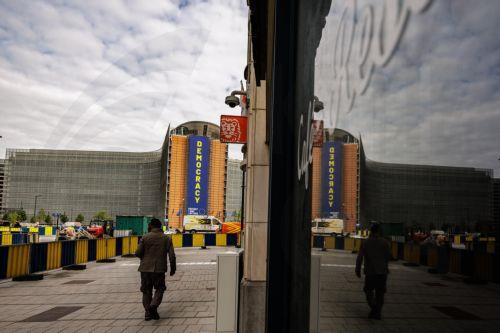

An event entitled “Echoes of Cyprus” was held in Brussels as part of the Presidency Day celebrations, highlighting Cyprus’s cultural heritage with the participation of EU officials and guests.
A key moment was the screening of the documentary “Echoes of Cyprus”, focused on the Cypriot tradition of “tsattista” and based on the work of James Anastasios Notopoulos and Dimitrios Petropoulos, who recorded Cypriot oral poetry in 1953.
In a video message, Commissioner Costas Kadis stressed the importance of intangible cultural heritage as a living element of identity and a bridge between communities. He highlighted Cyprus’s rich cultural history at the crossroads of civilizations and the enduring role of oral traditions like “tsattista”, which combine creativity, language, and interaction.
He noted that “tsattista”, inscribed by UNESCO in 2011, remains alive today in festivals, media, and public life, especially during Kataklysmos. Language, he said, carries memory, identity, and emotion, and helps communities recognise themselves.
He also underlined that such traditions reflect shared European values, linking cultural diversity with unity, and align with EU priorities on culture and social cohesion, as well as Cyprus’s Presidency focus on cultural rights and openness.
Christos Ellinides, Director-General of the European Commission’s Directorate-General for Translation, noted that since joining the EU in 2004, Cyprus has evolved from a country marked by division into a dynamic and active Member State contributing meaningfully to the European project.
He stressed that Cyprus embodies resilience, adaptability, and the search for common ground, and is among the EU’s fastest-growing economies, with strong employment levels and increasing foreign investment. Cities such as Nicosia, Limassol, and Paphos are emerging as centres of technological innovation and digitalization.
Aliki Stylianou, Director of the Press and Information Office, stressed that songs and poems cannot be fully understood if detached from the way of life, tradition, people, and audiences that created and preserved them. Oral traditions, she noted, are not merely texts to be preserved, but living cultural expressions shaped by place, time, and communities across generations.
This perspective, she said, is closely linked to the mission of the Press and Information Office to preserve, document, and transmit Cyprus’s cultural heritage in a meaningful and living way.
She noted that although the social conditions in which these traditions emerged have changed, songs and oral expressions continue to “speak” to younger generations through new interpretations and experiences. Their evolving meanings, she emphasized, are not distortions but a natural continuation of their cultural journey.
She also stressed that oral poetry extends beyond Cyprus, as similar traditions exist across Europe, highlighting both the shared and diverse nature of European cultural heritage.
Ethnomusicologist Dr. Nicoleta Dimitriou raised a series of research questions about “tsattista”, including whether there are recurring formulae or motifs, why performers use specific gestures and facial expressions, and why performances traditionally begin with a prolonged “e”. She also noted the historical absence of women from public competitions.
As her research deepened, she expanded her focus to poetic duelling traditions across the Mediterranean.
She described tsattista as a form of poetic contest in which performers demonstrate improvisational skill through immediate and witty responses. The aim is to prevail through speed, creativity, and thematic coherence. She noted that the term has evolved over time, having originally referred only to competitive couplets, and is also known by other names associated with conflict and contest.
