

Urgent funding needs linked to DNA analysis, the missing persons of the Turkish occupied village of Ashia, whose remains have been transferred to a landfill, and research in archives in various countries are the main concerns of the Committee on Missing Persons (CMP), according to one of its members.
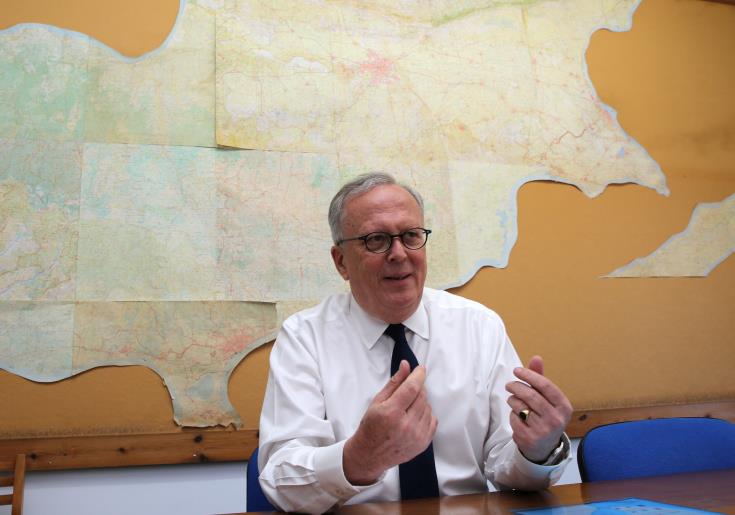
The Cyprus News Agency met the third Member of the CMP, Swiss Paul-Henri Arni, a day before a visit to the island by the European Parliament LIBE Committee, on April 4th. He was especially concerned about securing funding for the CMP and told us that he wanted to make an urgent appeal, through CNA, to countries to support the work of the Committee.
‘’I am seriously concerned because we took a risk and now we need countries to support us, to help us assume the risk. The risk we took in the strategy of 2017-2020 is to increase our budget from 3 million euro to 3,5 million over a period of a year to invest into investigation, into new technologies, new methods of soil analysis, in order to improve both our investigations and excavations and our work in the lab, the archive research etc,’’ he explained.
According to Arni, on several fronts the CMP took decisions linked to its vision ‘’that this effort should be our last push if we want to give the chance to find the maximum of the 900 or so remaining missing persons. It is the last moment and we have to push for an investment.”
Last year, he noted, the budget amounted to 3,5 million euro, up from the 3 m. of the year before. This year, the CMP has received its annual EU funding of 2,6 million ( EU is the biggest donor) and it is now 400,000 euro short of the minimum of this year, which is 3 million.
‘’We have received only two small donations from Portugal and Britain and we urge countries that have been supporting us regularly in the past, to help us this year and next year to cover our expenses, the most urgent needs are linked to DNA analysis,’’ he explained.
DNA analysis is the DNA extraction from bones that is being done in a lab in Virginia, USA.
‘’The cost is 400 euros per bone sample. In the past we had easy cases and most of these easy cases would require one bone extraction because the body had been found in an anatomical position and one bone extraction was taken and matched with saliva or blood samples from the families. Today we find more and more mixed bodies in mass graves or small mass graves of one or two remains, up to five bone extractions are required, so you understand that instead of 400 per individual, the cost is raised to 2,000. Since last year we had 118 identifications, you see how our budget is exploded,’’ he pointed out.
Arni said that any country interested not only in helping families of missing, but also in helping Cyprus to restore the broken trust between the two communities, should help with funding. The work of the CMP not only helps the dead and the living to cope with their suffering, but it also helps the communities to restore trust, he added.
‘’Because right now the trust is in short supply and this work restores trust, we have seen it, we have measured it with families who have received the remains and it helps countries in the region to restore cooperation, so it has definitely an impact on reconciliation, it is hard to see Cyprus reconciling and reaching a settlement with this number of missing persons still out it the wilderness. It is an important project to fund’’ he told CNA.
The big challenge of the missing persons in Ashia village
Around 70 people from the Turkish occupied village of Ashia, who were murdered by Turkish soldiers during the 1974 invasion, are believed to be buried in a landfill in Dikomo. According to testimonies, the remains were transferred there from the village of Ornithi.
Arni told the CNA that the Ashia missing persons is one of the big challenges the CMP is faced with right now.
‘’We have found, in two years of very professionally conducted investigation, several witnesses who transported and relocated the bodies from two wells to Dhikomo village. It was between 1995 and 1996 that this relocation took place, they dumped the bodies in what was then the biggest dumping site in the north. That was the perfect crime, the perfect hidden place because nobody would question the arrival of trucks, nobody would question that these trucks would unload soil and nobody would go and check because trucks would come in every day and dump garbage’’ he explained.
He said that nobody knew about this, the CMP certainly did not know apart from the fact that the remains have been relocated from the wells, because, as Arni explained, in the wells only seven full remains were found and mostly partial remains were located.
‘’Late last year we learned and had a 100% certainty that they had been for sure relocated to Dhikomo in 1995-1996. The EU, not knowing what had happened, funded and implemented the termination of this dumping site which was an environmental disaster for the region’’ Anri told CNA.
He explained that Portuguese experts came to Cyprus and carried out work between 2009-2012 to close this dumping site and transform it into a hill where trees were planted.
‘’So now we are facing a situation where we have a huge area that has been unknowingly reduced to a small area by pushing thousands of tons of soil to make a little hill and then more soil was dumped on this and trees were planted. We have to go ahead with an assessment with a double objective. We have contacted the same Portuguese experts, the EU has accepted to fund this mission and we will have them come to Cyprus soon. We need to find out if it is safe to dig into a mountain that may contain pockets of methane gas which might just explode. The safety assessment will tell us this and then we need a financial assessment because the work on that hill, if we have to go through, might just explode our budget and we need to know the cost before we start’’ he added.
Arni said that the information according to which the bodies were transferred to the dumping site was given by truck drivers, several of whom the CMP has met. ‘’It took two years to really cross check the information and every single detail,’’ he said.
Asked where the money will be found if they are given the green light to excavate in the dumping site which is now closed, Arni said that right now the CMP has outstanding needs of 400,000 for this year.
‘’When we have the confirmation for the dumping site to go ahead and an idea of the budget, then we will make a special appeal for this specific work. It won’t come probably from the regular budget. If we are told that it is a huge amount, we will make a special appeal just for that’’, he said.
National archives and military areas
Turkey has granted access to military areas in Turkish occupied Cyprus since 2006, Arni told CNA, adding that all together the CMP has excavated fifty one military areas in the past 11 years.
In 2015 the CMP reached an agreement to accelerate by 300% the access to these places. The CMP has altogether recovered 158 missing persons in eleven years in military areas in the 51 places excavated.
‘’We had, before 2006 and 2015, access to two to three places per year, as of 2015 we reached an agreement with the Turkish Army to get access to ten places per year, so we are in the last year of this agreement and it has gone according to plan, we have dug in ten- eleven places and this year we hope for 12 places, and we found additional, possible and potential sites, in additional military areas and it will be no problem to go beyond this agreement in 2019-2020 to continue working in Turkish military areas,
the access has been granted and has been facilitated through this agreement on 2015. We went from 2-3 places, to ten places,’’ he pointed out.
With regards to research into archives, he told CNA that according to an 2016 agreement reached between the other two members of the Committee, the CMP had to create an archives research team of three persons, one international and two Cypriots ( one Greek Cypriot and one Turkish Cypriot), in order to do research itself into the archives of the UN and the International Committee of the Red Cross (ICRC).
‘’ So we gained access to these two archives, both the open archives and also the non-publicly accessible archives, the third person has access to non-publicly UN and ICRC archives,’’ he noted.
He recalled that two trips of two weeks each have taken place to New York during which the CMP has researched hundreds of thousands of archives. The trip to Geneva for the ICRC archives will take place in May.
Arni told CNA that apart from these archives, there are another twelve countries to whom CMP has submitted written requests, for themselves to look into their military archives because an NGO or a mechanism like CMP cannot access any archives anywhere in the world.
‘’So we made requests for these countries to look into their archives for specific words, for key words , specific dates, and we sent these to 12 countries like I said, three of them are Turkey, Greece and Cyprus, and 9 of them are UN contributing countries including the UK, all of them agreed to cooperate and Turkey and Greece have set up a task force within their own army to look into documents, we have not yet received any official information from the Turkish army, neither the Greek army’’ he said.
As regards Britain and some Nordic countries, Arni said that they have asked CMP to come and see their national archives.
‘’We have sent a team to London for two weeks that has just came back because all of the Cyprus archives are now into their national archives. And the third group of countries, the Nordic countries have said that we don’t keep those field reports, but please contact our veteran UN associations, that is the case of most of the Nordic countries plus Canada.
So now we are in contact with veteran associations who kept their log books and what we are looking is any trace of transfer by UN soldiers or for that matter countries who cleared the battlefield after the battle, who transferred bodies from place A to place B , who buried sick or wounded people who died in hospitals, we are really looking into any field information that could help us locate or confirm the location of hidden burials’’ he explained.
Arni told the CNA that during the visits to New York and Britain, progress has been made because the CMP has gone through thousands and thousands of documents, especially in the UN.
‘’We have cleared these documents and we are now sharing them with the members and it will take time to make an evaluation, but we have already found many traces, particularly in the UN archives of locations, of possible locations of hidden burials’’ he said.
Asked when the CMP will be able to share this information with the public or have something more concrete to tell the public, Arni referred to his work in the Balkans.
‘’I remember a similar exercise we did when I was working for the ICRC in the Balkans, we did it with NATO countries who were involved in Kosovo. It took us several years to get information from all these national armies, mostly Western, some of them never answered, some of them answered very precisely. But yes it finally took us several years to make sure that this information was key to excavate at particular sites. We have in the past thirty years a lot of information, the CMP data base is full of witness reports and of investigating analysis that concerns a lot of places, so we already have information for most places, but what we need is more accurate information and that will take several years, in the Balkans we were able in the first five years to recover 43 bodies from archive material sent by five countries. In Cyprus we cannot yet share that but we share it with the two offices the Turkish Cypriot and the Greek Cypriot, the work is ongoing and shared for open source archives and for closed archives through declassification efforts’’ he explained.
He said that he wanted to make a call to all these twelve countries including Turkey, Greece and Cyprus to make all effort possible, to look into their police and military archives for any indication of arrest, death, transfer or battlefield clearance of mortal remains.
Replying to a question, he said that people who have information are afraid and do not wish to share their testimonies. The witnesses are very old, one such witness is an elderly Turkish Cypriot lady who was a shepherd and had information which she shared only a month before she passed away.
‘’I met her, she was on the eve of passing away, it was the last month before passing away, something in her led her to come to us, she felt that she needed to clear her conscience and she felt that she could not pass away without sharing this information, so we appeal all the time to all these elderly witnesses, our next effort will be through the mukhtars, to convince them,’’ he said.
Anri recalled that the leaders of the two communities made a video appeal and they could reiterate it but maybe talking to associations of veterans in the north and the south could help the CMP to convince those who are not willing to share information to do so.
‘’An old man feels bitterness and feels there is no reason to share this information on these past atrocities’’ he said.
Invited to comment on the upcoming leaders’ meeting on April 16th, Arni said that it is up to them to restore the trust, pointing out that when the talks were ongoing, there was a beneficial impact on the work of the CMP.
‘’My message is that if a solution is found, this will have a benefit and impact on the missing persons project. Both the Greek Cypriot and the Turkish Cypriot members of the CMP need the cooperation and the cooperation of each other’s related authorities, everything is linked, there is no problem in cooperation, we have an excellent atmosphere between the two members, but if we need the cooperation of all authorities concerned, we definitely need an improvement of the political discussions that will definitely benefit the CMP’’ he pointed out.
The Buenos Aires visit
CMP members were recently in Buenos Aires at an international conference that brought together NGOs, academics from 20 countries in South America and Europe who have experience in looking for archives, mostly security forces archives, from human rights point of view.
‘’That is to help the truth and to establish the truth commission etc , so we were the only representatives who came to this conference with a practice on archives, not for human rights purposes but for humanitarian purposes, which is to help the families of missing to find closure, so we had two days of extremely useful exchanges and positioning of CMP vis a vis the European and South American governmental and non governmental actors, so it is good that the CMP can share its lessons learned because experts tell us that we have the best lab in the world for old, ancient mortal remains, not fresh ones, so this is good to know’’ he said.
He also recalled that scientists from the region have visited the island in the past and were briefed by CMP on Cyprus’ project on missing persons.
‘’We had scientists from Iraq, Syria and Lebanon who came to build their own capacity in our lab and we do it ‘pro bono’ or just as a contribution to the neighbouring region of Cyprus which is the region that produces the biggest number of missing persons from Lebanon, Syria, Iraq, Iran and lots of cases and little capacity and little political will. So scientists benefit from this exposure, we had decision makers from different context, such as Armenia, Azerbaijan , Georgia and Aphasia and the Balkans coming to study our mechanism. Sri Lanka has just established a CMP, called OMP (Office for missing persons) they have 17,000 missing persons in Sri Lanka so they will probably come to visit and see how we work and we overcome the obstacles, the political obstacles and technical obstacles so we have this experience and we can share the lessons with the wider world,’’ he said.
Cyprus has been divided since 1974, when Turkish troops invaded and occupied its northern third. Since then, the fate of hundreds of people remains unknown.
A Committee on Missing Persons has been established, upon agreement between the leaders of the two communities, with the scope of exhuming, identifying and returning the remains of missing persons to their relatives.

