
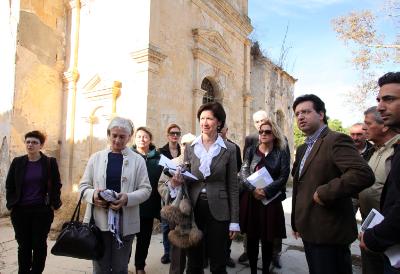

A tender for the restoration and reconstruction of the dilapidated Monastery of St. Panteleimon in occupied Myrtou is expected to be launched in the second half of 2014.
The church and the premises of the Monastery, located in the Turkish-occupied district of Kyrenia, are in urgent need of reconstruction works.
Representatives of Greek Cypriot and Turkish Cypriot political parties visited the monastery on Thursday, to demonstrate their public support for the conservation of cultural and religious heritage sites in Cyprus.
Earlier, party representatives, accompanied by the Slovak Ambassador in Cyprus Oksana Tomova, also paid a visit to the ruined Armenian Sourp Magar Monastery, in the Pendadaktylos mountain range. They also met with representatives of the Maronite community, in Kormakitis village, in the north-eastern tip of Cyprus.
While in Sourp Magar, Greek Cypriot and Turkish politicians, as well as representatives of the Armenian Community of Cyprus said it was necessary to restore the historic building, the only Armenian monastery in Cyprus.
Concerning the St. Panteleimon Monastery, Tiziana Zennaro from the UN Development Program (UNDP) said there is a funding of 2 mln euros available for a range of cultural heritage projects.
These funds are part of a 4 mln budget the European Commission has allocated for reconstruction works all over Cyprus, Zennaro explained.
Asked by CNA about her estimate for the funds required to restore the monastery, Zennaro said this will depend on a technical assessment report, expected in the first half of 2014. The deadline for this tender is in January next year and based on the assessment, a tender for reconstruction works in part of the monastery will take place later the same year, possibly in June or July.
Alessandra Viezzer, Head of the European Commission Team for the implementation of the Aid Program, said St. Panteleimon monastery has been included in a list of this year’s urgent reconstruction projects, prepared by the bicommunal Technical Committee on Cultural Heritage.
She added that the Commission is supporting such projects, since the establishment of the Technical Committee in 2008, working together with the UN program “Partnership for the Future”, while noting that other works are running or have been competed in Denia, Trachoni and Paphos.
While in Sourp Magar monastery, politicians from both Greek Cypriot and Turkish Cypriot communities had the chance to see the present state of abandonment of the Armenian monastery, whose history hoes back to 1000 AD.
The monastery was originally founded by Christian Copts, in the memory of St. Makarios the Hermit of Alexandria and came later, in 1425 AD, to the possession of the Armenian Apostolic Orthodox Church.
During the 1974 Turkish invasion, the monastery was occupied by Turkish troops and no reconstruction has taken place ever since.
According to Vartkes Mahdessian, the Representative of the Armenian community in the Cyprus House of Representatives, a rough estimate of the funds required to restore the place ranges from 8 to 10 mln euros.
The Slovak Ambassador Oksana Tomova stated that “it is our duty to find ways to protect and restore the monastery” either with funds from Cyprus or abroad.
She noted that the Armenian community is proud of its history and said the site was radiating “an atmosphere of acceptance, tolerance and mutual understanding”.
On their party, heads or representatives of political parties expressed their support for the protection of religious monuments in the island, noting that it is a matter of “our common heritage”.
They added that the monastery’s condition reflects the necessity for a Cyprus solution, while noting that mutual understanding starts with respecting each other, including respect towards religious sites belonging to other communities.
The trip was attended by politicians from the Greek Cypriot parties DISI, AKEL, EDEK, Green Party and EDI. They were joined by their colleagues form the Turkish Cypriot United Cyprus Party, New Cyprus Party, Republican Turkish Party and Communal Democracy Party. The visit to the monasteries was facilitated by the Slovak Embassy.
Last stop of the trip was Kormakitis, where party representatives toured the village’s Folklore Museum, depicting Maronite artifacts and culture.
Cyprus has been divided since 1974, when Turkish troops invaded and occupied its northern third.
