
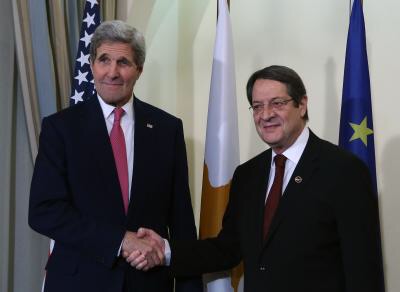

Europe has been buffeted in the last two years by one foreign-policy crisis after another. But there is growing optimism that one long-standing frozen conflict could be close to resolution: Cyprus.Negotiations to reunite the island are said to be making serious progress.
It’s a small island, but the consequences could be big.
Cyprus has been divided since 1974, when Turkish troops invaded to defend Turkish Cypriots against a feared plan, following a military coup in Cyprus, to unify the island with Greece. In 1983, Northern Cyprus declared itself an independent state, a status only Turkey recognized.
This year, the dynamic changed. Now leaders of both communities, President Nicos Anastasiades and Turkish Cypriot leader Mustafa Akinci, elected in April, favor reunification.
As a measure of big-power interest, both U.S. Secretary of State John Kerry and Russian Foreign Minister Sergei Lavrov visited the island this month. Officials in Brussels hope a solution would allow for better European Union relations with Turkey, whose help they seek to resolve the bloc’s refugee crisis.
A settlement would yield a large growth dividend. “The economic incentives are huge: It’s a win-win-win for everybody in the region,” said Amanda Paul at the European Policy Centre, a think tank in Brussels.
Growth on both sides of Cyprus’s so-called Green Line has been anemic in recent years. A study for the Peace Research Institute Oslo calculated that a solution would boost average growth in Cyprus over a 20-year period to an average 4.5% a year, from 1.6% without one. It would spur growth in energy, in shipping and in tourism. The entire eastern Mediterranean area could benefit, not least by allowing the development of a regional natural-gas market.
There could be geopolitical consequences too. The division of Cyprus has bedeviled relations between Turkey and the EU. The government of Cyprus has blocked negotiations over Turkey’s eventual membership of the bloc. Turkey, meanwhile, has used its membership in the North Atlantic Treaty Organization to limit cooperation on security matters with the EU.
Jean-Marie Guéhenno, president of the International Crisis Group, told an audience Thursday in Brussels that a settlement would be “a really major breakthrough which will completely change…the relationship between the European Union and Turkey.”
But like many who have followed the issue, he is skeptical. “We’ll believe they are a success once they’re completed,” he said.
In 2004, Greek Cypriots roundly rejected a reunification settlement in a referendum. A week later Cyprus joined the EU, along with nine other countries.
Negotiations are aimed at creating a federal republic, with the presidency rotating from one community to the other. They are being held in secret between the Greek and Turkish Cypriots, along with U.N. representatives. But the most difficult issues are no secret.
The first has become more problematic over the years: property restitution. Turkey’s 1974 invasion prompted large-scale movements of ethnic Greeks to the south and ethnic Turks to the north. They left behind properties that were soon occupied by members of the other community. Over time, migrants from mainland Turkey settled in the north; meanwhile, large numbers of hotels were built on vacant land in the south, and northern Europeans flocked in to buy second homes.
A second is the question of security guarantees. In the 2004 referendum, many Greek Cypriots were concerned that Turkey retained the option to send troops in again to defend Turkish Cypriots’ interests. Ankara is likely to want to hold on to that right.
The third major issue is where to draw the borders between the two communities. The North currently has less than 30% of the island’s population but occupies 37% of its land; some of that will have to be ceded to the Greek community.
Assuming these points can be resolved in negotiations, two larger questions still loom. Will the economic incentives of unity be enough to persuade Greek Cypriots to vote for a settlement, and how is Turkey—and in particular its unpredictable President Recep Tayyip Erdogan—going to react?
Mr. Erdogan could do with a foreign-policy victory after a series of setbacks, most recently Turkey’s deteriorating relations with Moscow following the downing of a Russian warplane.
But a settlement in Cyprus would present both him and the EU with a conundrum.
With the Cypriot objections set aside, full talks over Turkish accession to the EU would be able to resume. Yet it is extremely doubtful that either side really wants Turkey to join.
In the worst case, relations between Brussels and Ankara could be damaged when European governments are forced to make plain that they oppose Turkish membership. In the best case, it would lead to resetting ties on a more realistic basis.
Until now, Cyprus has provided a way for both sides to avoid the question. “A lot of big countries can hide behind a very small country,” said one senior diplomat.
Wall street journal

