
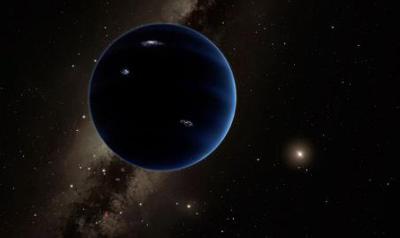

“If a ninth planet exists in our solar system, we will discover it in the next years,” Dr Dimitris Stamatellos, Guild Research Fellow of Astrophysics at the University of Central Lancashire, Preston UK, has told the Cyprus News Agency.
Dr Stamatellos was invited to comment on the new data announced by planetary astronomer at Caltech University, Mike Brown, who believes that the ninth Planet most likely exists after studying the behaviors of objects in the Kuiper Belt, an area beyond the orbit of Neptune, which consists of small bodies, like the dwarf planet Pluto.
“I am optimistic that if this ninth planet exists, it will be discovered in the next 2-3 years since large telescopes, such as the Japanese Subaru, have begun to investigate the area where it is probable that this planet exist”, Dr. Stamatellos told CNA.
Scientists believe that the ninth planet turns around the Sun in 10.000 to 20.000 Earth years and is 200 to 1.200 times farther than the distance between the Sun and the Earth. Its mass is believed to be five to ten times bigger than the mass of Earth and its diameter four times the size.
Brown announced last week that “a new eccentric Kuiper Belt Object was discovered. And it is exactly where Planet Nine says it should be”.
Commenting on Brown`s announcement, Dr Stamatellos said that “this new, unofficial for the moment, discovery of a new object in the Kuiper Belt reinforces the theory of Batygin and Brown on the existence of the hypothetical ninth planet in the outskirts of our solar system.”
He explained that the position and the orbit of this new object is similar to the orbits of other bodies in the Kuiper Belt that led scientists to the development of the theory of the ninth planet.
Those orbits, Dr Stamatellos told CNA, are very likely explained due to the gravitational influence of a large planet, up to ten times larger than the Earth.
He recalled that the anomalies in the orbit of planet Uranus, as a result of gravitational interactions with some unknown planet, led to the discovery of Neptune in the mid 18th century.
However, he said that one must remain cautious, explaining that the anomalies of Mercury`s orbit led to the assumption of Hephaestus planet between Mercury and the Sun which proved wrong after the anomalies of Mercury`s orbit were explained by Einstein in his theory of general relativity.
Expressing optimism, Dr Stamatellos concluded by saying that if planet nine truly exits, it will be discovered in the next few years, as research to find it has intensified.
But planet X, as it is also called, could be linked to disasters too, according to Daniel Whitmire, a retired professor of astrophysics.
Whitmire who believes that periodic mass extinctions on Earth, as indicated in the global fossil record, could be linked to a suspected ninth planet
