

Living Fellowship: The Thyateira Project and our Orthodox inheritance
“When I enter there, inside of a Greek church … my thoughts turn to the great glories of our race, to the splendour of our Byzantine heritage”
– C.P. Cavafy
The Thyateira Project aims to record the history, buildings, and tangible and intangible cultural heritage assets of the Eastern Orthodox communities in the UK.
It’s a study led by Dr Dimitris Salapatas, of the Alperton Community School and Dr Konstantinos Trimmis, of the Department of Anthropology and Archaeology, University of Bristol. This collaborative project has received financial backing from the National Lottery Heritage Fund.
The scope is primarily Greek and Greek-Cypriot, but also includes British, Russian, Belarusian, Serbian, Romanian, Latvian and other Eastern Orthodox followers.
Thyateira was historically a real place and is the name given to Great Britain’s Orthodox Archdiocese. This recognised the first European convert to Christianity. A woman called Lydia “from the city of Thyateira, a dealer in purple cloth”, heard St Paul speak, and said, “Come into my house, and abide there” (Acts, 16:14).
Fieldwork
The project aims to record the oral micro-history of our communities in the UK, starting in the Greater London area with the boroughs of Brent, Harrow and Camden. And further afield. Our esteemed elders, who have been the benefactors of this heritage, are keen for this knowledge and inheritance to be passed onto younger generations.
There is much that this project can contribute to sociology, language teaching, history and Religious Studies education in schools, by capturing the stories of our Greek speaking experience. It is all underpinned by the promotion of British values: rule of law, personal freedom, active participation, inclusion, tolerance, empathy and understanding.
There are some questions that the project seeks to answer and record. Who founded / funded these churches? What does the architecture and the archaeology tell us? What do people remember? How did it shape their outlook? What lessons can we draw, and pass on to our children and grandchildren?
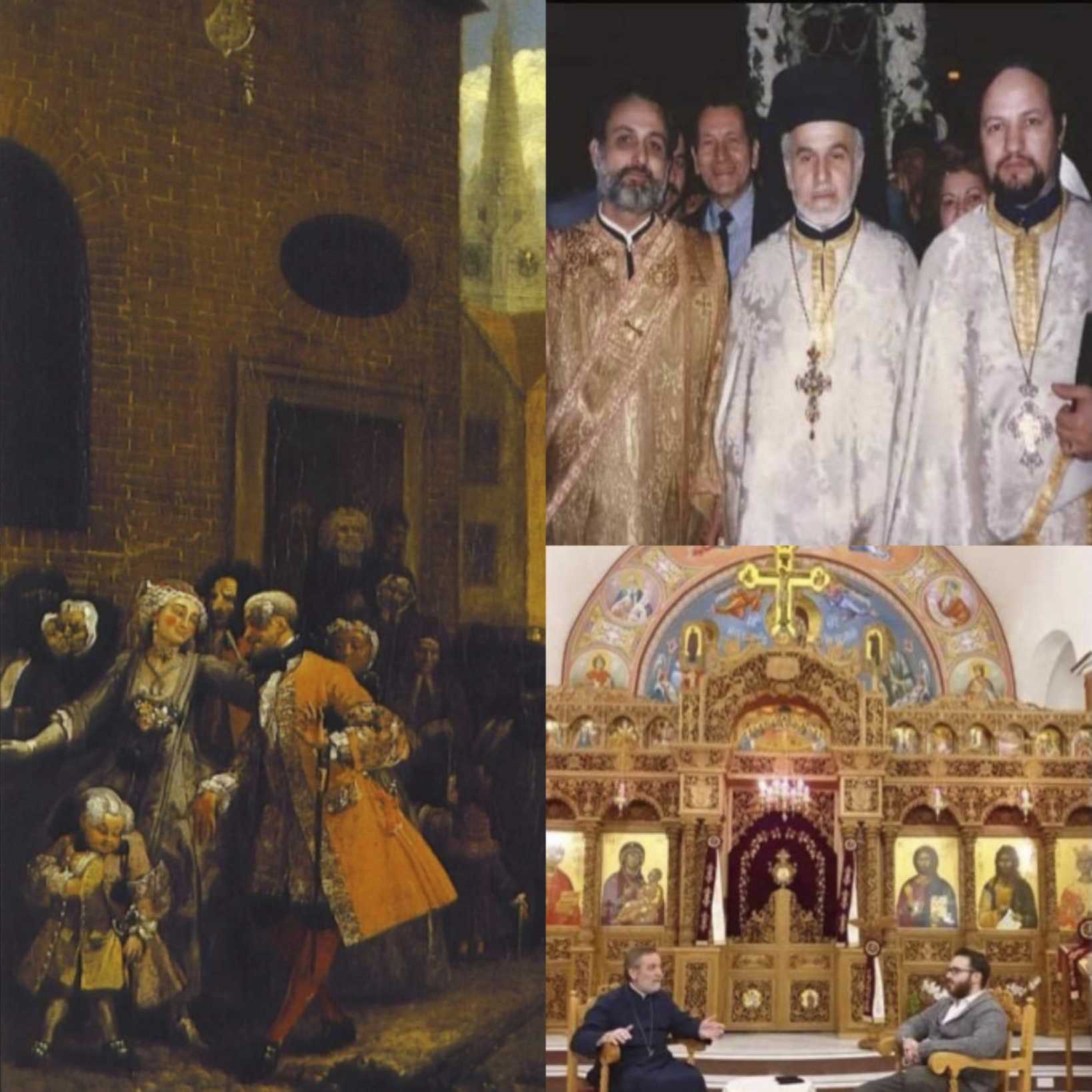
All this comes in the great tradition of eminent historians of social experience. The first Greek Orthodox church in the UK was built in 1677, in London’s Soho. In fact, Greek Street takes its name from this Greek church that was there. The church no longer stands but it is depicted in the great English painter and cartoonist William Hogarth’s ‘Noon’ from 1738 (left in the picture).
Community fellowship
The project will capture the historical and archaeological importance of the communal religious experience that has successfully sustained generations. Whilst the study begins in London, the ambition is to go further.
The project will conclude later this year and has presented interim findings on some Zoom calls. The project is already showcasing pictures and insights on social media (search for “Thyateira Project”). There are some stunning pictures from the drone of Thyateira’s Official Photographer, Alexios Gennaris.
We anticipate the project’s rich findings.
In Dr Salapatas’ book on “Fellowship” among Orthodox and Anglicans, one finds this truly compelling passage: “The Anglicans are united in outward organisation, but deeply divided in their beliefs. The Orthodox, on the other hand, are divided only in outward organisation, but firmly united in beliefs and worship.” (from Kallistos Ware’s ‘The Inner Kingdom”).
In its own way, the Thyateira Project is uniting the outward Orthodox organisation as well. Religious practice in the UK is a minority activity – around 1.5% of the population regularly attends church, although 27% declare a Christian faith (Office for National Statistics). However, we see new Orthodox churches and communities springing up – most recently in Ipswich and Hull & East Yorkshire.
James Neophytou
