
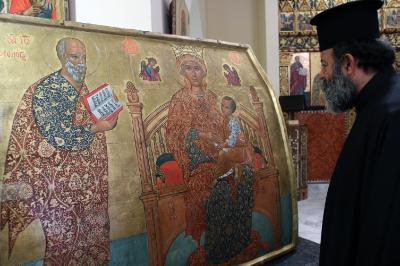

Two looted, centuries-old church icons, were officially welcomed on Thursday back to Cyprus.
A ceremony held at the Byzantine Museum of the Archbishop Makarios III Foundation, in Nicosia, marked the return of the icons of Christ and Virgin Mary that were stolen from the Orthodox Christian church of Agios Iakovos in Trikomo, in the northern Turkish occupied part of Cyprus.
“I hope that this success will continue, as thousands of icons and archaeological treasures of Cyprus are abroad and must be returned to the place they belong” said Archbishop Chrysostomos II, the head of the island`s Orthodox Christian Church.
The items were located at Christie`s auction house in London, in 2007 and following steps taken by the Church and the Republic of Cyprus, they were confiscated by Swiss Interpol and the repatriation process began.
The Limassol District Court ruled against Russian Aleksandr Kotsinski, an art dealer, who was in possession of the icons. The verdict of the Cypriot court was used by Swiss courts, where the Holy Archiodesce of Cyprus and Kotsinski reached a compromise on the repatriation of the icons to Cyprus.
“These icons are an integral part of the cultural, intellectual and religious life of Cyprus. They are excellent examples of the Cyprus post-Byzantine ecclesiastical art and date back to the first half of the 17th century” Director of the Department of Antiquities Marina Solomidou-Ieronymidou said.
She noted that both the Cypriot authorities and the Church work tirelessly to identify as many as possible of Cyprus` cultural items which have been illegally exported from the country.
“We are optimistic that with the help of the legal framework at national, EU, and international level, and the cooperation between countries and the coordinated action of the relevant departments in Cyprus, the number of repatriations will increase” she said.
The 1974 Turkish invasion of Cyprus and the subsequent occupation of the island has taken a heavy toll on Cyprus’ cultural heritage and despite existing internationally binding treaties regarding the protection of cultural heritage, Turkey chooses to ignore the treaties and continues its destructive agenda.
