
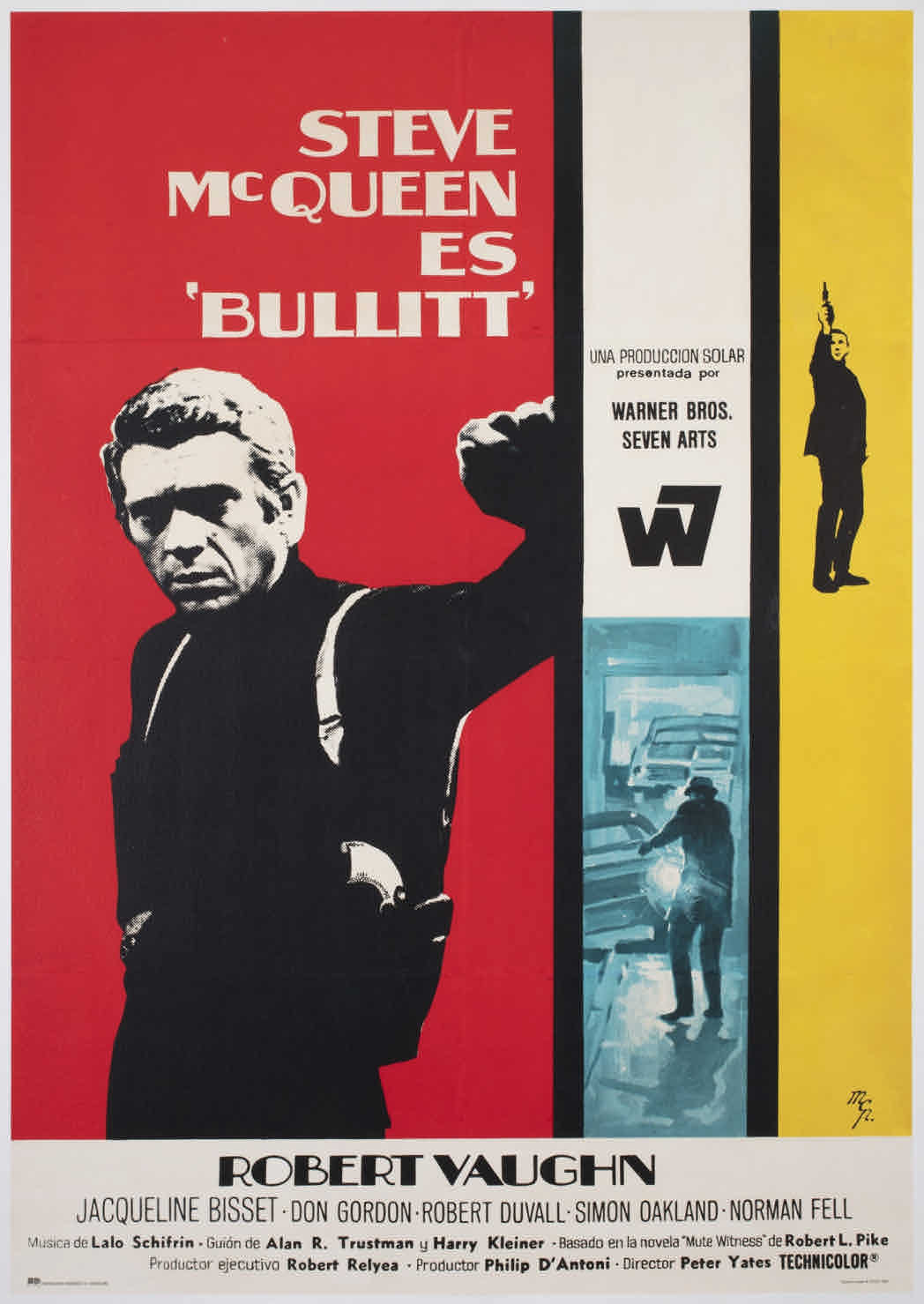

Bullitt (1968)
This is an edited extract from Cinema Speculation – a 2022 nonfiction book by American filmmaker Quentin Tarantino – courtesy of Orion Publishing…
Along with Paul Newman and Warren Beatty, Steve McQueen was the biggest of the younger male movie stars of the sixties. The UK had its share of exciting young leading men like Michael Caine, Sean Connery, Albert Finney and Terence Stamp, but of the young sexy guys in America, that were also genuine movie stars, it was McQueen, Newman and Beatty. On the next level down was James Garner, George Peppard and James Coburn. But for the most part, anytime one of them got a picture, it was because one of the top three turned it down.
The next level down was up and coming leading men like Robert Redford, George Segal and George Maharis, and pop stars like Pat Boone and Bobby Darin. In fact, if he had ever taken his movie career seriously, the young movie star leading man who could have truly given the three actors at the top a run for their money was Elvis Presley. But Elvis was a prisoner of both Colonel Tom Parker and his own success. Elvis made two movies a year and none of them ever lost money. Now, not all those Elvis movies were bad. Some were better than others. But it’s safe to say they weren’t real movies, they were “Elvis Presley movies.”
But one of the things that made Steve McQueen so popular in the sixties, along with his king of cool persona and his undeniable charisma, was that of the top three actors (Newman, McQueen, and Beatty), McQueen did better movies. Once McQueen became a movie star with The Great Escape, he made a string of movies that were all pretty damn good. In the sixties, the only real dud in his filmography post-The Great Escape is Baby the Rain Must Fall. And that’s mostly due to the ridiculous sight of Steve trying to play a folk singer. Whereas Paul Newman for his whole career did an incredible amount of lousy movies mixed in with some iconic ones. After Splendor in the Grass, none of Beatty’s films are worth a damn before Bonnie and Clyde. But the material McQueen chose to do – compared to the other two – was consistently of a higher quality.
But the reason McQueen’s material was superior wasn’t due to the fact that the actor was poring over all the material available and demonstrating his uncanny ability to choose projects. McQueen didn’t like reading. It wasn’t that he couldn’t read. He wasn’t illiterate. And it wasn’t that he wasn’t smart. He could talk to you about engine displacement, how to break apart the carburetor of a motorcycle, or discuss armaments until you couldn’t listen anymore. He just didn’t like reading.
So who read the material? Neile McQueen.
The importance of Neile McQueen to Steve’s success as a movie star can’t be overemphasised. It was Neile who read the scripts. It was Neile who narrowed down the material. It was Neile who was good at choosing material that would be best for Steve. Steve’s agent, Stan Kamen, would read ten scripts that were being offered, then narrow that down to five and send those off to Neile. She’d read those five scripts, write a synopsis on the material, narrow it down to the two she liked best and then tell Steve the stories and explain her reasons why she liked them for him. Which would usually end up in him reading the one Neile liked the most. Now of course the director was important, how much they were paying him, the location they were shooting the film at – all of these things were important. But so was Neile weighing in. Naturally, directors who worked with Steve before – that he liked – got preferential treatment. But if Neile didn’t like the script, it was an uphill battle. And it was thanks to Neile’s good taste and her keen understanding of both her husband’s ability and his iconic persona that she steered her husband, starting with The Cincinnati Kid, into the biggest winning streak of the second half of the sixties.
Neile was also aware of something that action director maestro Walter Hill told me about McQueen.
“Quentin, one of the things you would have liked about Steve is that while Steve was a good actor, he didn’t see himself as just an actor. Steve saw himself as a MOVIE STAR. It was one of the most charming characteristics about Steve. He knew what he was good at. He knew what the audience liked about him and that’s what he wanted to give them.”
Walter said, “I really admired Steve. He was the last of the true movie stars.”
And it’s true, McQueen didn’t want to bury himself under layers of characterisation, or wear false beards that changed his appearance. When he did movies, he wanted to do cool movie star things in these movies. He didn’t want to do movies where anybody else had a better role than him. He didn’t want to share the screen and he always wanted to come out on top.
I asked Neile how the film Bullitt came about. She told me Steve had just made a deal with Warner Bros.-Seven Arts to back his film production company, Solar Productions. And that was their project that Warner’s wanted to start the association with. Neile wanted Steve to do Bullitt too. Bullitt was coming after Steve’s biggest hit, The Thomas Crown Affair, and Neile thought, “It would be a good change of pace for him. In Thomas Crown he was a robber. Now he’ll be a cop.”
McQueen was famous for taking a long time to commit to projects, but the reason for his trepidation on the cop picture was his embrace of the flower-child counterculture. The actor started sporting love beads around his neck and wearing more hippie-inspired clothing.
In the book Steve McQueen: Star on Wheels, author William Nolan related that Steve’s daughter Terry gave him a string of hippie love beads as a birthday gift. Nolan wrote, “He liked them so much he actually considered using the beads in a trade ad for Bullitt.”
Eventually McQueen put Bullitt into production as a Solar picture with Warner Bros.-Seven Arts handling distribution. The end result was not only Steve McQueen’s biggest hit, but a zeitgeist smash, and finally McQueen surpassing his greatest rival, Paul Newman.
Bullitt also changed the cop film genre, and later cop shows on TV for good. Thanks to James Bond, it was secret agents that were the cool cats. Even private eyes, like Paul Newman as Harper, Frank Sinatra as Tony Rome, Ralph Meeker in Kiss Me Deadly, and George Peppard as P.J., were allowed to dress better, live in swankier digs, and generally have fun. But movies about cops were all very somber, serious and frankly a drag. The movies were all the same, the cops were all the same and they all dressed the same in their cheap dark suits and ties, with their porkpie hats and their trench-or raincoats. Frank Sinatra in The Detective, Sidney Poitier in They Call Me Mister Tibbs!, Richard Widmark in Madigan, and George Peppard in Pendulum were literally interchangeable.
Maybe Poitier playing Madigan might have drawn some attention but that’s why it could have been interesting, rather than snarling Widmark giving another in his never-ending line of snarling performances. But everything about those movies was the same. They all could have been costumed by the same costume designer, they could have rented the cars from the same garage, the supporting actors could have all swapped parts with each other, and the scripts could have been written by the same screenwriter and adapted from the same book. The cases they were involved in all dealt badly with something considered provocative in the late sixties. And they all struggled to have slightly more rough-sounding street dialogue. And almost comically, all these sourpuss cops seemingly had the same dissatisfied wife at home.
Enter Steve McQueen’s Frank Bullitt.
Bullitt is introduced to the audience waking up in the morning in snazzy pyjamas he could have borrowed from Hugh Hefner. Bullitt doesn’t have a dissatisfied wife, he has a very satisfied hot girlfriend in the guise of Jacqueline Bisset. When you see the police detective officially on the job – meeting with Robert Vaughn – he too is wearing a suit and tie, but a suit and tie that actually fit. And throughout the rest of the movie, Bullitt’s wardrobe consists of one chic outfit after another.
Peter Yates’ film doesn’t quite have the same zeitgeist position it enjoyed through the last decades of the twentieth century. While a lot of people born since 2000 may have heard of it, and they probably have heard about its famous car chase, that doesn’t mean they’ve seen it. I’m old enough to have actually seen Bullitt at the cinema when it came out. Which means I saw it at six. I don’t remember the movie. I remember the car chase. And that’s what most people usually remember about Bullitt. But they also remember how cool Steve McQueen was as Frank Bullitt, his cool clothes, his cool haircut, and his cool Ford Mustang. The one thing they don’t remember is the story. Bullitt does have a story. But it’s not a memorable story, nor does it have anything to do with what you respond to in the movie.
So for most people who haven’t seen the movie in five or six years, even though they’ve seen it a few times before, if you asked them to describe the plot of Bullitt, they couldn’t do it.
Even Neile McQueen laughed about how confusing the script was. She said both Steve and Robert Vaughn were tearing pages out of the script when they were shooting.
The story itself is more or less simple to follow. What’s unclear, especially during the middle section, is exactly what Bullitt’s up to, or why he does half the things he does. And if you think about it later, some of the things he does don’t make sense.
If Bullitt was going to change action films, it first had to break the back of the police procedural. The snazzy opening credit sequence with Lalo Schifrin’s score and Pablo Ferro’s stylishly designed titles sets the audience up for the whole movie. We don’t really have any idea what’s going on. But the characters on screen seem to know what’s going on. And we don’t really care, because it’s groovy to watch.
Bullitt is about action, atmosphere, San Francisco, Yates’ great location photography, Lalo Schifrin’s jazzy score, and Steve McQueen, his haircut and wardrobe. Nothing else matters.
Aside from the opening credit sequence, the other scene that sets up the movie is early on when Frank takes his girlfriend out to dinner. They go to a restaurant called Coffee Cantata. And we watch them have a good time and eat dinner. Yet, we don’t hear a thing they say. Other than demonstrating they like each other and that Frank is capable of having a good time, nothing personal is revealed about the couple during the whole sequence. What Yates feels is important is the jazz band performing at the restaurant, the hip vibe of the establishment, the San Francisco atmosphere and the spot-on looking extras that surround McQueen and Bisset. The scene tells us nothing narratively.
Don Siegel did terrific location photography in his career and he would do a good job shooting San Francisco three years later in Dirty Harry. But nobody had ever shot San Francisco as great as Peter Yates did or ever will again. The way he utilises location to such a dynamic degree suggests a master cinematic stylist. One of the reasons he did such a dynamite job was he went thirty days over schedule. Yates was shooting a movie, not a schedule. While Yates would do good work many times again – Breaking Away, The Hot Rock, The Friends of Eddie Coyle, The Deep, and Mother, Juggs & Speed – he would never demonstrate the cinematic style and confidence he does in Bullitt.
And then there’s Steve McQueen as Frank Bullitt. The reason why we’re here. The reason we’re watching. The reason the whole thing works.
Rarely in the entire history of Hollywood movie stars being movie stars has a movie star done less and accomplished more than McQueen with this role in this movie. The part is nothing and yet he makes it a great role. He practically does nothing, but nobody in the history of movies did nothing like Steve McQueen.
As great as McQueen could be, this is the role he needs to be remembered by. Because it’s in this role he demonstrates what he could do that Newman and Beatty couldn’t. Which is just be. Just fill the frame with him.
Steve McQueen plays the role the way Peter Yates directs the picture. Neither man seems to have any narrative or dramatic concerns whatsoever.
Steve McQueen as Frank Bullitt keeps moving forward, Yates as the director follows him and we the audience sit back and let them do our thinking for us.
As pure cinema, it’s one of the best directed movies ever made.
Image: Film poster: Spanish version
