
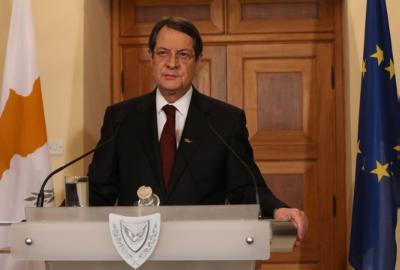

None of the Confidence Building Measures (CBMs), agreed with the Turkish Cypriot side, is against the Republic of Cyprus, President Nicos Anastasiades said on Thursday, assuring that the issue of the fenced-off town of Famagusta is among the CBMs but has not yet been discussed.
In statements after the meeting of the National Council, and invited to comment on allegations by political parties that CBMs may be against the interests of the Republic of Cyprus, President Anastasiades said that “no measure is against the Republic of Cyprus.”
The President noted that the process regarding the CBMs is an evolutionary process adding that he handed over a list of the measures proposed by the Greek Cypriot side to the members of the National Council. Anastasiades stressed that “we are aiming to maintain a good climate and not focus on the CBMs but on the substance that will solve many issues related to the proposed CBMs.”
Asked if the issue of Famagusta is included in the list of the measures, Anastasiades replied affirmatively, noting that it was not possible not to be included. “It just has not been discussed yet,” he added.
As regards the meeting of the National Council, he said that he informed the members of the Council and answered to questions. He noted that a new meeting of the Council will take place after his next meeting with Turkish Cypriot leader Mustafa Akinci on June 17.
Anastasiades and Akinci announced after their second meeting on May 28 a series of Confidence Building Measures including the opening of the Lefca – Aplici and Deryneia crossing points.
As UNSG`s Special Adviser on Cyprus Espen Barth Eide said after the conclusion of the meeting they also made a joint appeal on the “crucial humanitarian issue of missing persons”.
Eide announced that apart from the opening of the two crossing points they also referred a number of other proposed crossing points for further examination to the committee on crossings.
The other CBMs include looking into the interconnection of the electricity grids and to start taking practical steps towards this goal, the interoperability of mobile telephones which they will refer to the technical committee on economic and commercial matters and their respective experts.
In parallel, work will commence to prevent radio frequency interferences while the two leaders also agreed to establish a gender equality technical committee.
