
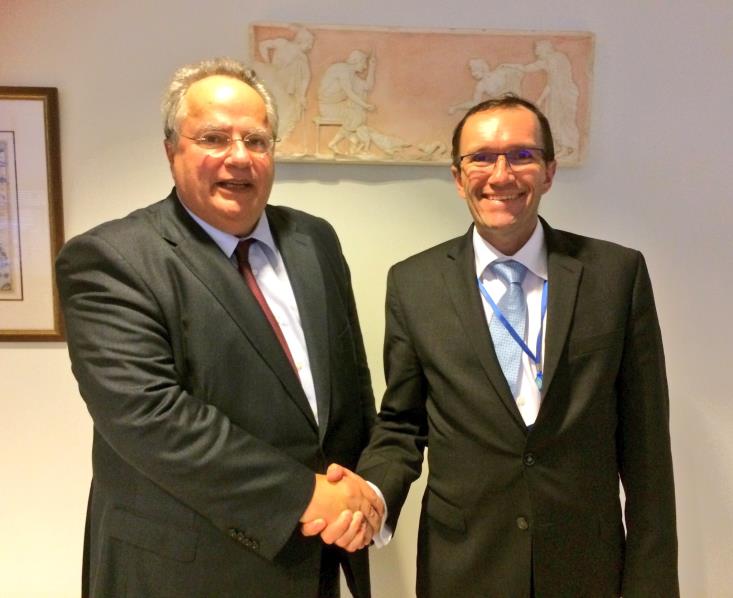

UN Secretary General`s Special Advisor on Cyprus Espen Barth Eide has acknowledged that there are real outstanding issues for a Cyprus settlement, which although not many, they are significant and have to be overcome.
Speaking after meeting Greek Foreign Minister Nicos Kotzias, in New York, Eide also said the meeting on Sunday between Cyprus President Nicos Anastasiades, Turkish Cypriot leader Mustafa Akinci and UNSG Ban ki-Moon is a step in a long process, it is not decisive and the leaders will see how specifically the SG can be even more involved.
Answering questions after the meeting with Kotzias, Eide described it as “very good”, noting this was the second meeting with the Greek FM in a week. “The reason is because we are in a very dynamic process. Greece is playing a constructive role and very supportive of the attempts we are now making to prepare for a solution in Cyprus; even on those issues that pertains to the neighbouring states, to the guarantor powers.”
“We are not yet there, we have a conclusion on those issues, by all means. But it is a constructive dialogue going on. I met with FM Cavusoglu of Turkey, on Sunday here in New York and I will meet with him again. I basically talk now to the relevant players, to see how we can prepare for the time when these issues will really be the center of attention”, Eide said.
In the meantime, he noted, the leaders in Cyprus, Anastasiades and Akinci, “are working hard to overcome the outstanding issues in those chapters of the talks which pertains to Cyprus only and which should and can be Cypriots in Cyprus. This is kind of parallel track in preparations for the time that the guarantors have to be involved. Because if we want to change the current security set-up, that requires the contribution and the dialogue with Turkey, Greek and the United Kingdom”.
Asked what are his expectations from the tripartite meeting, on Sunday, Eide explained that “this meeting is a step in a long process, it’s nothing (in) itself decisive, but is important to have this meeting because we want the two leaders to have conversations with the SG on where they are, where they are heading and how concretely he can be even more involved”.
He recalled that a joint statement issued last Wednesday said that the leaders “now want the SG to come more directly into this and we will discuss how exactly that can be done and options for the near future”.
On feedback from various international actors in New York on the sidelines of the General Assembly, Eide said “the feedback from absolutely everybody, without exception, is that people are saying this is the time where this problem can be overcome. They talk about the leadership and the courage of the two leaders and the achievements they have made so far and what they ask me is how they can be helpful”.
Eide said the international actors “can be helpful in supporting the process in many ways, including – at the end of the day – with some economic contributions and also by building the fund which we need to deal with both the property compensation issues and with other initial issues, if we come to the stage where a solution is finally found”.
“I have of course to be realistic. We are not there, we are not done. There are real outstanding issues. Not so many, but they are significant and we have to overcome those”, the UN advisor noted.
Eide further said that “we also have to think about what we do if we actually achieve this. Because what will really be a tragedy is that if there is a political agreement and no preparations in place”. “So you have one day celebrations and then you are realize that the practical preparations are not there. We want the whole island to apply the EU acquis communautaire. This is politically agreed, with no controversy, but it has to be done. We want the whole island to use the Euro. It’s politically agreed, no controversy but it takes preparations. We need to have federal police force and again, although politically agreed with no controversy, it’s not there”.
In order to do this properly, he said, “we need to focus both on the content of the talks themselves on the well known chapters and on the preparations for the implementation”.
Eide repeated that the UN is “encouraged by the progress in the talks, but we are somehow concerned that we are a little bit behind in practical preparations. And preparations are necessary even if you don’t know that you have a final settlement, because if you have it you need to be ready. Basically to hit the ground running”.
Asked if these are the points with outstanding differences that need to close, Eide said “these are not actually differences. They are largely in agreement, but there is work that has to be done. It’s a lot of practical issues. For example, if the Federal United Cyprus appears, you need to have clarity on immigration rules from day one. You cannot wait three months. You need to know because it is a united country in the EU. You need to be able to give people new passports. If you give new passports you need to know what will be the symbol of the state. You can think that these are really small things but it’s necessary to work on them”.
According to Eide, together with the leaders, they have come up with a list of practical things that have to be done well before we are ready. “It is not alarming that they are not there today. But it would be alarming if we are not able to start dealing with them reasonably soon”, he concluded.
Cyprus has been divided since 1974, when Turkey invaded and occupied its northern third. UN brokered talks have been underway since May 2015 between Cyprus President Anastasiades and Turkish Cypriot leader Akinci, aiming to reunify the island under a federal roof.
Apostolis Zoupaniotis
