
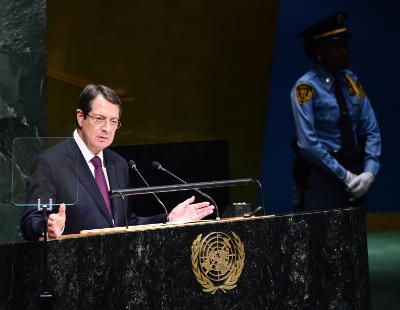

President of the Republic of Cyprus Nicos Anastasiades expressed his hope that rhetoric assurances of Turkey’s desire to reaching a settlement will be at last tested in practice, through the adoption of concrete steps that will positively underpin the negotiating process and correspond to the climate of hope prevailing in the island.
The President of the Republic of Cyprus addressed today the 70th session of the UN General Assembly and his speech besides the Cyprus problem covered a wide range of issues, both regional and global. Referring to the Cyprus issue, he said that what we aspire is to reach a settlement that will leave neither winners nor losers.
President Anastasiades expressed his strong belief that reaching a solution on the Cyprus problem can become a paradigm in the region of how diplomacy and the adoption of a reconciliatory stance can contribute to the resolution of even the most difficult international issues, prevailing over mistrust.
The President praised the role of the United Nations in peace keeping and also in both conflict prevention and peace-building.
“Cyprus through its own experience of hosting the UN Peacekeeping Force in Cyprus greatly values the UN contribution to maintenance of peace and security. And we also express our appreciation for a plethora of UN Resolutions and UN Security Council decisions which condemn the unacceptable status quo and the violent ongoing division of Cyprus, calling for its re-unification and the withdrawal of occupation forces. Resolutions and decisions which unfortunately have yet to be implemented.”
President Anastasiades gave an update on the Cyprus negotiations and the new round of talks which resumed in May 2015.
“Following the non-renewal of actions which violated the exercise by the Republic of Cyprus of its sovereign rights within its exclusive economic zone, and the change in the leadership of the Turkish Cypriot community, a window of opportunity opened that revived our hope that the new round of negotiations which resumed this past May will lead to the final settlement of the Cyprus problem. ”
The Cypriot President based his hope in his conviction that both him and the Turkish Cypriot leader Mustafa Akinci, “share the same political courage and resolve to decisively move forward in order to materialize the joint vision of our people who desire the solution of the Cyprus problem through a viable, lasting and functional settlement. ”
Describing the principles that should guide the solution of the Cyprus problem, President Anastasiades stressed that the settlement should be in conformity with the values and principles of both the Charter of the United Nations and the EU acquis, the High Level Agreements between the leaders of the two communities of 1977, 1979, as well as the Joint Declaration of February 11, 2014.
The settlement, he added, should lead to the evolution of the Republic of Cyprus to a federal state, in a bizonal, bicommunal federation with political equality, a single sovereignty, a single international legal personality and a single citizenship, and a state that is and will continue to be a member of the UN, the EU, and numerous other International Organizations and whose sovereignty, territorial integrity and constitutional order will not be constrained by anachronistic systems of guarantees by third countries and the presence of foreign troops in the island.
President Anastasiades said that what he aspires to achieve through this new round of negotiations is to reach a settlement that will leave no winners or losers.
“This settlement will leave neither winners nor losers. It will take into account the sensitivities and concerns of both communities. It will respect the fundamental freedoms and human rights of all Cypriots, whether Greek or Turkish. It will reunite the country, its people, the economy and institutions. It will create a homeland of peaceful co-existence and prosperous collaboration between all of its citizens, for the benefit of the younger generations. It will allow Cyprus to utilize its full potential by removing all the political barriers that prevent the full exploitation of our unique geographical position at the crossroads of Europe, North Africa, the Middle East and Asia. It will transform Cyprus into a shining example of the ethnic, cultural, religious and linguistic cooperation between Christian and Muslim communities. And it will turn Cyprus into a model-country of reliability, stability and security in what is now a very turbulent and volatile region, characterized by protracted conflicts and instability.”
President Anastasiades reported to the General Assembly that during this new negotiating round, progress has been achieved in a number of issues on almost all Chapters of the Cyprus Problem. But he pointed out that on other substantive issues there are significant differences that need to be resolved.
“Differences that, in order to be resolved, would also require Turkey’s active and determined contribution, considering that its occupation forces still remain in the northern part of our country.”
Anastasiades expressed hope that rhetoric assurances of Turkey’s desire to reaching a settlement will be at last tested in practice, through the adoption of concrete steps that will positively underpin the negotiating process and correspond to the climate of hope prevailing in the island.
He has also expressed a strong belief that reaching a solution on the Cyprus problem can become a paradigm of how diplomacy and the adoption of a reconciliatory stance can contribute to the resolution of even the most difficult international issues, prevailing over mistrust.
He also referred to the discovery of hydrocarbons in the region.
“The discovery of hydrocarbon reserves in Eastern Mediterranean has the potential to create synergies and a grid of alliances for broader cooperation between hydrocarbon-producing and hydrocarbon-consuming countries of that area and beyond to the benefit of their socio-economic development and the welfare of our people. Such positive developments can foster the achievement and maintenance of a much needed environment of stability and peace in the region.”
The settlement of the Cyprus problem, he said, will create a win win situation not only for its people, but also for the region, the interested parties, and the international community at large.
In concluding he thanked the international community and in particular the UN Secretary General’s Good Offices Mission in Cyprus, under whose auspices the negotiating process is conducted, for their positive influence towards the end goal of reaching a settlement.
Addressing regional issues as well as the huge influx of migrants he spoke of the ongoing turmoil, extremism, sectarianism, civil war and terrorism that are taking place in Middle East, North Africa and other regions of the World.
“The effects of the above are becoming a defining feature of the daily lives of those affected: Death, Persecution, Property Dispossession, Displacement, Destruction of Cultural Heritage and Forced Migration.”
President Anastasiades asked the world leaders to be vigilant while trying to address these issues.
“While we establish the fundamental principles of peace, stability and sustainable development for the future to come, in practice we observe increasing migratory flows from people who involuntarily flee their homes in search of a better future. While we set-up noble long-term objectives and goals, events that are now unfolding might render them either irrelevant or unattainable. While we assume that only Jordan, Turkey, Lebanon and subsequently Europe have been affected by the current refugee crisis, we fail to acknowledge that if this crisis is to persist other countries and Continents are to be affected as well. ”
He suggested, in order to reverse these worrying developments the need to tackle political instability and economic insecurity, so that all those countries and regions in the conflict zones, and in particular the Middle East and North Africa, are turned into places in which sustainable development is a reality.
President Anastasiades asked for this phenomenon to be addressed in a comprehensive way and pointed out that it is not enough to take action against those individuals responsible for terrorist attacks.
“We should direct our efforts towards the enablers of terrorism. It is not enough to rescue people from sinking boats. We should direct our efforts against human traffickers. It is not enough to financially support the economic immigrants. We should direct our efforts in creating those political and socio-economic conditions that would allow all those people not to migrate from their countries”.
The President of the Republic questioned the way the international community addressed the “horrific humanitarian crisis”.
“Were we negligent to taking the necessary measures to avert this crisis? Was our strategy adequate? Did we fail to predict the events that were to unfold?”
President Anastasiades citing Cyprus’s close geographical proximity to the Middle East and North Africa, as well as our historical, political, social and cultural links, he expressed the strong conviction that the international community has failed to sufficiently appreciate the complexities of the said region.
“The effects of foreign interventions and interests did not bring about the results that they aspired due to the fact that they both failed to take into account and apprehend the internal characteristics and particular sensitivities of those nations”, he pointed out.
Cyprus has been divided since 1974 when Turkey invaded and occupied its northern third. UN-led talks, aiming to reunite the island under a federal roof, resumed on May 15, this year.
