
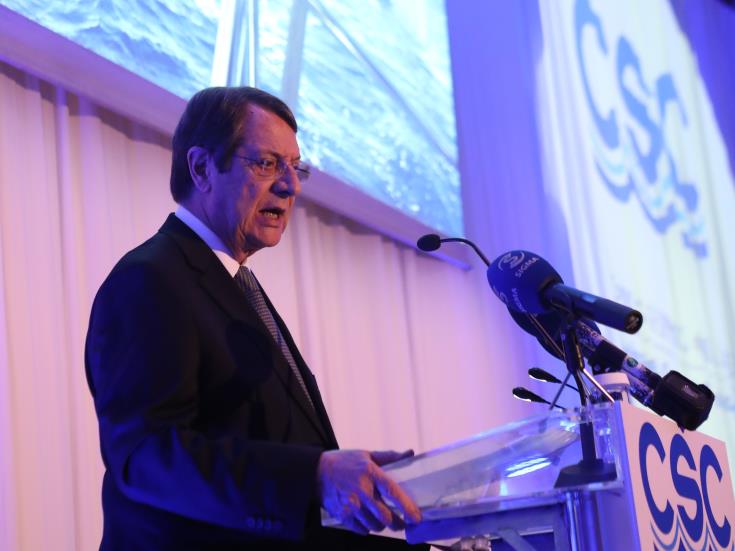

Cyprus President Nicos Anastasiades pledged on Friday that the government will continue working tirelessly towards the lifting of the embargo on Cypriot-flagged ships that Turkey has imposing since 1987.
“We will continue working tirelessly towards this end,” Anastasiades said addressing the annual official dinner hosted by the Cyprus Shipping Chamber in Nicosia.
The President noted that “a viable and functional solution to the Cyprus problem will inevitably lead to the lifting of the Turkish restrictive measures on Cyprus ships, a pending obligation by Turkey towards Cyprus and towards the EU.”
The Turkish restrictive measures were originally introduced in April 1987 and concerned exclusively the prohibition of Cyprus flagged vessels to call at Turkish ports. In May 1997 Turkey issued new instructions extending the ban against vessels under a foreign flag (of any nationality) sailing to Turkish ports directly from any port under the effective control of the Republic of Cyprus (Limassol, Larnaca), or against vessels of any nationality related to the Republic of Cyprus in terms of ownership or ship management.
Despite the Turkish restrictions, the Cypriot ship registry is the 11th largest in the world and third in the EU, while Cyprus is considered as the third largest shipmanagement centre in the world.
Furthermore, noting that the geopolitical realities in our area are rapidly evolving and Cyprus is claiming its rightful place in the centre of these developments, Anastasiades said that new political and economic balances are emerging, connected also with the discovery of energy reserves in our region.
“The discovery of hydrocarbons in the Exclusive Economic Zone (EEZ) creates new prospects for our country and our national economy,” he said, assuring that “we will do our best to overcome the problems we are facing with our neighbour.”
Stating that shipping can act as a catalyst in the stability and further development of the Eastern Mediterranean region, Anastasiades pointed out that shipping forms part of the tripartite agreements with neighbouring countries, such as Israel, Egypt, Jordan, Lebanon and Palestine.
“In this regard, it is clear that through intelligent planning and strategic alliances, the Shipping sector will play a lead role, in the joint efforts towards the creation of a new, more efficient and sustainable model for the region,” he stressed.
A historic moment for Cypriot shipping
—————–
In his address, Anastasiades pointed out that this year, “constitutes a historic moment for Cyprus Shipping, since this important sector has now its own dedicated Deputy Minister responsible for the shipping industry.”
Natasa Pilides, previously Director of Cyprus Investment Promotion Agency, has been appointed as Deputy Minister for shipping.
“The operation of the Deputy Ministry of Shipping and the restructuring of the maritime administration is expected to upgrade the services provided to the Cyprus shipping industry and further enhance the image of the Cyprus flag,” the President said.
He also noted that the Cyprus Government acknowledges the important role that the Shipping sector plays in the Cyprus economy, adding that the Government is well aware of the fact that the local shipping sector operates in a continuously evolving, highly competitive global environment, which requires stability, an essential ingredient for long term planning and investment.
“For these reasons,” he went on to say, “my Government is determined to introduce those mechanisms necessary to protect this important sector, as well as to develop and strengthen it much further.”
Concluding, Anastasiades praised the Cyprus Shipping Chamber efforts to promote Cypriot shipping, as well as the shipping professionals for the support and trust they have shown on Cyprus Shipping and the Cypriot flag.
