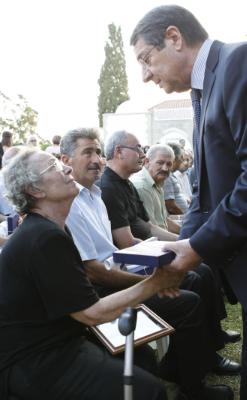
President of the Republic Nicos Anastasiades has pledged that he will do his utmost to raise money (900,000 thousand euros) for the acceleration of the identification process for hundreds of missing persons, whose remains are at the anthropological laboratory of the Committee for the Missing Persons (CMP).
Addressing Friday evening an event in honour of the missing persons and their relatives at the Presidential Palace, the President noted that Turkey`s intransigence to cooperate and give an end to the pain of thousands of families, turn his anger into an even bigger determination and persistence towards finding a solution to the problem that will terminate the pain and ordeal.
President Anastasiades went on to say that his feelings today are stronger as yesterday he had the painful experience to visit the anthropological laboratory of the CMP in the United Nations Protected Area in Nicosia. He spoke of his shock when he faced the remains of hundreds of missing persons that are yet to be identified.
In his address, the President said that the government will intensify its efforts and the issue of missing persons will remain high priority in the struggle to solve the Cyprus problem.
Cyprus has been divided since 1974, when Turkey invaded and occupied its northern third. President Anastasiades and Turkish Cypriot leader Deervis Eroglu are currently engaged in UN backed talks with an aim to reunify the island under a federal roof.
As a result of the 1974 invasion, 1,619 Greek Cypriots were listed as missing, most of whom soldiers or reservists, who were captured in the battlefield. Many of those missing were last seen alive in the hands of the Turkish military.
A further 41 more cases of Greek Cypriot missing persons have been added. These cases concern the period between 1963-1964, when inter-communal fighting broke out but none of them has been identified yet.
The number of Turkish Cypriot missing since 1974 and 1963/64 stood at 503.
A total of 1073 remains have been exhumed by the CMP, 491 of which have been identified with the DNA method (366 Greek Cypriots and 125 Turkish Cypriots).