
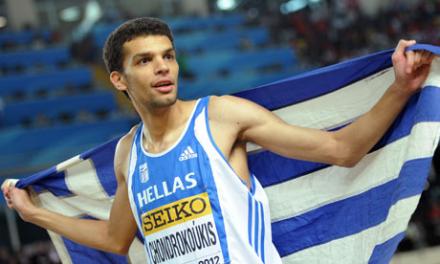
Two years ago, Greek high jumper Demetris Chondrokoukis had it all.
Born to Greek and Cypriot parents who were athletes themselves in their younger years, he shot to the top of the world when he took the gold medal at the 2012 Word Indoor Championships in Turkey with a personal best of 2.33 metres.
He had previously secured a personal best in the outdoor track with his leap of 2.32m, achieved twice, again in Turkey, on June 2011 and in the final at the 2011 World Championships in Athletics in South Korea in September 2011.
With his place in the world of athletics cemented, life was sweet and the future had no limits. But then things went wrong; horribly wrong.
In July 2012, a shell-shocked Chondrokoukis was informed by WADA that he had tested positive for the performance enhancing drug stanozolol, an anabolic steroid.
His career now hung in tatters. He was omitted from the Greek Olympic Team meaning that he missed the London 2012 Olympic Games scheduled to take place 25 days later.
Like many other athletes that have been hit with a two-year ban, Chondrokoukis says that he never willingly took the banned substance with his father and coach at the time arguing that stanozolol is one of the most common performance-enhancing drugs and that he would not have intentionally used it knowing full well the risks involved. At the time, Chondrokoukis had already been undergoing frequent drug tests.
But nothing could have prepared Chondrokoukis for what followed next. Three months later, his Cypriot mother Niki Efthymiou-Chondrokoukis died from a massive and sudden stroke. For the young Chondrokoukis and his sister Christina, the despair was all too much.
He contemplated packing the sport in, but spurred on by the memory of his mother, decided to make amends. And what better way to resurrect his career than by flying the flag of his mother’s birth-country. The Cyprus Amateur Athletics Association (CAAA), aware of Chondrokoukis intention to change sides, helped the youngster make the switch.
Unlike football, athletics will allow athletes to change the national team that they are representing in certain cases.
“My mother is Cypriot and it is an honour for me to represent Cyprus”, he said in a recent interview in Greece. “Cyprus has given me the opportunity to make a fresh start in my life. The Cypriot press has welcomed my move and the CAAA and its chairman Antonis Drakos have been very supportive. He, in particular, offered me great support.”
Maroussi-born Chondrokoukis is still haunted by the loss of his mother one year on and is determined to right the wrongs of the past.
“The death of my mother was the one thing that affected me the most. She never got over what happened and her death was sudden and had a profound affect on us all. Without putting too fine a point on it, the death of my mother is something that I will carry with me for the rest of my life. My donning the Cyprus emblem is my way to honour her memory. My first success will be dedicated to her.”
Chondrokoukis’ mother had been an athlete herself and had represented Cyprus in the past at the World Championships prior to her death at just 54. Born in Karavas in the Kyrenia district, Niki later moved to Greece where she married Kyriakos and would later become a coach and Physical Education teacher at a school in Glyfadas.
Chondrokoukis’ mother had been an athlete herself and had represented Cyprus in the past at the World Championships prior to her death at just 54. Born in Karavas in the Kyrenia district, Niki later moved to Greece where she married Kyriakos and would later become a coach and Physical Education teacher at a school in Glyfadas.
Speaking about how he got the news that he had tested positive for a banned substance at the time, the 25-year-old said, “My father had telephoned me and I could tell he was in shock. We just couldn’t believe what had happened. I remember holding the phone to my ear and just being unable to speak. The first thought I had was what affect it was going to have on others around me like my mother and my friends
Cyprus Weekly