
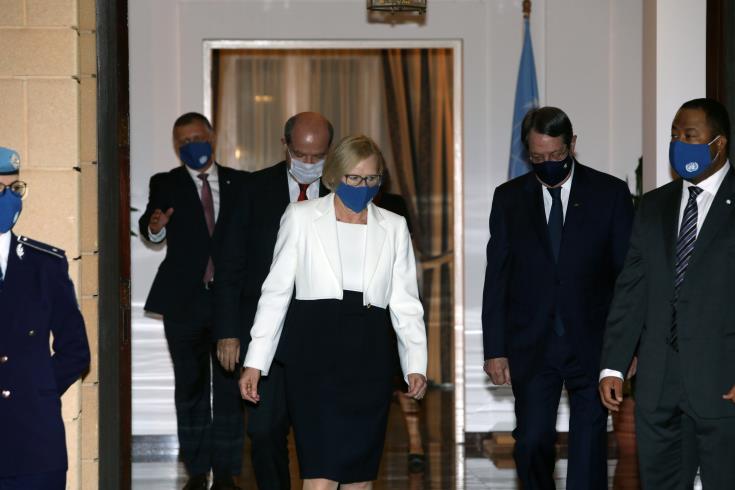

Elizabeth Spehar, Special Representative of the Secretary-General (SRSG) in Cyprus and Head of UNFICYP referred to “extremely difficult times in the Cyprus peace process” with the positions of both sides having moved further apart in recent months.
Addressing the Economist Conference in Nicosia, in her speech, titled “Current Challenges and Opportunities in The Cyprus Issue: The UN Perspective”, Spehar said although there is relatively peace on the island with the absence of war, yet Cyprus is not at peace, since the conflict persists.
She remarked that the UN see longer-term stability, and a sustainable and secure future in Cyprus as well as the region, as intimately linked to resolving the Cyprus issue.
In her speech, she noted that as the conference, overall, is focusing on sustainability, stability, and security, these are all fundamental concepts that relate to peace. “As the UN, we see longer-term stability, and a sustainable and secure future in Cyprus as well as the region, as intimately linked to resolving the Cyprus issue”, sad Spehar, noting that “there are many challenges on the way to both achieving and sustaining such peace”.
She went on to explain that “these are extremely difficult times in the Cyprus peace process. Efforts continue, and the Secretary-General has stressed that he will not give up, but there have been no substantive negotiations since July 2017”. The UNSG, she added, “is concerned about the future of the peace process with new facts on the ground being created as we speak”.
Spehar said that over the past six months, the Secretary-General hosted an informal five-plus-one meeting in Geneva among the parties to the Cyprus issue, as well as an informal lunch with the two leaders in September. “While these rare meetings provided opportunities for dialogue, the discussions that took place have not led to a breakthrough that would allow a return to substantive talks”, she added.
In fact, Spehar said, “the positions of both sides have moved further apart in recent months”, adding negative narratives and unhelpful rhetoric are spreading, and political polarization on the island is sharpening — between and within both sides of the divide.
Regionally, tensions have started to flare up again, she said adding that “it is no secret that the Cyprus issue is enmeshed in a broader geopolitical context where the roles of the neighbours, and particularly Turkey and Greece, two guarantor powers, are key”. Spehar reminded that the Secretary-General has called on all parties to avoid actions that could increase tensions and derail the efforts to continue the dialogue in search of common ground to resume talks. “It is more than ever evident that the status quo is not static and that the situation on the island and in the region is in flux”, she remarked.
This leads to the question as to whether, in Cyprus itself, there is peace said Spehar, noting that “the situation is relatively peaceful, as in, there is an absence of war, but Cyprus is not at peace, since the conflict persists. If anything, the past many months without substantive talks have been accompanied by a deepening mistrust between the parties”.
Stressing that this leads to whether security can prevail and economic prosperity flourish on a perpetually divided island, Spehar added that “we all must keep hope alive, not simply with words but, more importantly, with actions. The UN has worked on supporting countries around the world to achieve peace, and will continue to do so in Cyprus, and is committed to not only attaining but also sustaining peace”.
She went on to say that sustaining peace” is an all-encompassing concept which, among other elements, acknowledges that peace can be fragile and it is a responsibility that needs to be fulfilled not just by the official negotiators engaged in a formal process but also by all local stakeholders, women, youth, business leaders and civil society at large.
Greek Cypriots and Turkish Cypriots share many basic concerns and since the start of the pandemic, those have further grown, particularly in the economic field and in terms of safety and health, related to COVID-19 and changes only narrow the options for solving the Cyprus issue.
On how to move forward, Spehar said that all parties have stated their desire for and willingness to pursue a politically negotiated solution.
The UN Security Council is unified in its support for a comprehensive settlement in Cyprus and the UN Secretariat is not giving up on Cyprus and will continue to work with the parties to find a way back to the negotiating table. “The offer of an envoy to facilitate such discussions is still on the table; it needs to be seized by all parties” Spehar added.
The European Union has recently re-focused on Cyprus and the region; they also have a critical role to play, including in support of UN-facilitated efforts. She also said that in this process, everyone has a part to play and Cypriots, people on this island, have “democratic agency”. Therefore, they can and should encourage and support the leaderships to resolve the Cyprus problem in a way that serves their best collective interests.
Building a sustainable settlement in Cyprus will require more collaboration, cooperation and interaction between Turkish Cypriots and Greek Cypriots on the island, but also in the broader region, she added.
It is important to remember that despite the current negative rhetoric and polarized positions, it is still possible to have some positive movement in areas that are improving the daily lives of Cypriots and cited the work of the Technical Committees which bring together Greek Cypriot and Turkish Cypriot experts under the auspices of the leaders noting they are vehicles for this and demonstrate that the sides can still agree on a number of issues and make things happen.
Regarding the COVID-19 pandemic in Cyprus said Spehar, there has been medical and humanitarian support across the divide adding that more could be done to address the economic and social fallout.
Spehar added that the Good Offices Mission in Cyprus produced and disseminated a socio-economic impact assessment of a potential settlement deal, which outlined the clear case for a settlement to pave the way for greater stability and economic prosperity. She urged for the “attention of the business community to this assessment and their thoughts on how we can already build the foundations for this”.
Referring to the recent COP26 climate conference, she said small islands are particularly vulnerable to climate change and Cyprus needs to be having this conversation island-wide. At UNFICYP, we have been supporting young Greek Cypriots and Turkish Cypriots to do exactly what she said and they “are very keen to bring their concerns and their ideas to the leaders”.
Cyprus has been divided since 1974 when Turkish troops invaded and occupied the island’s northern third.
